
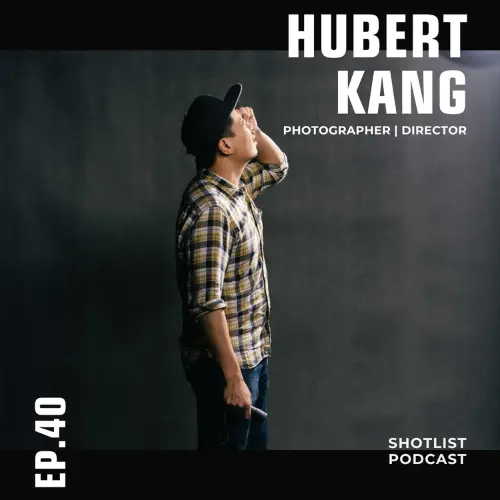
Episode 40 · June 29, 2025 · 1 hr 13 min
Soul Over Strategy | Building a Career with Creative Depth and Longevity as a Photographer and Director
with Hubert Kang, Photographer & Director


If you're keeping one foot in a safe job while you build this, or wondering when you're ready for a rep, this one's for you.
Still keeping one foot in a safe job while you build this? Hubert makes a strong case for going all in. He shares what he learned from getting fired as an assistant, why he treats everyone he works with like a friend, how he got into directing, how he built his production company around one value, and when you're actually ready for a rep.
Key takeaways
- Jump in with both feet. Hubert never bought the side hustle idea. He's doing it 100% of the time and it's still really hard, so how do you get anywhere at 50%? He finished business school, decided that was exactly what he didn't want to do, and started shooting five houses a day for realtors at 100 bucks a house. He lost the realtor's camera off the roof of his car at the end of that summer.
- Get in the room and see how it's done. Shooting motel 360s across the US, he had a day off in Santa Fe and walked into a world famous photo workshop. He couldn't afford it, so he wrote and asked to do the work study. Running film to the lab, filling coffee makers, sitting in classes with Gregory Heisler, Joe McNally and Arthur Meyerson. Then assistant number five on Jay-Z and Rihanna shoots. That's why big sets have never scared him. They're just people.
- Being a bad assistant is information. He got fired from that LA job. A good assistant anticipates what's next. He'd be in his head or just amazed by what was happening. So he went to London to study documentary photography, came back to Vancouver, and committed to being a photographer full time.
- Treat everyone you work with like a friend. People ask him for business tips and that's his answer. Appreciation, respect, assume the best. If someone doesn't get back to you, they're probably busy, maybe they have seven bosses. His North Star on set is simple. Am I being a jerk? Am I supporting this person? And be curious. Ask the crew what they'd do.
- Find your why. If you just want it to look cool, own it and make the coolest thing. But if it's only form, it gets shallow fast. On commercial days his why might be supporting his family, or that he gets to work with his friends that day.
- Clients deserve to see who you are. They know your commercial work went through seven layers of decisions. Show a few pieces, then show what you care about. For Hubert that's a baseball documentary in Uganda and a long term project on people and animals, in Taiwan, Japan, Cuba, Spain and Morocco. The project is also a key. Farmers in Cuba let him into their stables because of it.
- Directing is facilitating. He never decided to become a director. Clients needed video too. He picked photographer director over photographer DP because he'd rather hire great DPs and watch them work, and he loves connecting with people. His job is to have a perspective, help make decisions, then get out of the way. As a DP, I'm usually separated from talent. A photographer is already directing them.
- Build the business around a value. Kindred and Scout is Hubert and his producer Amy Jones. Visionary and integrator, like the book Traction. Their rule is people first. Fed, paid fairly, safe, proper turnaround. They don't own gear or a shooting studio, so they stay flexible. It's a slow burn, but repeat clients are the best marketing. He's learned to bring his ideas up two weeks out, not on the day.
- You get a rep when you're already busy. A rep isn't your friend, they're your business partner, and they live on commission. They're not going to take you on if you aren't already getting work. Both his reps, Sparks in Toronto and Greenhouse in New York, found him through recommendations. He picked Sparks because they were the nicest people.
“I'm doing it 100% of the time and it's still really, really, really hard. So I don't know how you're going to get anywhere if you're only doing it 50% of the time.”
Hubert Kang
Try this today
Start the personal project you'd show a client.
Hubert's test is what you actually care about. Write down one subject you'd keep shooting even if nobody paid you, and one place you could start this month. Then share it when you show your commercial work, so the people hiring you see who you are.
See Hubert's work →Chapters
- Squamish, running and a 35K race
- Made in Taiwan, assembled in Canada, reprogrammed in the UK
- Going all in, and shooting houses for realtors
- Shooting a motel a day across the US
- Santa Fe and assisting the greats
- Getting fired as an assistant
- Treating everyone like a friend
- What up and coming photographers miss
- Why personal work matters
- Moving into directing
- Kindred and Scout
- How his reps found him
- Riding the waves and staying resilient
- Where to find Hubert
Connect with Hubert
Connect with Marshal
More episodes like this
 Episode 38What Gets You Hired (and Remembered): A Creative Director’s Take on Building the Portfolio, Presence, and Energy That Stands Out
 Episode 37Beyond the Hustle: Filmmaking with Purpose, Balance & Inner Fulfillment
 Episode 33Breaking Creative Blocks and Staying True to Yourself | Sean Tucker Photographer, Filmmaker, Author
Transcript generated automatically, with names corrected. It may contain small errors.
If I do this, I got to do it 100%. I've always found it interesting that people were talking about side hustles. You know, hey, I'll have a regular job and you know, I'll do photography on the side. Maybe I'll make it as a photographer one day. To me, that's always been counterintuitive in the way that man, like I'm doing it 100% of the time and it's still really, really, really hard. So I don't know how you're going to get anywhere if you're only doing it 50% of the time. Hello and welcome to another episode of the SHOTLIST podcast where we talk about how to make a life and a living behind the lens. I'm cinematographer Marshal Chupa and today I'm speaking with photographer and director Hubert King. Today's episode is sponsored by Lorne Lapham Sales and Rentals for my first big camera purchase, the countless lenses and lighting rentals.
Lorne Lapham has been a huge support through my career, backing me from the early days and helping me build the career I have today. If you're looking for a trusted rental house for your next project or you're about to pull the trigger on a big gear investment, they're the team I personally trusted to grow my career alongside of. As a listener of the podcast, you're going to get 20% off of rentals by heading over to llsr.com/shotlist and signing up for your free 20% off Rentals membership. And no, this isn't just a one time discount. Once you're in, you're in and you're part of the Lapham Creators family. Link in the show notes below. In this episode, Hubert and I dive into his unconventional path from real estate photography to shooting global commercial campaigns while betting on himself with no Plan B was what propelled him to the next level. The deep value of personal work and how it helps shape both his creative voice and career, and what it really means to be a kind, collaborative leader in a high stakes production world.
Hubert is one of the most genuine and caring people I've met in this business. He's built a thriving career through integrity, curiosity, and an unwavering respect for his team and clients. I'm excited to share this conversation with you. Let's dive in. OK, Hubert, thanks so much for coming on the show today. Appreciate you being here. Thank you so much, Marshal. It's an honor. I think the first question is how are your legs doing? Because I just, I heard you, you did a race called Survival the Fittest yesterday. My legs are not doing so good, but that was it was so fun. I I had a lot of fun. I was running with some friends and we, yeah, we were very, very, very, very slow. But but it's good times. It's good times. Yeah. Well, let's. Keep in mind what was this like 35K or something? Or was. That 35 K, yeah, 35 K yeah, we did it over 6 plus hours, yeah. So yeah, slow.
Slow and fun, yeah. For background, Hebert and I both live in Squamish and we've both been doing the running thing, so it's been fun to kind of connect outside of our work life on this stuff. So yeah. So I was reading your profile and it says made in Taiwan, assembled in Canada, and reprogrammed in the UK. Yeah, that BIOS got to go. It's been a while. It's been a while, but yeah, that's kind of my my 3 identities. I was born and raised in Taiwan. My family moved me. They just sent me by myself to Canada when I was. Yeah, yeah. What was a common thing to do back then when I was 15. So I've been calling Vancouver home ever since. But in my early 20s, you know, I did travel quite a bit after I finished school in Vancouver, I went out and I studied for my masters in the UK and I was, I was a big, that was a big change for me. So I that's why I say reprogrammed, because that refrained, Yeah, my whole mindset about photography there. So tell me a little bit about those early days. What why did you choose photography? What gravitated you there?
And like, what made you dive into that, that side of life? I chose photography because I couldn't draw. I was, I was always as a kid, I always, I say maybe creative growing up, you know, I always loved drawing. I, I, I haven't drawn for a long time now, but always been creative, always loved. I remember when I was a kid, my mom would give me literally a giant pile of like a newspaper and I just go and I'll spend all day by myself drawing all day. And I think I peaked as an artist fairly early. I had, I think I had a show in one of our local museums, gallery, museum type of thing when I was maybe 9.
OK. And, and then they all went out. You know, since then, I have not had a solo show since then. Right. Yeah. Yeah. And then by growing up, it was, you know, I was grew up, like I said, I grew up in Taiwan and very, very urban environment. Family is always busy. And so a lot of times I was just left alone by myself. I have siblings, but, you know, everybody's busy, so it's left alone by myself. So lots of drawing on my own. Yeah. And as I, you know, then later on, I went to school here in Vancouver. And when I was in university with the UBC, met a bunch of friends who were very creative or in different disciplines. They were like, hey, why don't we start a magazine?
So this is about 100 years ago. People were still printing stuff. So yeah, we made student magazines when I was going to school. And I think that was for me, that was a great creative booster because because I realized, hey, there's a the stuff is super fun and, and there's more to, you know, more to school than that. So I did. That's why I spent so much time in school, because I didn't do so good then. I had a hard time finishing. Yeah, yeah, yeah. But I did end up, you know, like, deciding as soon as I finished Business School, I decided this is exactly what I don't want to do. Interesting. I'm out. So then and yet I started pursuing photography.
Right. So what did that look like? What did pursuing photography, which is meant like you had a camera, you start taking pictures with this this early magazine for fun with friends. And then how did that evolve into I'm getting paid to make photographs? Like what was that transition point like? Good question. You know, it's really interesting if I have to think about it, it was never so intentional in a way that I'm saying, OK, you know, I'm going to take this photograph and this is going to make me X amount of money or what not. I think the only intentional decision I made early on is that if I do this, I got to do it 100%. You know, like, so I, I've always found it interesting that people were talking about side hustles. You know, hey, I'll have a regular job and you know, I'll do photography on the side, you know, maybe I'll make it as a photographer one day.
To me, that's always been counterintuitive in the way that, you know, like men, like I'm doing it 100% of the time and it's still really, really, really hard. So I don't know how you're going to get anywhere if you're only doing it 50% of the time, you know, So, so earlier on, you know, like I just decided that if I'm doing this, I'm jumping it, jumping in with both feet. So my first job, this is funny, my first job after university, this is like why back in the day, you know, like Realtors started taking like the photos. So my first job photography, like call myself a photographer is shooting houses for real estate agents. And I remember that was like the first summer after I graduated from, again, like I, I went to a pretty serious Business School.
And so all my friends, they're going, hey, I got this job like, you know, at the bank, you know, I got this job as, you know, like whatever, you know, like fancy, fancy firms or what not. And I got that as a, oh man, I'm doing this job. I'm, I'm shooting 5 houses a day. And if I make 100 bucks per house, man, that's 500 bucks a day. Then like I do that four days a week, I'm good. So the only goal was to OK, by the end of the summer, I wanted to go on a little vacation, Hawaii. That's a very, very mellow goal. And guess what happened? I, this is all my, all my assistants are going to laugh. And I think by the end of the summer, I think one of my last jobs, I was using the Realtors camera in early days, right? And I lost the camera on the shoe. I think I left it on the roof of my car. I just, I just drove away.
So, so much. Would I go? I didn't go very far, man. So that was my first photography job ever. Oh man. Yeah, I was really lucky back then. It was so slow. Also the early days of remember, like back there back then, like you go on Expedia, like you want to book a hotel room, you want to see like a 360 view of the hotel. Yeah. So a lot of that work was done by a company here in Vancouver. So I was really lucky. And so I reached out to them and and and they, they, they were hiring and I reach out to them. I did a whole interview process, really funny story again, like I remember they did a psychology test on me. What? OK, is it just me or is it personal now? Is it, does it work for everybody? And I was luckily I'm very lucky I got hired. I think they saw something in me. So I had this really fun job for like for a 20 year old guy I was, they sent me out on the road. I was doing this assignments maybe 30 days at a time, shooting one motel a day.
So it was a fun experience. I basically go shoot the motel in the afternoon and like my region, like I went on assignments. I remember like New Mexico, Texas, Oklahoma, Ohio, you know, all these places, ice places, I would never go by myself. So I every day in the afternoon, I'll spend a few hours shooting a motel. Like the motel rooms. It's just imagine roadside motel, super hot, you know, like they all look the same. Then the next day, get out in the morning, drive 3 hours to the next town, shoot some more, Repeat that for a month at a time. Yeah. So that was like my early one of I remember, like I was too, even too shy to call myself a photographer to begin with, but I was one of my early photography jobs.
And yeah, yeah. But add that to me to places. Right. Yeah, that sounds like that's what kicked it off and allowed you to kind of, yeah, do the full time thing because I think you said like 2 feet in. I think it's a challenge for a lot of people. Sometimes they're side hustling something and don't have enough time to actually put the energy into the photo space. But I think I think the cool part is that even though you're shooting real estate stuff, you know, you're shooting 360 Cam stuff, you're still playing with cameras for a living, you know, and just getting your feet wet in the right industry. And I think that's a really, yeah, cool part. Totally. And you know, I'm a firm believer, like if you're jumping with both feet and you never know where this goes, you never know where it goes. So when I was doing that the Hotel 360 photography job, just one day totally by chance, I have an off day.
That down day turned out to be in Santa Fe, NM, and I don't. Have you been to Santa Fe? Oh my God, it's magical. It's such a magical town. It's, it is so artistic and so just gorgeous, gorgeous. And I knew about a photo school there, a photo workshop that obviously I didn't have the time, but because I had a down day, I went there, I visited them. I was absolutely just enchanted by, by the environment and like they were in. So this is back then. It's world famous. I think it's still world famous. Some of the best photographers would go there to teach. They will teach these, these workshops one week at a time. And like the setting is in this old like, monastery thing, you know, and it's for me that was just like the most exotic thing ever.
So I went and visited them and I made a decision that, hey, I'm going to come back here. I'm going to take a workshop here. And you know, this is where I want to study photography, photography here. But then like coming back to the jumping in with both feet. I didn't have the money to do it because it wasn't cheap. You know, it was, you know, to I forgot for it was thousands of dollars a week, you know, the accommodation, travel and whatnot. I didn't have the money to do it, but I noticed that they have a internship work study program. And so I wrote to them and you know, like, it's like, Hey, I really admire what you guys do. You know, I don't know if you guys take international students like, you know, because this, this is obviously America, I'm from Canada. Is it OK if I come in and beat a intern and do the, do the work study program with you guys? The, the exchange was that, you know, I will be kind of like a class assistant, you know, I'll be, you know, doing all the chores.
For example, like back in the day, I had to run film to the lab every night, you know, like to make sure that the coffee makers are full, you know, like, you know, you furnished make photocopies photo instructors. But the exchange was that I got to sit in the classes and I was watching how this all went down. And back then the students there, these were all top professional photographers that would go there and they were taught by world famous photographers. You know, like, no, I, I, I was in classes with people like Norman Gene Roy back then. He was like the, one of the top celebrity photographers in the world, still is a Canadian guy. And I was like, or like the, some of the maybe more commonly known names still today, like Joe McNally. I think he teaches a lot. I was in there's a bunch of them and you know, Arthur Myers Myerson and I was, I also got to study with man. I forgot his name.
I'm sorry, I forgot his name, but I like anyways, these back, back. These are the people that I only read about in magazines, right? These are like my absolute photography idols. But now I got to work with them like while being in the same room, being in the same room, working very closely with them. You know, I'm just helping them like making photocopies and I get to sit in in the room. And that was a game changer because I thought I was really amazing in that right away, I saw how things are done on a big scale. Like these are some of the top, top photographers in the world. But there's really nothing, well, like, a huge amount of respect to them, but there's really nothing to it. It's not a big mystery, right? Like, you know, sure, they are extremely talented, extremely intelligent, but they're also just people.
So yeah, so I learned that right away. And I thought, like thinking back, I thought that was really amazing to have to be given that opportunity. So what I'm hearing is that like, yeah, you're able to get yourself in the room with some bigger players and that kind of just revealed to you, well, one, yes, they're talented people, but yeah, they're just normal humans. So was that like a moment where you're like, well, I could do this? Where was that? Was there was there a waking up or like a seeing of a path from there? Or how did? What was that like? I wouldn't say, you know, to me that was still huge, right? So I I didn't arrive at the conclusion right away thinking that, hey, I could do this. But what I saw was that, OK, at the highest level, this is how it's done, you know? So I so right away, I think I was very lucky to learn how things were supposed to be done.
And so there was never. It's strange. Yeah. I was never afraid of big shoots. I think maybe maybe it came from there because you know, I've been to some of the biggest shoots with them, you know, as their assistants. The the evolution of that story in Santa Fe was that after Santa Fe, I got asked to go and assist one of the photographers in LA. So back then. So again by this is like the heydays of editorial photography, right? So I would show up on set for a magazine cover, maybe, like, then there'll be like 40 people running around for magazine cover back in the day. So I don't know if that still happens today. But then I saw how it's done. You know, we were like shooting Jay-Z or shooting Rihanna. We're shooting like the biggest celebrities in the world. Again. I'm like, assistant #5 you know, but, but like, I'm still making coffee.
But then I saw how it's done. OK. So right away I knew OK, bigger sets, this is how it works and and it is serious, but there's also not as scary. Yeah, that makes a lot of sense. It's just getting the exposure, like because in the beginning you have no idea how it works and like you make up stories and all that kind of stuff. I remember the day clearly, driving into Vancouver and walking into Lorne Lapham for the first time. It was one of those big career moments. I had word that if I could get my hands on a Sony FS7, I'd have a shot at joining the Canadian Rally Championships media team. I'd done my research and I knew which camera I wanted, but I wasn't just looking for the best price, I was looking for someone who actually gave a shit. That's when I met Brent. He told me that he had a used FS7 with 0 hours on it and he knocked a few grand off the price tag to help me get into the package. That savings helped me afford the little things that inevitably come with buying a new camera build. And right away I felt it.
These guys cared. They weren't just selling gear, they were investing in people. From that point on, as I grew my career, I started renting my lighting and grip from Lapham. As projects came up, I'd rent different lens sets depending on the look I was chasing or different lighting and grip gear I needed on a shoot by shoot basis. Years later when I kept getting asked to shoot on Red, it was time to level up once again and I knew exactly where I was going to buy my Red Raptor. Brenton helped me out so many times, even hooking me up with rental gear for passion projects I couldn't have otherwise pulled off. And when there was a light leak issue with my Red Raptor, his team jumped on immediately, handled the shipping and made sure I had a backup camera lined up for the next shoot. They've gone above and beyond for me and honestly, I've felt my career with laugh them beside me the whole way. So if you're in Vancouver and you're looking for a rental house, or you're about to draw money on a big camera purchase from anywhere in the world, these are the guys I trust.
And as a SHOTLIST listener, you're going to get 20% off rentals by heading over to llsr.com/shotlist and signing up for the SHOTLIST Discount membership. Lapham has been a part of my story from the start, and I hope they can be a part of yours too. Let's get back to the conversation. So what was the point where, OK, you're assisting, you're kind of finding your way into the industry, You're learning about how everything works. What was the point where you started to be like confident enough to say I'm a photographer and like, you started to build a body of work and like, own that? What was that moment like? Really funny. So coming back to the LA assistant job, I got fired. I was so mad. They're like, I, I was such a terrible assistant. I got fired. You know, again, this is another thing about jumping in with both feet.
Then I realized, man, I really am a lousy assistant, not because I don't like I understand the technical side of it personality wise. It's just not me in a sense that, you know, I had trouble not doing stuff and just focus not and and have to switch focus. You know, like I'm sad you, you be like as assistant, you're watching, you know, things to happen. A really good assistant will anticipate thinking about what the next needs are. I would just be like in my head somewhere else, somewhere else, or I'll be absolutely amazed by what's happening and then forget where I am. So, and I realized, man, I'm not going to cut it as an assistant for very long. Like this is not going to be a good career path for me. So I decided that, OK, I'll go back to school. And this time I decided that I'll go to study. I'll study documentary photography in London at the University of the Arts London.
My, all my heroes were documentary photographers. I realized I had, I didn't want to do fashion. I want nothing to do with like fashion, beauty and whatnot. Not because, again, not because I don't respect them. It's just not, it's not something I'm interested in. So I decided I want to go to Europe, study documentary photography. And so off I went. I, I dropped everything. I went and and then yeah, that's spend the next year in studying in London and you know, again, I don't know how much I learned in school, to be honest, but I was able again put myself in the same environment. Now all of a sudden, like I'm on the streets was plot on, you know, I'm like, I mean, he plot on like he would come back to school like he he's alumni. So he will teach us like, you know, have seminars with us and I'm like on the streets where like David Bailey will shoot or, you know, Katya Abirsang will shoot, you know, and all these things are really inspiring for me. He and I saw like a these are where some of the most historical photography photos were taken. And here I'm standing in the same spot, you know, So that's I, I went and I did, I did that.
And after Europe, my wife and I decided, OK, we want to come back to Canada. Vancouver is still home. Again, jumping in with both feet. We came back and decided, OK, I'm just going to be a photographer now, 100%, and I get hired for the next 12 months. That's how I would, Yeah. Well, I mean. That leads me to a good next question is how did you begin to build relationships? Because I think that's one of the hardest parts of what we do. And especially moving, just moving to a new place. Like, I mean, I don't know, I've never met someone so humble and nice. And like, I remember walking into your Christmas party, you know, 1 and you just make, made me feel like $1,000,000 in, in your own party. And so you have this like incredible ability to be, I don't know if you just boost people up around you and have this energy about you. And something I, I would say it's probably one of your, the, the strongest skills.
I see every time I see you on set, you're just like you lifting people up, you're supporting them, you're encouraging them, making them feel like, you know, really important. I think it's such an incredible skill. So yeah. How did you does that feel natural for you? And like, how did you build relationships? It's really interesting to say that I think it comes from a lot, a sense of appreciation. I really do appreciate people a lot. I understand that this is a team sport. On my own, can I can't go very far, no. So it definitely comes from a real place, a real sense of appreciation and a lot of people, you know, assistance up and coming photographers, directors, they'll ask me and say, Hey, what are your business tips? You know, like, you know, how do you, you know, because we our industry so competitive, you know, like, you know, especially I think a lot of guys are guys and girls are not comfortable with the business side of things. You know, houses all done or how do you do your marketing and whatnot.
And to be honest, I think it Co comes down to one place. I always, always, always treat the people that I work with like how I would treat my friends. There's no distinction. It always comes from a place of appreciation and respect, and it always comes from a place of assuming the best in people. There's never second guessing. You know, I, I don't know, maybe somebody's having a rough day. You know, I had never assumed that, hey, this person just mean maybe the person having a really rough day. I admire a lot, you know, like that people just put themselves out there. I never judge people by their work. I see that they put themselves out there and I know how hard I is and I respect and appreciate that so much.
So you know, I'm imagining an assistant coming out to help me out for the day. It must be scary for them as well, right? You know, cuz hey Zai, I want to get more work with these guys. You know, like I'm a little nervous and what not. You know, I always assume the best. I'm I just appreciate that the person is there. Will it help me out on the day and I'm going to do my best to help do whatever I can to help the person to have a better day or a client, you know, like maybe a client is making demanding requests and what not. The assumption is always for me, always see the best in people. You know, maybe this person has a really tough boss. Maybe this is a really complicated job. Maybe why there's there are 17 more things that I cannot anticipate. I don't know what's going on on there and what I can do from my end, you know, I, I just do my best to help. So that's that.
So in terms of like business tips, you know, there's really no tip for me anyways. I, because it really comes from the place of just treating everybody else like your buddies. And if you wouldn't treat your buddy this way, you wouldn't treat your colleagues or your clients the same way, right? So vice versa, you know, like I when I talk to them, you know, like, you know, I don't let them get away with stuff that my buddies can't get away with, you know, so, you know, like I just got it out, but in a very nice way. And so it's, it's, it's the same. So yeah. And I think for me that makes it really simple in terms of dealing with people because I have a basically I have a North Star, right? So I always, you know, assume the best in people. Kindness is always the top thing. So when I have to make these decisions in terms of reaching out to people to build a business relationship, in terms of treating everybody on set, in terms of getting the best out of the talent on set, in terms of getting the best out of my crew, then it's a very simple North Star. Am I being a jerk?
No. Am I, you know, am I supporting this person? Yes. OK, Then we do it simple. Yeah, it really is simple sometimes. I mean, at the end of the day, it's all relationships. And I think as often times artists and creatives in general are introverted and they struggle with that whole communication side of things. And maybe there's nerves and all that good stuff. But yeah, it really is just being a very good human. And everything else seems to come back the other way. I think so. I think so. And and and also I think another thing is curiosity. There's always, I'm always curious. So I'm very, very curious about people, about things and, you know, like I was. So I think a lot of times I'm more interested to hear what the other person has to say than talking about myself. So maybe that's why I'm so terrible at marketing and self promotion.
But I know about me. I want to hear about other people. And yeah, so, so, but I also find it to be a really good way to inspire the best out of the people as well. You know, like I'm always when I'm on set, I'm always interested in what the crew's opinion. I'm always, I'm interested in everybody opinion, you know, like it is such a team sport. What do you think, you know, help me out. What would you do? And yeah, and that that that has definitely helped me because I learned so much from everybody. Yeah. And if there's like anything, let's say you're up and coming trying to break in, looking at you as like, oh, Hubert's made it. He's got all these big commercial shoots under his belt. Like like what are what are the photographers who are just have like a basic portfolio and they're just kind of breaking into it. Like what are they not understanding?
Is it like they don't have enough reps yet, have they? They need to develop a relationship side of things. Like what is the thing they're not seeing? Yeah, OK. It's a really good question. I mean, relationship definitely, right. So, you know, we are in such a people business. So again, assume the best in people, reach out. You know, people don't get back to you. It's fine. They're probably really busy. You know, they probably have seven other bosses about them. So, you know, they're probably having a really bad day. They don't get back to you once, twice, three times. It's fine. It's not you, you know, the, you know, people, people have their lives. So that's one. So relationships and you know, think about how you're treating your community as well, right? So why would people want to work with you?
Hey, this guy is really nice to work with. You know, that's why I knew I wouldn't. I started as an assistant because I was such a liability on the team. But you know, but like I try to help in other ways as much as I as much as I can. So now anybody, you know, anybody who has questions, I am always, I try to make myself available, answer questions, doesn't matter who it is. But I think in terms of work, a lot of times what I see is maybe people not asking themselves like what they are actually interested in. Like, are you going to go out and shoot something because it looks cool? Yeah, sure. I mean, it's totally it. That's a totally legitimate motivation. So just own it. You know, if you want it to look cool, go out and like make the coolest shit. Like, you know, if you like sort of set aesthetics, you know, go out and make that, you know, there's no, yeah, there's no better or worse.
Just do something that you're actually passionate about, something you care about. Because I think if it's just the form, it becomes shallow very quickly. And I don't know if it was me, I would have a hard time motivating myself if it's always just a form for me. There always needs to be a deeper level of meaning. Obviously doesn't always happen in the commercial setting, right? Because you are given the task today, you are promoting a product or service or what not you know. Then find your reason why, why you are doing this and maybe that will drive you to be your best, you know, like it could be totally legitimate reasons. I'm I got to do my best today because I have a family, you know, I got to support my family.
That's one or for me a lot of times is that I really enjoy working in that environment, in the team environment. So, you know, today maybe what we're shooting isn't that exciting, but I get to work with my friends today and that's awesome. You know, I just, I'm just, I'm, I always joke about with the people I work with, you know, like we pretty much have to take these jobs to, to hang out together on set. So that, that, that's another, for me, that's another motivation, right? Like I, I just enjoy hanging out with before. So yeah, but find your why, you know what, what you care about in your work. And you know, so one of my wives is like, I enjoy the team environment, but I also care about, for my personal work. I care about, you know why I make my personal work. So why do you care about making personal work? Why?
Couple of things I think I, I've been in the industry for coming up to 20 years now, actually 20 years this year and I have so much respect for my clients. You know, my, my clients are mostly in the advertising space. So, you know, sure, like we all, we're all given different briefs all the time. But I really admire my, I really expect my clients. I think they're all very smart people to begin with. You know, they are in the chair that they're in because they're talented. So I got to do my part when I show up, if all I show is this really cool mayonnaise commercial that I made or whatever, you know, like, you know, the mayonnaise looks amazing, like it's look this way, it's done that way. Yeah, sure, sure.
But I there, I also know that they know there's probably like 7 layers of, you know, different people making different decisions before we arrive at the final commercial or the final photograph. It's not truly me. It's a it's teamwork, obviously, right. So yeah, they they see that it's important to show that stuff, but they see 2345 pieces of that. That's enough. They know this guy's been around, you know, he knows his stuff. I think what to show my respect for them, I gotta show them what I'm about, what I care about and my perspective on things, you know, as a quick example, I really care. I don't care too much about things being absolutely perfect. I find imperfect things really interesting.
You know, I, I really love this is obviously a buzzword for too long, but I didn't when when people talk about real things, authenticity, I really do care. That's the kind of stuff I'm interested in myself personally. So if I'm coming up to show them my work, if they are taking the time to check out my work, I got to show them what I'm about, you know? So personal work is a great place for me to go out and just make my own stuff. It doesn't matter if it's good or bad. It's my voice. And I think they deserve to hear my voice before they decide if they want to hire me or not. So what is that? What is one of your favorite projects you ever shot? Then as as personal work that you would show someone to kind of show who you are. I grew up in Taiwan, so baseball is the thing, right? So earlier on, what had I played baseball growing up? Terrible, terrible player.
But I, I, I, I love, love, love baseball. Earlier on in my career, I had the opportunity to go and make a photo documentary in Uganda. I was helping these young players, you know, they, it was a really cool baseball story, You know, these Ugandan young players somehow figure out their way and now they're playing at a very high level. So that's what was into, into sports. So that was one of my earlier projects. I really enjoy, I really enjoy. And in the last few years I've been working on this personal project about people with animals relationships. I don't have AI have a working title. I don't have a final title yet. I'm calling it best friends for now. But I, I truly care about animals. My, I have two dogs and they are my everything basically.
So they got me really. So my, why is there that they got me really interested in this incredible connection people have, can have with other species. And OK, it sounds a little metaphysical, but it got me thinking, you know, our dominant culture, especially say in the last 200 years, we have this really human beings as a species has a really dominant relationship or over other species. You know, other species work for us. You know, the cow comes to plow my farm. You know, the dog is my pet. You know, I tell the dog what to do, you know? So I also think that's why we are such a lonely species in the world. You know, like if you look at other animals, you know, sure, they sometimes eat each other, but but but they coexist in nature and then that there's a there's a harmony in that. And so I'm interested in exploring, you know, other types of relationships that we can have with animal. It was nature by extension, you know, maybe it doesn't need to be so dominant.
Maybe there's a way that we can figure out how to treat our best friends better. Look at doing COVID, you know, like lockdown, people are at home who came to rescue our pets. You know, they came, they helped us, you know, a lot of times it's, it's our worst year ever. We're all locked down. But for those animals, the pets, it was their best year ever, you know, because, you know, they, we get a hand out together every day. I don't know if you remember, like it was a huge demand for dogs because everybody was real realized that they need friends, you know, like, you know, so all the shelters were empty. And now the sad thing is that, you know, now we kind of got out of that trouble. Now the shelters are full again people because people are giving up their dogs and whatnot. So that got me thinking. So it's very broad. So my goal is to kind of look at different cultures, different places and find examples of, you know, a better, maybe a better human animal relationship. I've done Taiwan, Japan, Cuba, a bit of a Spain this week I'm going to Morocco.
So, you know, go chase some camels around this kind of stuff. Yeah. And hopefully, like, you know, this is my long term personal project. Again, like I it works both ways. It satisfies my personal curiosity because I'm just so interested in these animals, is satisfied by why, you know, I care about them. I think I'm done with like making really sad photos. I think I really want my work to help uplift people. So I think this is a great subject matter. I'm always happy when I'm with my dogs, so I can imagine the same for other people. And it's such a cool key for me. And now I go to, for example, I went to Cuba.
I had no reason to hang out in the horse tables with the farmer. You know, like any random stranger, they wouldn't let me in, right? I told them what I'm doing. I showed them what I've been doing, you know, and all of a sudden they open all the doors for me. And it's such a privilege. And that's a really cool thing about what we do is that we have this reason that is key to do things that we're curious about. And so, so that's kind of like where I'm at with my personal work. And obviously don't forget now when I on the business side of things, when I go talk to somebody, I can say an advertising agency, a potential client or whatnot, they can see all the fancy many commercials that I have shot. But hey guys, this is something I, this is who I am, this is something I care about.
And if you're interested, you know, this is the other side of me. The dream is that for the 2 to converge, converge more and more that it's extremely difficult. It's not impossible, I've seen it done, but it's it's always a goal to work towards. Too. Yeah. And so there's the photography side and then there's also the directing side of you. Like when did that come about and why did you go that length? So I see a lot of photographers kind of doing that now, kind of being a photographer, director. I was very lucky that, you know, I'm given these opportunities and these resources on set. You know, it's like, hey, we don't just want to make photos. You know, we also want to make video commercials. So pretty early on I was given an opportunity to do these things. So I think there are two things about directing again, in terms of like the active position, I don't think I ever made active decisions.
Hey, I'm just going to be a director now. It's more like, OK, the projects now require more a different form of a deliverable. You know, it used to be a set of photographs. Now we're making this commercial, you know, like because you know, it's if you think about it's not that different from delivering photos and all the sudden you got to deliver it like all 20 different types of aspect ratios or what not. Now you're delivering the video side of it as well. And more and more now I'm asking to, hey, come in direct. But on top of directing, hey, can you also take some photos, you know, so you can work both ways. Yeah. So it started out as a very practical requirement from the clients. And then then I realized I really love it because coming back to people, you know, it, all of a sudden it gave me even more opportunities and excuses to work with the best people that I can find, you know, like the somebody I really admire, you know, how do I learn from these people?
Hey, maybe I'll just hire them for those jobs that I'm doing and it's great. So like I work was amazing. DP like yourself, you know, I got to learn from you a ton. Found the jobs that we worked on get together. I learned a ton from my editor, from my producer, from everybody I work with on set. And it's it's incredible because in the commercial world, motion world, you know, your teams are much bigger and you have a lot of really incredible specialists. For example, the last job I did, and it was like a winter job and I got to work with some really amazing set designers that I would otherwise never have the resources to hire. I would, I don't, I don't naturally think about set design, but I now I got to work with these people. I learned so much.
So that's, that's a really cool part of directing. Yeah. So I don't know if that answers your question. Like there was never an active decision to to, to go straight into directing. But once I'm in it, like once I get more opportunities to do it, I found the part I love about it. And then I go I, I, I over index on that. Yeah, I mean, it sounds like a natural progression ultimately, I think for the photographers out there debating should I be a director too or what not, it sounds like it kind of just naturally sucked you in and and then you you found your why with it, you know, as another deliverable, another asset. But I think, I mean, coming from a documentary, you wanted to be a documentary photographer and going to school for that. That makes a lot of sense. Like you just you're a people person you want to interview, like being in there with the talent and all that. I mean, something I've noticed also about photographers is naturally compared to like ADP, I'm not usually the one talking to talent, the director's talking to talent. I'm separated from them.
But as a photographer, there's no one between. There's no director. Well, there's maybe an art director, but oftentimes you are the director of them. And then you're also pressing the button on the camera. So I feel like it's more of a natural transition. You know, you're already directing talent. That's just what you're doing. You're 100% right. It's a very natural transition. And I think I, I've made a decision that I'm not going to try to be ADP because, one, I have way too much respect for DPS. They are incredible, incredible people. And I am such a nerd when it comes to like creating good imagery. Like I want to see these amazing people who are better than me to come work together so I can, you know, I can just watch in all what they're doing.
So that's one. And two, you're totally right. As a photographer, I'm directing the talent already anyways, right. So what is my contribution on set If we have this amazing producers, amazing DBS, you know one amazing editors, what can I bring to the table? OK, maybe what I can bring to the table is that I am never shy about talking to people, you know, you know, I'm, I'm happy, happy to do a ton of pre pro Yeah, I mean directed mostly in pre pro and yeah. How do you do a time, a time of free pro? I'm curious. I'm happy to they can do stuff. I'm happy to share ideas and I'm happy to do if you help or post all that stuff. So I I earlier on, I, I picked my lanes. OK, I'm a photographer. I'm not a photographer DP.
I'm a photographer director because this is where what my strength is and the kind of. And again, if I'm just VP and I, I feel like a, I'm behind the camera again, which is great. I love, I love driving again, I come from photography. I love being behind the camera, but I also really love connecting with people. So, you know, being a director gives me all the opportunity to do that. Yeah, it feels like a very natural fit for you just because of your personality and the connection and how much you care about people. Ultimately, directing is just caring about people and then bringing the best out of them and building a relationship. Like it's just, yeah, it makes a lot of sense. Yeah, I see as a facilitating a lot of times, you know, like my job is go in and get out of the way. You know, like we we have all these amazing people we brought together for the project from the crew side, from the agency side, the creative side to the talent side. As a director, I feel like my responsibility is 1/2 a perspective.
Not everybody needs to agree with my perspective, but you know, I think they want me there because they want to hear what I have to say. So have a perspective, right or wrong, help make some decisions. You know, it's hard, you know, when people and nobody because you know, again was a group of group of talented people, it's really hard to go wrong. So just help make some decisions, you know, steership. And once we did, we have a direction we can all move together. So that's two and three is just help bring out the best in everybody. You know, like we have, again, amazing crew, amazing talent. Everybody at this level, they're all experts in their fields. So I don't have to come in and tell everybody exactly what to do. You know I'm there to give them the canvas. Yeah, that makes sense.
It's really, yeah, the role of directing is empowering the people and letting them do the thing they are very good at. And yeah, it's more of a conductor role and an empowerment role, which is which is really cool. Another thing you have is, you know, you have a production company, Kindred and Scout. Tell me about why that, why you started that and like how that's been good or bad for your career direction and all that. Yeah, it makes Yeah, Kindred and Scout, I'm very proud of it. And so it's my production company with my business partner, Amy Jones. So Amy, she is a producer. I'm biased. I think she's the best producer in the world. I would agree with. That by the. Way so you know, like I'm just so in awe with her abilities and it's it's amazing that I, I get to work with her on all these projects. Incredible business partner.
So Kidron Scout, we put together Kidron Scout six years ago now because we have worked together so much, Amy and I, we shop around the world together and always like she hired me or I hire her, you know, she hired me as a photographer, I hired her as a producer, depending on the job. And I think more and more we realized together that something we both really care about and for again, if our North star for this project is how we are treating the people that we're working with. Our team, our crew is incredibly important to us and we want to make sure that, you know, we, we take care of them. So by having our own production company, then we get a lot of, a lot more control in that.
I'm not a control freak, but I, I do want to make sure like basic stuff, right? It's not like I'm doing anything amazing, making sure, you know, people get on set, everybody's fed, you know, like, you know, everybody, you know, everybody's prepared that they know what's happening for the day. You know, we want to make sure that again, simple stuff, you know, I'm a little embarrassed to even bring it up, but it's so simple. Like people first, you know, like, you know, like making sure that people are paid fairly. Maybe like in our pre production, making sure that we put in the right things so it's safe. You know, that kind of stuff, you know, was a production company just have a little more infrastructure to do that because I'm not just a higher gun coming in, right.
So now we get we are involved from the very beginning to the very end. That's not our Emmy between AIM and me. That's our common value. We go to Kindred Scout for that reason, Kindred because we're always treating people that we work with like a family and Scout is their venture part. So it's like you go out, you know, with your family for a little adventure, you know, and that's what these projects about, right? So that's kind of where we're at. And yeah, it's been really successful. It's it's it's really great in that we are lucky that we have a lot of repeat clients that keep on giving us opportunities. Again. I think one thing we can really, really do more is sharing. Like we're so busy working, a lot of times we forget to share. Like I look at my BTS libraries, Oh my God, there's some comedy gold in here.
Like I would love to share. But then you then you move on to the next job, you know, and you know, and you don't, you don't share as well. So we can do a much better job in sharing marketing by extension, but in a good way not marketing to just talk about ourselves. We can share, we can talk about our processes, our projects and hopefully that becomes useful for somebody else who is trying to do a similar project. But in terms of like the business side of things, it's been really good because we now we have a little more control in terms of where we're investing in our resources. You know, it's a production company. Again, we made a very conscious decision that we're not investing in gear. We're not opening a studio like we're not getting a physical studio space because we would rather invest our money energy in other aspects of the business.
You know, in terms of gear, you know, I we're going to hire the best DP we can find, you know, that would who's willing to work with us. They are going to come with a shit ton of gear. So, yeah, we're do their best gear, whatever they are comfortable with, you know, and we we don't want a physical shooting studio. We have a studio, office, studio, but we don't want to shooting still because we often we're working, you know, around the world, different places and we don't want to have such a overhead that doesn't allow us the flexibility. Yeah, I mean, I think a lot of photographers, like there's always the debate, should I have startup production company or should I have a business partner or should just keep going solo? So like, it's from what I know about you and Amy, like you guys are the perfect yin and Yang. You know, it's just like you're the, and if anyone's ever read the book called Traction, it's like the visionary and integrator.
Like you're the visionary director, big idea, you know, and Amy's like integrator grabs all those ideas, puts them in a box. Make sure there's streamline makes it, you know the timelines are all ticked and the boxes are you know and where they need to be. She is absolutely incredible like that. You know, she just puts everything in motion, making sure everything is done. It's funny. I, I can say like, hey, I'm on the creative side, but she actually comes up with a lot of incredible creative ideas as well. And but she lets me take the credit. So yeah, she, she, she's amazing. But I, I think, you know, the partnership then you know, it's, I think you, you got to have a common value, right? Like, you know, like Amy and I were very, very different people in that she is so organized and very, very disciplined, detail oriented, big planner.
She sees into the future. She's always like 10 steps ahead of me. Incredible. I couldn't say enough good things about her. And I'm the complete opposite. I'm always late. Like I'm making stuff up. I go and, you know, and I sometimes I, you know, I, I forget about, you know, like on set, I'll be like, hey, wouldn't it be cool if we shoot it this way, this way, in that way? And she'd be like, yeah, probably should have told us like, you know, like 2 weeks ago when we're preparing for those. But I was like, Oh yeah, right, right. I should have. So I was learning, right? So I learned more. OK. I got to think about my ideas earlier. I can't just come out with shit on set. The rest of the team needs to know. So for but our we our common value is in that no matter what we do, nothing is more important than treating our people well, you know, so that again, that makes the decisions really simple on set.
Is this putting any crew in danger? Yes, not doing it, you know, OK, you know, simple things, you know, like, you know, are we putting the talent in a good place for them to perform? Are we playing the shoot in a way that makes it reasonable? You know, for people, we have like a proper turn around time as much as we can. We're not asking people to go work for 14 hours and show up again 4 hours later. That kind of stuff. And that provides a really good structure for us because we have that priority and we will plan everything around everything else around it, not at the expense of the actual product. It just makes things so much tighter now because now I can just ask him for random stuff on set. I need to come up with the ideas earlier so that I can communicate to the rest of the team to put it in a good place.
But you know, the benefit of that is that on the day we're all prepared, right? We're not just making random stuff up and we're creating the structure to deliver the best we can. And another bonus on top of that is that once you have that box, you are so prepared, so dialed with everything. You actually get to be really creative within that box. You know, I think for me, it's always really scary if it's just all over the place, all the time, everywhere. As a photographer, that works sometimes because it's just you, right? But as a director with a team supporting you, you need to have that framework. So having the production company, having the control in production and in creative really helps us get there. So it's a win, win, win in all kinds of situations. But it wouldn't happen if Amy and I came in and like, hey, our goal is to make as much as as much money as possible on the shoe.
I mean, it could maybe it will work for other people. Like if that's their N start, fine, That's no judgement, no judgement. That's you. Like we're obviously in business, so we need to be profitable as well, but we have a set of rules that were are willing to break and that in turn has actually helped us a lot, Yeah, in running a successful business. That makes sense. I mean, yeah, I can say that probably the person chasing the money but willing to sacrifice on like keeping their crew fed and breaking some rules to make sure they make the most profit margin, All that kind of stuff. Like that's going to work for a couple of shoots and then no one's going to say yes to coming back and the clients are going to realize, oh wow, you didn't deliver on time because ABCD and whatever, whatever it is. So I think yeah, you sounds like you put a really solid foundation in place for maybe it's a slower burn, but it's a longer success rate, you know?
It's definitely a slow burn. And and I like like looking back to my photography as well. And now in this directing career and with our production company, slower burn. But we get rewarded by a lot of repeat clients. And that's the best kind of marketing in my book. You know, like you're not starting from scratch every time. You know, you already have a trust and you already you can build upon your success, right. So, yeah. So it's really cool that way. Yeah, and you also have a photo wrap or someone rapping you? I do. I do have two raps. I have a rap in the US and I have a rap in Canada. And how did that work? So I think often times super like, should I get a rap? How do I get a rap? Am I good enough? Is this where I've heard some bad things about raps? Like where where? What has your experience been like?
I have a positive experiences with rats, you know, and I think when people ask me, I always need to remind them that your rap isn't necessarily your friend in that they won't represent you just because they like you. You know, they you guys are in business together. So people are saying that, hey, I need to get a wrap to get more business. The reality is that you get a wrap when you have so much business that you can't handle it yourself. You need help because one, a good wrap is not going going to take your arm. You are not already busy. You know, again, they are, it makes total sense. Again, I you know, because they, their profit depends on the Commission, right? If they can't make the Commission, why would they invest their time and money in you?
That's one. So, yeah. So you get a you get a agent. When you are busy, don't think that your agent is going to solve all your problems. You know your agents there to help facilitate and you want to tap into their network and you know they and tap into their experiences and their wisdom when it comes to dealing with jobs. So for up and coming photographers, I would think the best thing to do is just go shoot your personal work, share with your community. And you know, I know it's not a quick way to do it. I'm sure there are better ways, but my approach is the slow burn approach. You know, like you, you get there, you start working, you get a reputation at that time an agent, a rap will approach you. You don't approach them necessarily. So both of my current reps are decided to work with me because of that.
So my my Canadian rap sparks on Toronto. They got to know me through recommendations, you know, like, hey, check out this guy. It's actually Amy, my producer. You know, she so she used to produce work with them and she's like, hey, check out Huber's work. And again, I didn't approach sparks directly through Amy. They already trusted Amy. They already trusted like other. I already have a reputation in the industry say hey, wow, this guy looks like he knows what's up. So they approached me and funny thing at the time like would there were actually a couple of other agencies that are also interested in working with me, a couple other reps and they and I in the end, I chose to work with Sparks because again, coming back to my. North Start, I just think they are the nicest people ever. You know, like you know, they have, you know, everybody's really experienced.
They all have their network. But I decided to work with Sparks because they are so nice and together, you know, we have, we share the same value so we can be successful together. And my US Rep, same thing, you know, Greenhouse, I'm represented by Greenhouse out of New York. Greenhouse in my mind is one of the top agencies in the world. I was very lucky because I look up to the people they represent. I look at their rosters, what I'm on the same rosters. These guys, these guys, my photo heroes. But again, they saw me through. They came to me through recommendations, you know, another mutual mutual connection, you know, they, they introduced me to them. Hey, you know, Huber has been getting these jobs to you guys want to work within so you guys can tap into these other jobs as well. You know, so great, we'll win for everybody right again now. So it's really cool because then they, it opens up the whole another world.
I, I don't live in New York, you know, I don't have a lot of connection with the local agencies. So they've been in business for decades. So they, they help me tap into that. So it's a good win situation. Like, again, unfortunately it's not the answer to everything. You're starting out. I don't know if the rap is the right place for you straight away. But you know, as you work, as you, you develop your career, then at that point, consider if you want to work with a RAP, don't forget they take a percentage in your fees, right? So you again, you got to be busy enough for that to justify. So yeah. Yeah, it's kind of sounds like they will find you when you're ready or, and, or, you know, the right, the right one will pop up and when you're at that stage. And ultimately, yeah, I think if you're not cranking work, it's a it's a, it's a relationship.
And so, yeah, how are you going to give up your 1520, however many percent you know, they're you're asking for if you're not busy? That doesn't even make sense anymore. So yeah, that makes sense. Exactly and or you want to be in a place where you know that you can already ask for more money, right? So they could so your your reps responsibilities is to get you more so that the the percentage really doesn't count of your pocket, right That you just have higher fees. Yeah, that's all Yeah, that makes sense. Yeah, yeah, yeah. So it's it's for me, it's been successful, it's been fruitful. I know it's not for everybody. So think about, you know, the type of person that you are. I really, again, I really enjoy working with people. I love the the team environment. I, I am very one track, I think if I'm not a photographer director, I don't know if there's anything else I can do in life.
I just have this really random set of skills that happen to work for this thing that we're doing here. So, you know, I would rather work with specialists like, you know, reps that they, they can go and they can help market myself and, and so I can like, I'll focus on what I'm good at. Yeah. I mean, as we wrap things up, I think kind of leads me to one of my final questions is like, why did you, why did you choose this hard path? Like what keeps you resilient through it all? Well, it's really interesting. It, it is a very hard path. Like, don't get me wrong. I think it's, it's really, you know, people ask me now like about like becoming a photographer. My first thing is always to encourage them, you know, because I don't know their lives. You know, who am I to say don't do it? No, you know, like, you know, because that, you know, new talented people come up all the time. So, but I do tell them that it is very hard. You know, you got to have the personality to be able to deal with the uncertainties.
I think I can speak for most people that have been around for a bit. It comes in waves. You know, sometimes you're riding high. You know, everybody's calling you, you know, you're turning down jobs the next day. You lose all the time that you're wondering about your mortgage next month. So yeah, so it comes in waste. So be ready to take out the wave. Your lifestyle is going to be strange. You know, like you, you would never, I don't know what I'm doing in two weeks, you know, the the schedule always changes. So your what are your life needs to be your life, your life partners need to be able to look after that. I'm very lucky. My wife is very supportive. My wife is an artist, so she has a flexible schedule as well. So what I need to drop everything to go on my job. She's got my back.
So that's, that's very, very important. And she also understands what I'm going through, you know, like sometimes the creative process, the production process, she gets all of that. So it's very important to have a good teammate like that to help you see the ups and downs. And, you know, sometimes I'd be like working a really hard job and I'll be like, oh man, I wish I was doing something else. I wish I was dumplings or whatever and then be like a Tuesday morning. I'll be walking in the forest with my dogs and the sun is shining and I, you know, I and I get to do that. I'm like, man, I'm so lucky. Like I get to do this. I have the freedom and flexibility to do this. Makes it worthwhile. Sometimes I'll be in some crazy locations, like I have no like exotic places in the world. I have no business to be in to begin with and I'll pinch myself.
So what for? How did I get here? And oh, photography, photography got me here and it's really rewarding for. So for me, moments like that, it's worth the 100 knows that I get 1000, knows 10,000 knows that I get on the way. Yeah. So how do you stay resilient in this? I think for me, I don't know how other people do it. For me, I think I really take the time to appreciate the good things that when they do happen and they don't even need to be big things. You know, it could be as simple as a walk in the woods with my dogs. You know those moments, if you really take the time to enjoy them, then a lot of times that gives me more space and more energy to deal with the hard things.
Yeah, 100% agree that this yeah, the roller coaster is aggressive sometimes, but the the payoff of freedom, I think that's the freedom. Yeah, of of Yeah. Tuesday morning you have you're on your own schedule, you're on your own dime. Yeah, sometimes you're on a 20 day Sprint on the road and you're bagged and you're exhausted and there's nothing left and you're like, I can't do this anymore, why am I doing this? And then, you know, then you're just have those beautiful moments of yeah, freedom and control and you're like, well, everyone else is out there 9 to 5 right now grinding and perhaps not even, you know, not enjoying the path of their on where. So I think it's, yeah, such a gift, a gift that comes with the challenge, though There's Yeah. So yeah. But it's only fair, right? Like if we only get a good stuff, then why, you know, why do we deserve that? Like I'm a firm believer that, you know, we are given this gift because we take way more risk. You know, if we don't take the risk, why do we deserve to have more?
I think it's just simple economics, but diminishing returns and the more risk you, you take, the bigger reward you get. You know, that's just the, the way the world work works. So we're willing to take the risk and then we get rewarded sometimes and the rewards are so great that they, they, they make it all worth it. I agree, risk tolerance, my response is aggressively high. I've learned this over time, which is highly uncomfortable whether we're talking about the stock market or we're talking about our career path, either one. Exactly, exactly. But that's, that's it. That's the the crazy risk tolerance, right? And but then we realize that that's, but what we do has to be done that way. Like it has to be done that way. Otherwise, you know, if we don't jump in with both feet, if we don't commit, we don't fall sand every time, you know, then how do we do the hard things? We can't, you know, there's no reason that we can do the hard things if we don't fall sand.
So that's a beautiful note to leave it just full sand. Hubert Kang. Oh man, we'll talk about more rummy next time. But yeah, it's yeah, yeah, definitely got myself in some tricky places with full sand sometimes. Yeah, so people want to go. Where do people go to find you? Where do you find your work socials that good stuff? So my website is very simple, Hubert, kang.com, just my name, HUBERTKN, g.com and my production company Kindred and Scout Kindred and scout.com. I think that's a place where you could see more than I'm trying to update my my website more but not doing good. As we all are. Yeah, as we all are. Yeah, Well, that's another sign that you're busy, right? Or that's true. It is a good thing. And socials, I'm only on Instagram, such as Hubert Kane.
That's it. Yeah. I think that's where you can find me. But hey, Marshal, thank you so much for taking the time to chat. It's such a huge, huge, huge honor for me. You're doing an incredible thing for the community. And I I am so happy that I got to be a part of this. But thank you for taking the lead because if you didn't do it, I've never done a podcast before. So, you know, I don't know if I will ever do it, but because of you, you know, you're doing that. So OK, so you and and I, I'm just happy that I got to do this with you. Thank you. Of course, yeah. Thank you so much for coming on. Beautiful conversation. And again, you're such a genuine freaking human. It's super hard not to. Just want to always talk with you. So thank. Thank you. Oh, I have nothing else to talk about. This is this is OK.
Doesn't go over. Thank you so much, Marshal. Thank you. OK, take care. OK, that was photographer and director Hubert Kang. Hubert is truly a master of building trust with clients, collaborators, and subjects alike, as he's a reminder that kindness and curiosity can take you incredibly far in this industry. I encourage you to check out some of his work at Hubert kang.com and his production company Kindred and Scout, or on Instagram at Hubert Kang. If you're looking for rental gear for your next commercial or spec shoot, make sure to sign up for the 20% of SHOTLIST discount by heading over to llsr.com SHOTLIST. I have a feeling you're going to enjoy checking out the new sub stack articles I'm writing, filled with behind the scenes photos and videos of the guests, tips and tricks, resources and tools to help you grow your career.
You can find them at shotlist.substack.com or Shoot Me a DM and I'll point you in the right direction. This podcast has become something I really believe in. What started out as a passion project turned into a way for me to pull back the curtain and give creatives access to the kind of insights that are truly and usually kept behind closed doors. My goal is to help all of us build a successful career we love and make a great living while we're at it. If you found value in this episode, my ask is this. Please give the podcast to follow as it helps me grow and keep bringing high level guests your way. And if this episode landed, please share it with an industry friend who could also gain value from this conversation. We're in this together. Rising tides lift all boats. I'd also love to hear from you. Right now, there's no real way of knowing who is listening. Shoot me a DM on Instagram at Marshal Chupa and let me know you're tuning in. In future episodes, I'll be speaking with photographers, cinematographers, directors, producers, reps, and anyone who has decided to take this ambitious leap of faith of building a life and a career behind the lens. Thanks for listening and we'll catch you next time on SHOTLIST.