
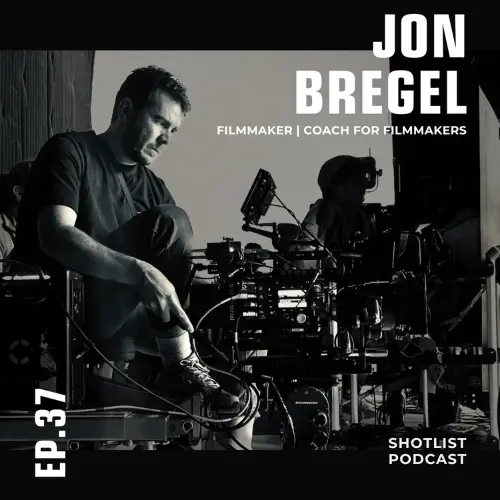
Episode 37 · March 12, 2025 · 1 hr 12 min
Beyond the Hustle: Filmmaking with Purpose, Balance & Inner Fulfillment
with Jon Bregel, Filmmaker & Coach for Filmmakers


If you've hit the goals you set and still feel empty, or you're running on fumes chasing the next gig, this one's for you.
Jon's personal project landed him a call from Nike to direct a commercial with Spike Lee. Then, at the peak, he walked away from his production company to find something deeper. Jon is incredibly humble and genuine. We talk about burnout, self-doubt, and building a creative life around your values.
Key takeaways
- Success without alignment burns you out. Jon scaled his company at full speed and hit a wall. Chasing outside wins without checking in with yourself doesn't last.
- Personal projects open doors. A self-funded passion piece is what got Nike to call. Keep making work for yourself.
- Know when to step back. Burnout gives you warning signs. Listening to them early is better than being forced to stop.
- Certainty is an illusion. Freelancing never feels certain, and that's normal. Learn to work with the doubt instead of waiting for it to go away.
- Let your values steer. When you know what actually matters to you, decisions about clients, money and time get a lot clearer.
“Beneath the awards, beneath the staff picks, beneath the job. What's actually driving you towards living a meaningful life?”
Jon Bregel
Try this today
Write down your top three values.
Then look at your last month of work. How much of it lined up with them? You don't need to change everything. Just notice where things are out of line.
Chapters
- Guiding Filmmakers Towards Purpose
- The Nike Call That Changed Everything
- Scaling Up & the Challenges of Running a Production Company
- The Wake-Up Call: Realizing Burnout
- Finding a New Path: Self-Discovery & Coaching
- Battling Self-Doubt & Finding Clarity
- The Illusion of Certainty in Freelancing
- The Nourish Community: A New Kind of Support System
Connect with Jon
Connect with Marshal
More episodes like this
Transcript generated automatically, with names corrected. It may contain small errors.
I'm guiding clients towards their deepest dreams and desires, using their values as the compass. And so when I understand what's driving filmmakers on a deeper level, being their core values, I can actively and effectively help guide them to where they want to go, whether that's their personal life, professional life, usually a combination of the two. And I find my biggest strength in it all is just consistently reminding people of what's most meaningful them. Beneath the awards, beneath the staff picks, beneath the job. You know, what's actually driving you towards living a meaningful life. And that's what I find the most fulfilling in all of it. Hello and welcome to another episode of the SHOTLIST podcast where we talk about how to make a life and a living behind the lens. I'm cinematographer and photographer Marshal Chupa and today I'm speaking with filmmaker and coach for filmmakers John Bragel.
In this episode, John and I dive into his journey, story and how his personal project led to getting a call from Nike to direct a commercial with Spike Lee. Why he chose to leave his successful career and production company behind at its peak to choose himself and listen to his own inner voice. How we deal with our relationship with self doubt and uncertainty that we all inevitably bump up against as freelancers in this creative journey, and how to build in tools into our lives to help create a more holistic and balanced lifestyle in this wild roller coaster we all inevitably signed ourselves up for. John is incredibly humble, genuine, and someone who sees far beyond awards and fame that is easy to get wrapped up in while chasing and building a successful career as a filmmaker. It's time to take a minute to look inward on your journey and ask the bigger questions that come with why. Do we do what we do?
Let's dive in. John, thanks very much for coming on the show today. Excited to have you here. Yeah. Thanks for having me, Marshal. So I think I originally discovered you many years ago before I even I think started this podcast and it might have been on a podcast. I heard about you and do you. Was Variable its own podcast prior to this or is? Variable was a podcast and the community and recently we evolved it into Nourish. Right, that makes sense. So I remember hearing a podcast and just you telling your journey story of like success into burnout, into many facets. And I remember listening to that thinking like no one else is speaking to this stuff. Like everyone, everyone talks about the, you know, next new thing, next new lens, this lighting set up, all this tech. And I remember listening to that and just feeling it so much, like heartfelt connection to like, wow, thank you. Someone's talking about their journey through the realities of filmmaking and the behind the scenes of what their life looks like.
Offset. And I remember many years ago. So who knows? Maybe that seed got planted into what this podcast has even maybe become. But I was very. Yeah, just intrigued that someone was finally speaking to that part. So that's how I originally found you. And again, you've told that story. But I'd love to maybe start from the beginning with my audience and just talk about where did the beginning of your film career as a director, DP start? Yeah, so I got started in film initially through skateboarding videos when I was 1314 in high school. And then after that I, you know, I was thinking of going to college and I didn't really know what else I wanted to do. And so film was always something that I just enjoy doing, but I actually didn't really think of it even like film. It was more of just making videos with my friends. So I didn't make that connection to think that I could be like a filmmaker or like there was really even like a living in it. And I started looking around at different colleges and discovered that there are film programs in some colleges and you can actually specialize in that. And I remember I got a brochure in the mail from Full Sail University and I was like, wow, this looks really cool the way that they marketed it.
And they had like a back lot and they had all this gear and I was always a very hands on kind of person. So I went there without even knowing what a cinematographer was. And it was through the work that I was doing there in the various workshops and just hands on with the gear that I realized, oh wow, this is really cool. Like this could take me somewhere. Like I picked it up pretty quickly, was making some cool stuff with friends. And that was just the path that I started to go down once I realized that that could be a feasible career. Was also directing a bit here and there in film school and then after film school mainly directing and DP ING as well doing a lot of touring with bands and musicians. I was shooting News for a while.
Just loved every part of it, like every part of having my hands on a camera and working with friends was just amazing. Yeah, that sounds like a bit of the traditional trajectory. You know, you're dabbling a lot of different things to start. You're finding your fit in the industry and all that. So let's just zoom into the moment where you get a phone call from Nike, right? Tell me about that moment. Well, that was maybe 3-4 years after I graduated film school, so that's skipping ahead a bit. And I made a personal project in Brooklyn where I was doing a commercial job and I was filming on The Phantom. And I asked the production company if I could take it out in Brooklyn and film a personal project. And they were like, yeah, that's totally fine, do whatever you want.
And so I just went out with a couple friends, made this little film called 8 Hours in Brooklyn. I think that was probably like 14-15 years ago maybe by now. And at that point, I've been working with a couple close friends doing some production company type stuff. And so that film came out and this was like the dawn of the Vimeo Staff Pick era. And so a lot of agencies and brands were looking at that website for new talent. And so I was in Austin, TX at the time and it was Nike's, one of Nike's agencies that called my cell phone asking me if first of all, like, is this John Bragel? I was like, yeah, like who is this? And turned out they wanted me to direct this Nike commercial with Spike Lee, who's obviously a pretty big deal. I never worked as a director in commercials, let alone I think I may be DP D1 commercial at that point. So it was pretty eye opening.
I was looking at my friends that I was with that I was doing some like smaller productions with at the time and I was like, OK, this agency wants to hire me to direct this project and I guess that means we would produce it too. I don't know. And so it was kind of like overnight we became a commercial production company and that was that was sort of it sort of how it goes. Which became variable. Yeah, exactly. Exactly. And So what led from that? So I mean, maybe give me a taste of what it felt like jumping into the Ring of Fire. Like, no experience. You're on set with Spike Lee. You're probably pretending to know a lot of things that you don't like. How did that and I go? Yeah, it was all great. I mean, it was really exciting to think that I was making a Nike commercial. Like it's one of my first commercials that I ever directed and we ever produced as a production company. I think everything was just very reactive at that point, just trying to figure out how to do this thing without the experience of doing it to the agency or client's expectations. So we were, you know, a lot of like faking it till you make it vibes were happening.
But no, it was really exciting, like thinking about how to push the threshold as much as possible. And I think we probably broke a lot of traditional conventions in terms of how you're supposed to produce commercials because we didn't really know how to. So we just kind of created our own process and it was all just a lot of fun, a lot of learning. Yeah. So moving forward, you that sounded like that's what kicked off the trajectory of your kind of career and it sounded like it went full blast from then moving forward. Tell me about the years to come and and how things progress from there. Yeah, for sure. So it was after the Nike commercial, shortly after the Nike commercial that National Geographic reached out cold as well as a result of the same project, that phantom project. And so that was like our first client, like ongoing client that wasn't through an agency.
Everything just kind of snowballed from there, I think. So we were working now and like building a new client relationship and figuring out how to manage that and how to profit from that. And because we were, we were so used to spending all of our money on every project we got before that because like the production company was more of like a passion project. It was like we just made a bunch of things and spent all the money on the gear and you know how it goes. And so it wasn't really like a profitable thing. But then all the sudden we were getting hit up the work on all these jobs with budgets that were substantially bigger than what we've been working on. And we were like, OK, we got to figure out how to make money and make this sustainable. And so fortunately, one of my partners at the time was much more interested in that part of the business. And so he really got gung ho on that. And then my other partner and I got really gung ho on like the creative development and how we're going to execute and all those types of things.
Yeah, it started scaling really fast. We started hiring a few people like right off the gecko just to like keep up with the kind of influx of it all. Just like I said before, it's just like non-stop learning for years. Like the whole time we were there, it felt like the first five years maybe it was just like every lesson we learned was just through doing it and just through making mistakes and refining and making mistakes and having little wins and refining and hiring some of the right people, hiring some of the wrong. You know, it's just, and we didn't have any mentors that were in the business earlier on. I, I think it was a mixture of just like naivete and probably stubbornness and we just rolled with our team and I think that was just such a thrill ride for so many of us was like this challenge of how are we figuring this out? How are we going to make this work? It was just like a big ongoing project that just required a tremendous amount of attention.
Yeah, it's a bit of a blessing and a curse that you had no idea what you're doing 'cause I feel like some of the times when I now looking back and when I'm shooting a project, it feels like when you get stuck in the boxes of like how agency wants to do things or all of that, you kind of rips away a lot of the creative juices. Let's say that I'm like sometimes when I forget about all that structure and I kind of been having that moment the last few weeks looking at like I found some old pitch decks that, you know, were around and it was just like, Oh yeah, that time when I had no constraints and didn't care what all this structure, I felt way, way more creative. My more like you just said, you get a phantom camera, you have an idea and you're just going to run and go shoot whatever you want that weekend and that and like there's no constraints. So I think that gets easily lost in the process sometimes of like all the structured storyboard approved by 7 people, all that you know things.
So. It's the best. Yeah, it's kind of cool to hear that you were able to push through. I just have so much flexibility in the beginning to to really lean into the creativity part of it. I feel like that was mainly the creative part of it was the beginning. There's like formative five years of like figuring out how to build and sustain a production company. I actually think I like that more than the work itself in retrospect. So you're trying to like figure out how to build a team through shared values and work towards some shared goals, and that's really invigorating in and of itself. That's like the big projects. That was actually ultimately more exciting to me. But then all the reactivity from all the jobs that would come across the table, it just felt like that would constantly pull away from the source of love. Like at the core.
And over time, it just got way too hard to really nurture and nourish, for lack of a better word, The core of what I just love the most about that company was just the people that we worked with. So let's talk about that as you probably slowly went into burnout from this process of just going and going and where did the part begin where you're like, this is maybe not sustainable, I need to maybe something isn't working here that's transitioning in my personal life. Where was that kind of piece? I think that was sort of trickling in for years. If I was honest with myself, it probably started within the first year of having the company, but not really giving that sense much thought or attention because I just figured and because of everything that I heard about the film industry, you know, you just have to kill yourself to make it in this industry. Like, you know, it's brutal.
It's incredibly competitive, which it is, you know, for sure. But maybe I just took that a little too seriously and was operating from just like a place of fear and scarcity and unwilling to look at the signals that were speaking to me for years that just kept getting louder and louder. You know, over time, you experience things and a lack of joy and thing in situations that used to bring me joy. And it's accumulates over the years to a point where you're just like, oh, wow. And I think there was a few of those points could have been from, you know, my roommate once asking me, when was the last time you had fun?
When I was working on a treatment at like 2:00 AM. And he just said it really casually. You know, he's just like, dude, when was the last time you like had fun? And I was like, it just really struck me. And then another time, one of my best friends kind of having a heart to heart with me about just like how much I had been working and times visiting my parents in Maryland and just like sleeping on the couch the entire time when I hadn't seen them in months. And, you know, I had four of my best friends move to New York City and I like rarely saw them because I was just working all the time. And so these things, all these things and more, a ton more just started to kind of add up to more and more awareness of the fact that I was sort of missing out on a lot of life by just being so absorbed in my work.
And there was a few catalysts for leaving that company behind. But the biggest one I would say was when I met my wife in Shanghai on a job, because that really opened my world up because I'd had a few failed relationships over the years, which of course those wake you up too, if you're honest with yourself. And, and the signs are constantly, Oh, you're just working too much. It's like, well, there's probably some truth in that. And over time I, I realized like, OK, I'm the problem, obviously, right. And so when I met my wife in China, for one, she was in China. It was not my wife at the time, but when we met in China, I was like, wow, this woman's really special and I don't want to mess this up. And how do you not mess something up? You have to give it time.
And so I started to really prioritize that relationship and would be flying over there and then a commercial job will come back up and then I'd fly back to the States and so on and so forth for like 2 years. But that was the huge catalyst when I first met her, 'cause I remember I came back to my office after meeting her and we had just moved into this new office in Dumbo and there was like all this new furniture moving in, outfitting it with nice stuff. And I had this sort of out of body experience that was a huge wake up call to me that was just essentially like, you need to get out of this company or else this relationship is not going to last. It's just not going to work. And it was a crazy couple of weeks.
You know, I, I made the decision within a couple of weeks and was out of the company maybe like a month later. But, you know, I think our bodies carry a tremendous amount of wisdom. And I'm very grateful that I had the instinct to leave when I did because I look back at other times in my life when I didn't really understand the mind body connection at all. And I'm like, wow, like the body really does speak to you when it needs to speak to you. And so that was an example of that. Like my mind was telling me I should be staying in this company. Like, I would be crazy to leave. You would be so dumb. You just got this multi $1,000,000 five year lease and all these things and you have to be so responsible to this, like you, you can't leave.
This is insane. And I know that there is a lot of irresponsibility attached to that decision in the moment, but I had pushed myself far past my threshold and it just broke. You know, my body just spoke to me and I had to make a really hard decision. So I left and fortunately I've maintained those relationships and it was not easy, but like things are manageable. I think in those really difficult times, looking back on it, like it was extremely a really big and difficult decision at that time. But like the people that I work with are good people. Like they understand that things change and things happen.
And I'm just grateful that everyone knew me and, like, knew my heart and knew that I wasn't doing this to like, destroy the company, you know? Like they knew that I was burned out for a while, like everybody did. So a couple of my employees at the time told me like they weren't surprised, you know, so. Again, going back to the people that I worked with, like, good Lord, if I had left that company and I didn't have good relationships with everybody on the team, like I'd probably be a ton of hate out there for me right now. Yeah, At the end of the day, you prioritized yourself, your health, your own mental Wellness. And I think that's just ultimately what so many people in this industry forget to do. And and it's not an obvious thing, like you said, the the, the mentality of competition and this is a super hard industry to be in and going to grind. Like don't take your foot off the gas pedal. Like, and like, I think there's a big wake up call that's been happening in my life too.
Like being into this for a decade is just like, OK, at the end of the day, what do I care about when I'm on my deathbed? Like what is the piece that like, sure, I made a bunch of pretty moving images that will probably be dust on a hard drive one day. But what I'm hearing is you've come back to the what it matters most. And for you, the trigger was your now wife, you know, the person you'd met at the time and then that looping you back into what matters most on this journey, you know, and it sounds like the pressures of what the business was putting on you were just like unsustainable, unrealistic moving forward. So you had to make a really hard decision to to move on. And I'm curious when that the one that all changed for you. What were some of the things that you began to when it comes to mental health? And like there's, I can only imagine bouts of anxiety and perhaps depression and all those sorts of things come up. What were some of the the tools or the things that you began to change in your life that that made a difference that helped you?
Well, I think just going on a journey of self discovery and sort of figuring out how I got myself in that situation in the 1st place. Because a lot of times I find that people have a tendency to blame the industry. It's not the industry's fault necessarily. We're the ones that are putting ourselves in that situation over and over and over and over again. We don't have to do that. No one's telling you that you have to suffer for what you're doing. That's a choice, and I realized that I was making that choice over and over for years. And that is largely related to a lot of things I started to uncover when I decided to take a step back. Why do I keep punishing myself? Why do I keep finding in in a situations where I'm exhausted and burned out, what is happening in my mind and in my body that makes me keep putting myself in these incredibly stressful circumstances? What am I avoiding in my personal life and in my mind, in my spirit, that I just keep throwing myself back into this madness?
And that's largely what happened as a result of stepping away from it all was understanding that. And that's been a journey of the last like 8 years to where I've recently decided to just take a break completely from the industry and focus on what I'm doing now, which is coaching and making my own films on the side. And just really understanding myself as an artist, as a filmmaker, as a person away from the culture inherent in like Hollywood, in the commercial industry. Just getting back to the roots, the art, to the spirit of it all that I loved about it in the first place. So I never I say all that because I don't blame the industry, I blame myself. Yeah, and ultimately I think it's very easy to get wrapped up in it all and think, well, this is what I got to do.
This is how it is. This is how the the things that just work. And and then you I often, and it's way easier to do with your friends, 'cause you see your friends in it and you're like, dude, you literally have a choice right now. This is this is your life. You can shape and leave this job, you can leave this relationship, you can leave and you can, but when you're in it, you're like, no, this is what I'm doing. Like this is just my thing. I'm in and that's what I'm doing. And so I think that also leads to the the next beautiful point about you starting the coaching practice and and helping people perhaps look at the mirror and saying, Hey, look how look, you don't have to be in this and or you can do it differently than the way you think you're doing it and probably get better results or similar. So can you speak to me a little bit about like, I mean, what is a you're a coach for filmmakers?
What does that even mean? There's a lot of ways to get to the core of what it is, but I would say in its essence, it's a a collaborative and actionable process of deep inquiry that fosters reflection and personal growth. So like I'm guiding clients towards their deepest dreams and desires, using their values as the compass. And so when I understand what's driving filmmakers on a deeper level, being their core values, I can actively and effectively help guide them to where they want to go, whether that's their personal life, professional life, usually a combination of the two. And I find my biggest strength in it all is just consistently reminding people of what's most meaningful to them. Beneath the awards, beneath the staff picks, beneath the job, you know, what's actually driving you towards living a meaningful life.
And that's what I find the most fulfilling in all of it. Yeah, that makes a lot of sense. And I think they're just, I don't know, I think we're cut from the same cloth because I love speaking and diving into that stuff so heavily. You know, I think a big part of my life that I don't a lot of people don't see online is that, you know, I'm deeply into men's work and the, you know, the growth that comes from our own human experience. And, you know, our our careers are part of that, but they're definitely not all of it, which I feel like the people in film and photography and that often wrap their whole identity in the very thing we're doing as creatives in our career. And it's so easy to get caught up in that. And I feel like I'm, you know, I'm really unwinding that this past year for myself. And what does that look like? So you talked to a lot of filmmakers and I'm curious, what are the threads that you see similar when it comes to like what are the things people are most struggling with in their journey?
I think it's mainly clarity. Most of the times people know what they want deep down. They have a good idea enough of what they want, but having the courage to actually look at that and say to themselves, this is what I want is huge. Because there's so much external pressure. There's so many. As artists, a lot of us have experienced outside pressures that tell us that this isn't a real job or this is a lot of that imposter syndrome and self doubt that trickles in for a lot of us. We should be doing this, We should be doing that. And I really think it's largely clarity and the permission, giving themselves the permission to do the things that they want to be doing. It's a really big part of it.
And then of course, there's on top of that, it's, it's a lot of practical guidance just from like industry experience to help aid them and create the pathways to get to where they really want to get. And a lot of times it's being stuck in a type of work that isn't fulfilling and sort of wanting some guidance on how to get to a place of work and connections and community that is a bit more fulfilling and a bit more meaningful. So to dive into more pointed parts of that, I think like one that comes up for me is just like a work life balance. Like what is, what does that even look like? John? How do we, how do we have a work life balance?
Because I think, is that a fake thing someone made-up? I just think there's a meaningful life and that's something that you have to decide what that means for you. And like how do you get to a meaningful life? From my experience, you work in alignment with your values and live in alignment with your values and allow them to guide your actions. And if you do that and double down on that, often that results in a fulfilling life. What doesn't result in a meaningful life is not living in alignment to your values. And that's ultimately going to cause you as much suffering as possible. And I think that the challenge of living a meaningful life is that it goes very much against the grain of our culture and what the culture tells you is meaningful.
So when you start living in alignment of your values, it can be very painful and very difficult at first because you're going in a more spiritually aligned direction and the culture is going to tell you, oh, you need this product or you need this thing, or you need to make this amount of money or have this type thing, which is often directly in conflict with our core values, which I see as being the most spiritual parts of who we are. A meaningful life. I feel like a lot is just shutting out the noise of the world and the culture and advertising has so much to do with that. And oh, the irony that we're the ones creating the advertising. Exactly. There's a big dilemma there for a lot of us.
And when you asked about what do I work with people in coaching, a lot of time it's that. It's what the the fact that they're creating things that don't align necessarily with their values or with that. Well, A. Deep underlying and restless disbelief in what we're doing in commercials actually matters on a very deep and existential level. And I talked with a lot of people about that. And it requires a tremendous amount of self honesty to get there cuz again, the culture says this is really cool. You know, you can make a lot of money doing this, which is valuable, you know, and I'm not completely throwing shade on commercials. I mean, of course there's some brands and things that I would probably not choose to work for, but generally it's just good to see it for what it is. That's my only point.
Like just see what you're doing and if you're can find a place of contentment and being OK with what you're doing and how you're providing for your family, I think that's way better than being naive and not being honest with yourself. I know for me, that was one of the main reasons why I had to step away from the production company and a lot of the commercial stuff in general, was that there was this constant lingering sense of existential dread and feeling that nothing I was doing actually mattered in the grand scheme of things according to my values and according to what brings me meaning in my life. Just feeling like, OK, I'm expending all this energy into this thing and it might be beautiful and it might get awards, but I actually don't even feel good telling the people that matter the most in my life about it because I don't think it actually matters to me and to them. And so I actually never really felt good telling people that I was a commercial filmmaker.
It never sat well with my soul. And so that's why I've been pivoting away slowly over the last like 8 years and just re examining my relationship to how I'm spending my time generally speaking. Yeah, ultimately we only get so many tick boxes or weeks or months of our lives to when you strip it all back. And I think it's very important to be asking ourselves what are we actually doing with that time and the piece? Yeah, it's such an interesting inquiry because I, you know, I just reflect on myself as you I hear you speak those things. And that's kind of the antithesis of what my last year has been about is like, OK, if if making pretty moving pictures isn't like the value, where like, where's the value in that process?
And I realized for myself that I don't ever want to stop doing that. I actually really love the creative process. I love the collaboration you spoke to in the team, the camaraderie and like the, the actual process and the like that flow state I get in when I find that like beautiful, like those ideas are flowing or you're hitting that incredible shot with beautiful backlight and the haze and the freaking shout out of the field, all those beautiful, you know, nerdy creative things. And it's, it's not enough for me. And so there's certain things. And I think you and I talked offline when we first met each other, just about like fatherhood and you know, like that being a piece of like something much bigger than ourselves. And I think the reason I started this podcast is because something much bigger than myself, something much grander than I think at for me, adding value and inspiring others on their journey seems actually more fulfilling at times than it is making pretty pictures that move on camera.
So that's kind of how I've gone about my journey of being like, well, I this could be a both end, you know, OK, I don't necessarily believe that the commercials here are the end all be all. So then how what are the things in life that I could do that are hitting those values you speak to? So there's like big part of that for me was, you know, men's work in helping others in, in and around that part of like life alignment. And, and then there's like, yeah, then there's this podcast and there's like the community aspect that I'm slowly building. And I think that's super cool because I've seen, I've seen you do similar things with the Nourish community and speaking to all of these things that I think are so important in our in our journey. But to come back to like a specific point around maybe you speak to with filmmakers who are going through challenges is a piece around self doubt.
Perhaps they wouldn't ever say that to you. So maybe I'm throwing you under the bus here. You would identify that they're the thing they're having is self doubt through process of me being like I'm not getting the work I want or I'm not meeting the people or the I don't know what it would be. But yeah, I think you would maybe identify the self doubt was probably a part of that process versus me just being like IA lot of people don't recognize what's actually going on. So maybe that's a challenging question. No, it's it's a good topic for conversation. I think more than anything I will share. For me, a lot of it comes from where I'm getting my sense of validation. That's where I combat a lot of the self doubt, because self doubt is thinking I'm not enough, I'm not good enough, I'm not going to make it, I'm going to be a failure, I'm an imposter.
However you want to spin it, right? Is that how you think about self doubt? Yeah. It's the piece of like, I think it gets lost in seeing all the other people quote, UN quote more successful than you doubting that ability to be that. Or even if in the something that I've been trying to reframe myself as like, it's so hard to see yourself and where you're at. Like there's always something better. So it took a friend like voice noting me the other day and we've just been like being each other's bounce back when it comes to how can we just like lift each other up or show each other each other's value essentially and say, dude, like, look how freaking incredible your work is. Look how incredible of a human you are. Like just like pointing it out. And it was just hearing him say a few very specific things to me in a voice note the other day. I was like, oh, you're right. I forgot about that part of myself. I'm just like in this little tunnel of like better, more, longer, whatever the heck it is, right? And they're just like when you look at like, oh, look at the body of work I have, look at the friends that I've created, look at the network, look at the community, look at the lifestyle.
Like, Oh yeah, I actually am doing really cool shit and I have value to add to the world and I'm a good human. Like often times we forget all of those things or we and we need someone else to yeah, to share it back. At least that's what I've experienced. Yeah, I think the thing that I find myself opening up about and sharing the most frequently with the people that I've come in contact with is the importance of gratitude and creating a consistent practice of drawing awareness towards the things that we do have. I know for me that's been absolutely life changing and as you know, you take one look on Instagram and it just sucks all that life out of most of us. I should say that excitement for the things that we do have.
It's just I don't have that immediately. So that's hobby. That's the obvious. We all know that. Don't go on Instagram if that's the case. If you suffer with self doubt or imposter syndrome, stay the heck away from Instagram because that is the worst thing you can do. But gratitude is, is completely life changing. I think if you get in the habit of that. And then also, like I was saying before, is like, you know, something that I might say or ask is like, well, where do you get your sense of validation? And I think if we put our sense of validation in external circumstances, that's ultimately setting us up for failure because there's so much outside of our control. So it's ultimately comes down to where people get their inherent sense of self worth. Some people weren't brought up to think in these types of ways, to think that they are worthy of love and belonging. I was fortunately.
So I have that and I cultivate that through practices and meditation and journaling. And I, I take this stuff very seriously because it can slip away in a snap of a fingers if something really stressful or traumatic or whatever pops up, it's really easy to forget who you are. So I encourage people to do that. I mean, that's a huge part of coaching is accountability and building routines that are healthy and supportive of your identity and your confidence and, and ultimately who you are. So it's all designed around self doubt in one way of thinking about it. So, so it's a really good question though. So everyone that I know deals with that in some way or another. Now you just kind of hit on a few tools there, journaling, meditation. What are some of the things you recommend that people could lean into as resources or things they should think about making part of their routine or their their life? I would say the number one thing that I just think everyone should do and.
It feels weird to even say that, but some type of practice of practice of silence and solitude. But I would say some type of practice of silence and solitude because of the importance of needing perspective on experiences and the need to listen to your inner voice or God or your spiritual nature, however you define it for yourself. But that still small voice is just so incredibly valuable. And I found for myself, if I'm not actively cultivating a practice of silence and solitude, then that voice hits you in really unpleasant ways and really bad times. Like for me, when I was walking into my office after being in China, that voice throttled my body to the core and just was extremely painful.
So I think the more you cultivate that sense of silence and solitude, the more balance, mindfulness, peace. I think that's fundamental for me. It's fundamental to everything because everything sort of comes from the stillness and the silence, like everything kind of rises through that. So I would say that's the main thing that I might recommend. Then from there there's all sorts of practical things. There's so many little practical things, overwhelming amounts of things. But I I think that's if you're just saying a setting off on a journey of self discovery or wanting to make some changes. Start with a minute, maybe 5 breaths and go from there. And that inner voice will guide you on a journey.
It will tell you what you need to do the more you keep showing up. Yeah, and I feel the need to nudge even a little further because I know what people haven't dove into the stuff at all. Something that I found useful is just like choose an app like, you know, like there's like a someone who's just going to guide you simply because when you say someone to someone, OK, just listen to your breath and take 5 breath. Like if someone who's never done this is just like dude, like I'm in my head. I have no idea what you're talking about. So something I would recommend to the people who are listening are there's a few apps I originally started with Headspace, kind of most beginner meditation app. I think it's, it's guided, it's very simple. I've definitely got into there's another one called open OPEN and that one has more breath work and tied into it. And I found there is, it's also guided or not guided depending on the, the session, but I found those very practical tools when looking for something like, I have no idea what I'm doing. I'm, you know, so often times I just share that with friends who are seek, trying to seek something and they don't know where to start.
So I'm just going to plug that for people. I'm getting started. But I think once you have the awareness, like you said, you're like, oh, I can actually, I think the second layer is, well, then I have control of now I have awareness. I can see these thoughts going on in my head. So then in times of stress, I can use the tool like you just said, stop, take awareness of my breath, 5 simple breaths, box breathing, maybe like 5 in, five out. And then that is what kind of levels you in that moment. But I think until you have the even the awareness piece is the very first fundamental one that I think I struggled with for a long time. And and then once you have that, that's the foundation that you can go up from. I think so. There's a lot of other things kind of in my experience, are just like band aids in a way. It's like if that foundation of presence and deep state of connection is not regular, then all the other things don't last for me.
It's just like a Band-Aid is how I feel. Yeah, I agree. There's so many, so many things you can do, but they're, yeah, I don't know, you can go out and I think like having a conversation with a friend and grabbing a beer and talking through whatever, you know, that's, that's great. And if that's the only thing you have, it's I think there's not enough for a sustainability long term when it comes to creating that internal, the internal work and recognizing that dialogue. Yeah, that's also like just getting comfortable with discomfort. It sounds so cliche, but that's the reason why so many people don't sit in silence and need apps is because we're so uncomfortable with discomfort and agonizing thoughts and pain and things popping up. It's we need something to distract us away from that. So that's been the biggest thing that I've learned. And I'm not throwing shade on guided apps. I started largely through those for years. And it's incredible because I, I wasn't comfortable with the discomfort the first few years, you know, but now I'm realizing like that's, that's what it's all about really is like being able to sit in your pain and your sadness and not thinking of yourself as less than, but actually thinking of yourself as a whole human being that has darkness, light limitations, gifts, everything in between.
It's just part of being human. And that's, that's what I've learned, you know, over the years of avoiding is that, oh, I've just been hiding from all this pain and sadness that I never looked at my whole life. That ultimately found me in a position where I was burned out and depressed. So I was running away from it. Yes, we run away from it, we numb it, we look to vices, we distract ourselves with the endless work funnel. I think it's so easy. And I think something that's not intuitive and something that I've taught, I've had to learn over the last year of going really deep down the rabbit hole of inner work is just like going in to the very thing you're resisting. Because by not looking at it, sitting in that silence, sitting in those emotions, feeling that sadness, grief, anger, whatever is showing up for you and allowing yourself to feel it and then move through it. If you don't do that, then it just stays stuck and you just keep suppressing and stacking layers of whatever you want on top of that, whether that be work without the alcohol, whether that be social media.
I mean, so I think it's been a massive part of like from my journey, it's just like looking how do you oh, how do you go into the very thing you don't want to look at? Oh, you know, that's it's the opposite. Like you just said, sitting in uncomfortable and being comfortable in the uncomfort and then continuing to want to go pursue that. That's the opposite of what I think how we're wired. It's not like we're we're wired to go to pleasure, not pain, you know? Yeah, it's always those cliche sayings that are the most true. It's like, just embrace the moment. Just be comfortable with discomfort. It's like we've all heard that stuff so many times, but maybe there's a reason that we've heard it so many times. That's why I started my gratitude practice.
I heard about it so many times and read about it so many times about the benefits of it, that I was just like, all right, I'm just going to do it, damn it. And it has changed my life in a lot of ways. So it's a reason for cliches, I suppose. Yes, but if it's just like a a few words you read on Instagram on like a a highlight post, you probably doesn't get, you know, you actually you something has to unfortunately, there's something also discovered in life is like usually there has to be an event that throws you into the depths of. And then you're like you, you have that wake up call, whether that's like, yeah, for you burning out at work, you know, and the career you love or a breakup happens or a death or like something. Those are the moments in life that force you to look at everything that's actually going on and reassess it all so that that's when that quote hits. You know, it's just like until until that moment wakes you up. It's hard to see the writing on the wall, let's say. Really is.
It really is. Another piece I wanted to speak to was in and out uncertainty because I think this is something that is such a, something that's all of us freelancers deal with on a very fundamental level of like not knowing where our next job's coming from and the inconsistency of like big wins and then crickets. And then and I just think the industry this past year has been quite challenging for a majority of people and it is continuing to be. And so I just wanted to speak to you like uncertainty and your thoughts are on that. When is there certainty? That's sort of where my mind goes when I hear that, because I can't think of a any job where there's any certainty or any season of work where there's ever any certainty. Good point.
I don't know if that answers your question, but. I mean, ultimately I see what you're doing, you're reframing it. And I think the point is that say, let's be working a consistent 9:00 to 5:00 and you got a salary and all that. That is also false belief in security that that company can go under, you can get laid off tomorrow. You have no idea what the economy is going to do. This this same level of uncertainty exists. We just frame it differently. Yeah. So if someone's coming to you and you're, I don't know, I'm struggling with that process, like how, how could you help them reframe that process as like, we're all in this, how do we deal with that? Well, I would first probably ask him that question because coaching is largely inquiry based. It's getting people thinking and coming to their own conclusions, as you know. So that would be the first question I would ask is, you know, what is certainty?
What would make you feel that there was a sense of certainty? And ultimately, I think it comes back to the things that we can most control that are in front of us. We can't control if a job comes across the table, we have no control in that as filmmakers and we have no control on if we're going to get fired off of a job. I mean, we can do our best, but like, things happen and what I always come back to is, again, what are the things that you can do within your control to give you that feeling of certainty? And a lot of times that has to do with, you know, personal projects, for example, like creating things that are meaningful to you consistently. That's how I see most people thrive and grow and quote, UN quote make it in the industry is they're just relentless with the personal work because that's the one thing that they can control most of the time.
And you have to get creative about how you make the personal work. You, you have to find sustainable rhythms to do it and just stay very proactive so that that muscle doesn't atrophy. I think I see a lot of times people like create a personal project that maybe it doesn't do good and then they get really down on themselves and then don't make another one for like 2 years. It's like you have to love this stuff and it has to do something for you on a personal deep level or else it's just going to atrophy. And I think that that happens to a lot of filmmakers where they feel helpless, they feel lack of control. And ultimately it's like, well, let's get back to work here. Like, let's figure out why you're not actively creating. And, you know, 'cause we, so many of us find so much fulfilment when we're like actively involved in creative projects, 'cause it brings us so much meaning and creative fulfilment.
And it's just getting in the rhythm of doing that because every time you stop doing it for a period of time and start over again, it's like when you have to go to the gym for the first time and you haven't been in like 4 months, it's terrible. Like, and it's just easier not to go, so you just don't go and then you just get fat and whatever. Like I think that's a very similar analogy to making excuses on personal projects, making excuses on collaborations where you're not getting paid with other filmmakers. It's like that's really, you know, other than sending out like hundreds and thousands of like cold emails and there's all sorts of like strategies and things you can do to try and drop off work to like give you more of an illusion of control. But at the end of the day, as it relates to the career, like the people that inspire me, the things that have worked for me, the people that I look up to, like they're not sitting around waiting for somebody to give them permission to make something. They're just doing it.
And I think that's so empowering when you can really tap into that and find that rhythm because there's nothing worse than just like sitting around waiting for things to come to you. I just never subscribe to that personally. It just, and most of my friends don't eat. I pretty much all my friends don't subscribe to that. We we've just never been that way. And but I understand it. I'm, I'm blessed to have had really good role models and collaborators that have like brought that out of me in the process. A lot of people don't have that. A lot of people don't have creative partners or support structures that have like encouraged this type of meaningful, relentless creative output. And I don't mean that even in like an unhealthy way of being relentless. I mean it in like an absolutely integral, fundamental part of who you are as a person.
Like, if you're not creating, I don't believe you're going to be living the best version of yourself. And that doesn't mean like creating a huge film. It could mean taking a photograph could be painting, It could be involved in any type of the arts, any type of creative self-expression. Yes, you're speaking to the right or you're speaking to my soul right now, let's say and that like it's just even been this past month that I've I've been in such a a creative. I don't know yeah, I just waiting for the job to then do the thing and I haven't created personal work in so long. So I've just been reminding myself like again, looking at like coming across an old deck that, you know yesterday as I was sorting through an Organism. So I was like, wow, that's actually really inspiring. I forgot that I like made and thought and got excited about stuff like that and I re sparked something in my brain like why am I not doing this anymore? What if like I've got so far down this rabbit hole of waiting for the phone to ring or this has to pay me money to actually do the thing where it's like, what a stupid excuse again, as I think the gym analogy is perfect. It's like, well, I haven't I just the muscles dead. I have I forgot about I haven't been doing the reps and it feels so challenging.
Or rather I forgot that I even knew or had those muscles in the 1st place. Unless someone is telling me, hey, we need those muscles, then I'll put them to work. But if they're not, then I'm forgetting that. Oh yeah, that's why I'd start in the 1st place, because I love this. Before money existed, before someone was telling me what they needed me to create for them, like, you know? And so, yeah, I'm just, that really speaks to where I'm at and what I needed to hear today. So thank you. Yeah, I just think we have to do it. And so a lot of what I do in my own life and what I talked to my friends and other filmmakers about too, is building sustainable rhythms to create passion projects, personal projects. It could be spending 30 minutes a day, an hour a day, a day, a week, a day, a month, whatever that rhythm looks like that you can actually do within the context of your means to make a living, like your day job. Do that and just don't let go of that because it's so important. But then again, there's seasons where life gets crazy and out of control.
And that season could be a month, it could be years. And then you find that muscle atrophying. Atrophying. What's the word atrophying? I don't know, but let's go with that. Yeah. And, and I think that's a lot of the times when people would reach out to me, you know, they may not even realize that that's the reason that they're reaching out to me too. And then we come to realize that they have not been proactive on the personal projects. And that is ultimately what's most meaningful to a lot of people is self-expression without clients telling us what to do. It's the best and we can do it. We can do it every day. So true. And yeah, and when it comes to the cycle, like I think some a healthy cycle that I've seen because we talked about how do you find fulfillment and like, you know, sometimes you have to shoot the toothpaste or the yogurt commercial, you know, and you're like, cool, that was a nice chunk of income.
Now how could you take a portion of that and dump it into your personal project that actually does light your soul up, but actually does create something in the world you want to see and all that. So I think that's been like a a piece that I've tried to use, you know, to remind myself of how you can both and, you know, make a good living from the things that maybe don't fully align there. OK, well how do you come back to finding alignment with that will then repurpose the income into something you give a shit about? Yeah, the phrase that I'm most familiar with that comes up in the community quite a bit is this idea that your jobs or sponsorships for the work. And there's a really great talk by the governor of Maryland, Wes Moore, which he was on a Oprah Winfrey speaking tour like a few years ago. But the point is, you can find the video online, but he talks about the difference between your job and your work.
And I find that just such an incredibly empowering concept that like, we have our job that pays us, but then we have the work that is the most meaningful, connected to our soul, connected to our identity. And that work could be volunteering, it could be photography, it could be painting, it could be whatever it is. The work is the work that matters. That really, really matters on the soul level. So it's a helpful analogy for me to remind myself of too, when I find myself getting tired of whatever it is that I have to do to pay the bills. And like, this doesn't have to fulfill me entirely. It's paying for my life that I thankfully enjoy. So that's a whole rabbit hole we could go down to. Yeah, I agree though, job versus work like this, this for me is quote UN quote, the work, this podcast, this feels like has meaning, it has purpose, it has value for the world. It does something beyond myself.
Whereas, you know, yeah, maybe the commercial I'm shooting next week doesn't like it doesn't, you know. And so I, I love that analogy to to trade, not trade, but yet to balance and and realize and separate those for your brain and one can feed the other. So I like that sponsorship phrase. I'd love to dive into you a little bit about. So you started this community called Nurture, which originally was variable. Tell me a little. Bit about that Nourish, sorry. The Nourish Community was formed three years ago, originally as Variable, which Variable was my old production company in New York City for a number of years. And that production company shut its doors. And I still loved the essence of the company and all the people I worked with.
And so I had this idea to repurpose the name and the brand into a community of filmmakers in pursuit of Wellness, meaningful relationships and purpose. And the thought behind that was how to have a sustainable, meaningful career in film. Because these are questions that I'm. Continually to this day interested in, and there's a lot of other filmmakers interested in this stuff too that I've connected with. Initially it was a handful of my old coaching clients and some close friends and collaborators and it was sort of just like a hub for us to come together and have conversations about things like, you know, identity and self worth and imposter syndrome, networking, practical things too as it relates to just like growing as a filmmaker and human being.
So then I just love doing it so much. Like we would do these in the beginning. We're doing like 3 Zoom calls a week on various topics and different guests would come in and you know, there'd be anywhere from like 5 to like 40 people on a Zoom call. And it was just so fulfilling. And I just continue to show up and continue to get people involved here and there. And I just love doing it. Like it brings me so much meaning. And I've met some of my best filmmaking friends through the community too. And I don't see any reason to stop doing it because like I said, I get so much out of it. The people that I connect with in there get so much out of it. And it's just a, it's just a kind of like a bit of a, to me, it's like a bit of like an Oasis in like a cesspool of filmmaking culture online.
So I love it and so I just keep showing up, you know, it's my work, you know, like totally. I mean, I, I think like I told you before, I think there's 350 members in there. I think I've given high 260 of those memberships away to like different friends in college. Like I want, I, I want it to be free. And the reality is there are some costs associated with and I can't really have it be like a loss completely. But I just want everyone to like engage in these conversations that we're having in there. And, you know, so we charge 120 bucks a year, just 10 bucks a month. And there's just really great opportunities to like connect with other filmmakers in meaningful ways and network. And I found one of the most fulfilling things to me and one of the few things that keeps me coming back to it is when I hear that filmmakers are working together that met in the community because there is this like fundamental alignment through values like I keep talking about of like, OK, it's important to every member in there to have some degree of Wellness in their life.
Like that is a value of them and working towards doing more meaningful work. So you already know that there's this core of connection. And so when I hear of people working together and people making friends and best friends and meeting up and this and I'm like, God, that's so cool. Like that's what it's all about to me is building your circle of collaborators through shared values and not on the solely on the basis of like they are wrapped by this company or they do really cool work. It's like that's so beside the point in my opinion. It's like community should not be on the basis of what you've accomplished professionally, in my opinion. So that's sort of how I see the communities, just people that are maybe super far along in their careers and people that are just getting started out that are just like friends and like, and, and often times the people that are just getting started out in their careers have a tremendous amount of wisdom that impacts the people that are super far along in their careers.
So you see this like cross pollination happening. And I'm like, that is so cool. So I, I always struggle with like the hierarchy because I, I felt like I was in that for a while. Like I was kind of like, you know, like the one of the cool kids in the advertising industry. It's just stuff I've heard and like things that people tell me and I'm like, God, that's so like I was so uncomfortable and like negative and when that was sort of like a part of my life. Yeah, it's like that ego, cliquey culture part of this. But I think that's something I really value about you and the community you've built is just stripping that all back and just saying like, hey, we're human beings trying to do what we love, you know, and like what? And let's connect and help each other in this process, which is so much about what this podcast is about for me too, so.
That's the goal, but it's also hard. It is hard to like build a brand and an awareness, you know, like I try and have people onto my podcasts, at least in the past that are like not as far in their careers and things of that. And I think it's something I I continually want to do. But then there's the side of me where it's like, Oh, well, I can get this big person and that big person and like aim for the numbers and, you know, make more money through memberships and this and that. And I think that's all great. But I was having a good conversation with a friend last night that was just like another yet a good reminder of like, what is this all about? Like we got to make sure that this stuff is like really relatable for people too. That's how I feel.
It's a lot of times like I feel like when I'm interviewing people that have you know, or like the biggest in the industry or this or that, it's like that's great. And there is some wisdom and insight to be gleaned for those people. Don't get me wrong, more through their struggles than anything, I think. But it's also like the people that are working at small production companies or the people that are doing like corporate work and the people that are like the majority of the people in the film industry. Like that's super relatable to me. I don't know how I got off on this tangent, but I think I'm just reminding myself like don't abandoned the the most relatable parts of this industry in service of like the film gods. 100% Yeah, it's hard. It's it's hard, man. Like I said, we're so influenced by like the culture and needing to make money and all these things that it's like I, I get jaded all the time.
Yeah, I think it's a both end. And ironically, like I listen to the Wandering DP podcast for so many years and I think he interviews a lot of high level dudes and I was always kind of like, that's great and I can't relate to this, so how can I speak to people? And that's kind of an antithesis why I started this podcast was how could I speak more to the rudimentary fundamental pieces that we're all experiencing. And so I hear you on that and I feel that before we wrap up here is if you know people something's landed and people are looking for a coach or they want to be part of the community, how do they, how do they find you? How do they get involved? Yeah, for sure. Thanks for asking. They can go to jonathanbragel.com/coaching, which is where I have a little spiel about that and you can book a free 30 minute consultation call. There's a bit of like an intake questionnaire for that. But yeah, if you're interested, it'd be great to connect. And then the Nourish community is the Nourish dot community is website, and then the Instagram is at the Nourish dot community. And like I said, it's 120 bucks a year. We do weekly meetings, weekly Zoom meetings. There's a main feed.
It's a whole like ecosystem, private kind of social network situation. So it kind of makes it feel a bit more OK to have a lot of these types of conversations like we're having. So it's a good, a good vibe, a good group of people. There's a two week free trial on that too. So like you can duck your head in and it's like no pressure at all to join. Just like come to a couple events and see if you vibe with the ethos. If not, that's totally cool. But but yeah, just trying to make it as accessible as I can within reason and chipping away day by day. You know, I've been doing it for three years now and I honestly, I, I have no sense that it's ever going to like blow up into some huge thing. I just, I just want to like keep showing up and let it take its course.
So. Yeah. Well, thanks for doing what you do, John. I appreciate. You know, I think again, we're cut from the same cloth and I really, I think a lot of my values align with your values and what you're trying to do in the world and, and for this community and, you know, as a whole. So thank you for getting only coming on today and speaking to these things, but also for, you know, your work. No, I appreciate it, man. Appreciate it. It's a it's a good time talking about this stuff. OK, that was filmmaker and coach for filmmakers John Bragel. John has chosen such a unique path and direction in life that is true to his values and what he feels is in deep alignment with his purpose and mission in life and something that I deeply respect. In a world where it's easy to just get caught up in, put her head down and build a career chasing fame and validation from the external world. I encourage you to check out his work at johnbragel.com or on Instagram.
Jay Bragel, if you want to check out the community he mentioned, you can go to the Nourish dot community. This podcast means a lot to me and it has been a passion project that I truly believe in. That is to spread industry knowledge that is often kept behind locked doors. I want to help us all build a career that we love well, making a great living from our craft. I want to ask to you is that if you found value in this episode, please give it a like and a follow and share it with a friend who would resonate. We're in this together and those small actions will allow me to continue to grow and bring on more high level guests to add more value to this community. Rising tides lifts all boats. I'd also love to learn who my listeners are as frankly, I have no way of knowing. So shoot me a DM on Instagram at Marshal Chupa and I'd love to hear from you in future episodes. I'll be speaking with photographers, cinematographers, directors, producers, reps, and anyone who has decided to take this ambitious leap of faith at making a life and a living behind the lens.
Thanks for listening and we'll catch you next time on SHOTLIST.