
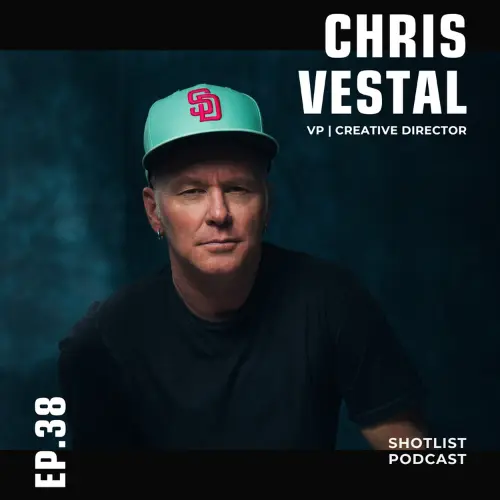
Episode 38 · April 24, 2025 · 1 hr 12 min
What Gets You Hired (and Remembered): A Creative Director’s Take on Building the Portfolio, Presence, and Energy That Stands Out
with Chris Vestal, VP of Creative, Aspen One


If you dream of shooting for the brands you grew up loving, here's what the person hiring actually looks for.
Chris went from pinning surf magazine pages on his bedroom wall to leading creative at Roxy, DC Shoes and Eddie Bauer, and now Aspen One. He opens up his inbox: what makes a portfolio stand out, the politics of big shoots, and why the energy you bring to set matters as much as your work.
Key takeaways
- Be honest about where you are. Before you pitch a brand, ask yourself if your style really lines up with what they're doing. Self-awareness saves everyone time.
- A thoughtful note beats a mass email. Creative directors can spot a template from a mile away. A real, specific DM or email lands way better than a slick blast.
- Energy on set is part of the job. Chris curates people, not just portfolios. The vibe and chemistry of a crew is a big reason people get hired again.
- Big budgets come with big politics. Multi-million dollar shoots have tradeoffs and team dynamics. Knowing that going in helps you navigate them.
- Make room for great work. Sometimes adding one extra day of white space is what unlocks the breakthrough shot.
“You need to be honest with yourself. Can I really shoot for that brand? Does my style align with what the brand's doing?”
Chris Vestal
Try this today
Audit your portfolio against one dream brand.
Put your best ten images or clips next to that brand's last campaign. Be honest: would they see themselves in your work? If not, that's your next personal project.
Chapters
- From Superfan to Creative Director How childhood inspiration and personal passion shaped a
- Lessons from Working with Iconic Brands
- Big Budgets, Bigger Politics
- What Gets You Noticed as a Creative
- Authentic Outreach vs. Template Pitches
- Building Set Energy & Why It Matters
- Creating “White Space” to Make Great Work
- Shooting Beyond the Brief: Portfolio Gold
- Manifestation & Career Alignment
- Leading Through Systems, Vision & Vibe
Connect with Chris
Connect with Marshal
More episodes like this
 Episode 45Cold Outreach That Actually Works for Filmmakers & Photographers
 Episode 40Soul Over Strategy | Building a Career with Creative Depth and Longevity as a Photographer and Director
 Episode 35Alex Strohl’s Business Blueprint: 10+ Revenue Streams, 2 Million Followers, and the Value of Knowing Your Worth
Transcript generated automatically, with names corrected. It may contain small errors.
Self-awareness of where you are in your career and then positioning yourself to brands, to agents, sliding into creative directors, DMS and justice. Like having an honest conversation, but you need to be honest with yourself to be like, can I really shoot for that brand? Does my style align with or something that I'm doing is parallel or adjacent or influence that brand? It's coming at it where it really making sure that the vibrations align, what you're doing and what the brand's doing. Hello and welcome to another episode of the SHOTLIST podcast where we talk about how to make a life and a living behind the lens. I'm cinematographer and photographer Marshal Chupa and today I'm speaking with VP of Creative at Aspen One, Chris Vestal. In this episode, Chris and I dive into the creative journey from a surf obsessed teen pinning magazine spreads on his wall to collaborating with the very photographers who once inspired him.
What it actually takes to lead creative teams and high budget campaigns with heart and vision. How to stand out and get hired by top level creative directors and the right ways to show up in their inbox. And the power of manifestation, self belief and the alignment when it comes to building a career that truly fits who we are. Chris has built a career many dream of, from working with Roxy, DC Shoes, and Eddie Bauer to now leading creative from one of the most iconic outdoor lifestyle brands in the world. But what sets him apart is his generosity, grounded leadership, and the way he thinks about energy and chemistry on set. I'm excited to share this conversation with you. Let's dive in. Chris, thanks so much for coming on the show. Excited to have you here today. Likewise, I was stoked to connect with you last week and get this thing set up. Yeah, I think one of the things that I learnt in our our pre call, let's say last week was that you've basically got like a resume full of like the most bad ass companies you worked for and had quite a a journey into this all. Can you tell me a little bit about that? Yeah, maybe I'll take it from the start. I was always excited about brand and brand work and brand stories and having these opportunities in my life where graphic design really positioned me to take advantage of those opportunities as they presented themselves to me. Kind of a sidebar story.
I, I was always interested in scuba diving and Jacques Cousteau and one of my first corporate jobs was with Aqualung US divers. I was, I had a job as a senior graphic designer and I got to like create packaging and ads and catalogues and trade show displays. So that was like really cool. And it was kind of that first real big moment of where you're like, well, I'm working for an iconic brand, you know, and just the excitement behind being somebody that gets to like put your hands on it and design it, shape it, influence it and to find the story and every like little part that you get to touch. That's that's what really got me charged. I did have another amazing experience, like taking a bit back to high school. I was born and raised in Southern California, spent my whole life surfing and skateboarding. And I would usually tear every time the surf magazine came out. You would tear out your favorite spreads or pages. And I had my entire wall was just like pinned and taped with all these photos.
You and I both. Yeah. And what I had found was I'd always look at the caption and read the caption and study the photography. And I noticed that I had pulled a lot of Aaron Chang's work, and he's a legendary, you know, photographer from that era of, like, 70s and 80s, paddling out a pipeline with one roll of slide film in your camera that's in a waterproof housing. So I'd always saw a photo Chang, photo Chang, photo Chang. And I was really inspired by his style, his crop. He did it much differently than a lot of the other photographers. And then like, Fast forward like 15 years and I'm like traveling with him as an Archer, as his art director, like kind of this manifestation of somebody that had a massive influence on my life.
And here I am, like, working with him. And he's like showing me like how he does stuff as like a legendary photographer. So for me, I was just like this Grom that was like, well, I'm working with my hero. That's pretty amazing. It's like, and being able to like be part of his story and be inspired and learn from him. And what I started to see as I was working for these brands and these people and positioning myself that it was like propelling me forward in my career. And it was kind of like going after those things that inspired you. It's like 1992. I had met my my wife, my girlfriend at the time, and Roxy had launched. It was like 93, I believe, and Roxy had done its first launch and we were both really excited about graphic design. That's like when Ray Gun Magazine and David Carson and Chris Ashworth were doing just really revolutionary work in the print space.
And then here comes like Roxy and it's just got the most unapologetic photography and just like very confident, super cool girls and product. And the way that the story was coming through the magazines in a print space, I was just like, Oh my God, that's that's like something that I want to do. That's the work, that's the photography, that's the design style. Those are the stories that I want to tell. Fast forward. Yeah, 20 ish years and I'm like the creative director for for Roxy. So it's just like, yeah, so it's just like these manifestations of like things that truly inspire you and then doing the work that's going to build your toolbox and it's going to put you in the position to be like a candidate or to be the nominee for that role.
So it was using all of that manifestation like experience and preparing myself. I started to, like you said, collect these iconic brands. I worked for DC Shoes and I think that was mid 2000s. Again, just an amazing opportunity. I'd grown up skateboarding in, in the 80s. We were like the Encinitas kids and the San Marcos skater kids. And then there was like the Vista crew, H Street crew, and that's like Danny and and Damon way. And that's where 8th St. came out of and that's where like drawers came out of. And then all of a sudden it's DC shoes with Ken Block. So it's just like local brand for us, but it's this global brand obviously for everybody else. And then to get a seat at the table where I was like running the photo studio and the catalog, which is amazing creatives. There's just some legends that came out of that place. So it's just like the whole time, always just feeling like a grom like how did I get lucky enough to work for a brand that I've always loved and grew up around the people. So I think it's like keeping that stoke and as the Australians say, froth of of just like what keeps you happy and what what makes you charge.
And it was, yeah, being part of these brand stories and like bringing stoke and bringing solutions and excitement, enthusiasm into the projects. And then as I was like finding myself moving through different brands, really kind of finding that I was really successful leading teams and seeing that it was kind of just by survival, you know, like in that era of like action sports or smaller budgets, it was really like, how do you do a lot with nothing? You know, how do you make something out of nothing? And being a graphic designer and coming from that world of like scrappy skate DIY, do it yourself. So it was really fun to be given challenges of to salute, to put solutions to big problems.
And I find with the less budget you have, it's like the more hands off they are. And then it's just that that you're allowed to really be inventive, which is really fun. And then I found as I've moved up to brands like Eddie Bauer where I had very large budgets, then there's just more stakeholders. And then I call it the democratized creative where it's like you're having to have, everybody needs to be satisfied. And then when you have no budgets, less people or they're just like, just make something out of nothing, get it done. And I, I always find that's when the best creative happens because you're using instinct, you're using inherent knowledge and you know that you got to get it done right. You don't have a lot of chances. So you really put a lot of confidence behind the work.
And I've always found the best work just comes from when there isn't a lot of budget at stake. Right. Well, that was actually one of my questions was like, how do the politics work, You know, on a big set like that, 'cause I think when I did a little chat with you before, you know, you've done shoots anywhere from like we got gas money to like, oh, we have a $2 million budget. And I think not for many people get the opportunity to work on a set like that or have a that much, much to play with. So what are like, I mean, more money, more problems, right? That I feel like there's a, you know, there's always sayings that go along with that, but what does that look like? The difference of experience and like someone who's never had an opportunity to sound a set like that or have lead a team in that world, what is the difference in like the political landscape of all that?
Yeah, I think it obviously with, like you said, more money, more problems, the more money you have to spend on a shoot, it just means there's just like larger production, more stakeholders. If you're doing an apparel shoot, right, you're going to have merchandising, styling, location, art department, photographers, video, social teams. And really it's like if you're coming in to be a creative resource on that crew as a photographer, ADP, or any one of the other components of that crew that you need to be successful, it's like, is the question more around getting on the crew or what does it feel like? Well, just like the politics of that, like I think a lot of people don't get the opportunity to be on a shoot that has a $2 million budget. I know a lot of people like understand what it's like to go.
On a shoot, yeah. Shoot for gas money and goes, go make it happen. But like what I'm hinting at is just like the, the amount of like client management and like the energy and the, the challenges that come along with like people say like, well, like that would be a dream shoot, a $2,000,000 shoot. Yeah. The politics behind it are like if you're trying to like get on that job, be the photographer or be the TP on that job to navigate, we'll call it the client or like the agency that's going to be booking you. It's making sure that you have the depth of work and the portfolio that's going to give you the confidence to go after that work to be on a set where there's like millions of dollars at stake. You have no second chances, right? We all know that you're going out to shoot. It's like the turn around is X date and we have to have the content back so that it can go out for paid media or go on site update all the channels where that content is going to live.
So I think if there's a just a natural progression, right, you as a photographer or DP are going to be scrappy in the beginning. You're going to try to get on any job you can to get the experience. Maybe you're a first or second or even third assistant. You're getting exposure to how crews move work, how to navigate it, paying attention to the conversations, being above no task, bringing solutions to whoever needs them, but ultimately making sure whoever that you're working for on their on that crew is is being set for success. So it's like having the eyes. Like, I've seen some amazing assistants, right? I worked with Jeff Lipsky, who's an amazing photographer out of LA, worked with him for like, probably the better part of six years. And he had a first assistant named Nate Bressler.
And Nate Bressler could see anything coming, like miles ahead. So like Jeff would want a different lens or something was happening with the camera and Nate was already swapping it. Nate was already in front of what was happening. So, and this is going to make sense to the question, but it's like getting all of those levels of experience that are going to give you the confidence to go after that big job is by putting yourself into almost every role you can on a crew. Obviously you want to specialize and become the primary photographer or the primary DP on a set. But if you're coming up through the ranks and to be able to navigate conversations, to be able to provide solutions and to have a conversation with the creative director around, we all know what it is out there.
We're solving problems, solving for light, solving for weather, solving for the shots. Not quite working. What's the pivot, right? We go in with the like the best plans and the best intentions, but knowing the best crews are the ones that can solve any problem on the fly, right? Just like that. So in order to get to that place, just like anything, you need to like put yourself into a lot of different situations and a lot of different roles so that as you're progressing through your career and building your portfolio, it's like you're going to be able to get those jobs. It's kind of that if I'm using some of the stuff we talked about at the beginning of the conversation, it's that manifestation of like, I want to be a primary photographer on a giant fashion shoot that's got millions of dollars behind it. Like say that out loud.
Start walking in that direction. You what you're going to do is you're going to find yourself assisting maybe on grip. Maybe it's, you know, any job that you can imagine to get the exposure to, like what the conversations are like, what the clients are like, how to navigate those situations, how to be solution minded and ultimately being confident. Because what you need to have is an energy of like cool, calm confidence. That's what everyone's going to be attracted to. And you have to have leaders on the set because I've been on many sets where it's a little bit like oil and water and you've got a lot riding on that day. You know, like to turn around the content. And if everybody's not aligned to like what the vision is and the vibration isn't like In Sync with everyone, it's like that's when stuff can go sideways.
And that's when really the leaders will emerge. And those are the people that have had all those different experiences that can identify like a Nate Bressler who can identify like they can see things happening and get in front of those before they are happening so that the production can keep moving. I think if, if I was really to summarize it, I would say like get as much diverse experience that you can as you're going through your journey so that when you get into that seat and that position, you've got all the tools you need to to solve the problem. That makes a lot of sense and it kind of leads me into the next question around like the tiers in which our career take us. I feel like there's the stages and a lot of photographers, DPS, you know, they go through different growth phases and yeah, I can see them in tiers in the in the career.
So like, talk to me about like why and when you would hire a specific photographer for a different tier of campaign and like, what are you looking for and what should people be aware of like in their growth stages? I think it's being honest with yourself and in this position of self-awareness to understand like where you really are in your career and what it is that you still need to work on as a professional so that you can find yourself in those positions. I think we talked about last week, I got to work with this really super passionate, very motivated, really hungry young photographer when I was at Hollister and he just slid into my DMS. His name is Josh Aiken. I love this kid. He was just super confident and said like I can shoot your campaigns. I'm super excited. I have a lot to offer and would be stoked to be part of whatever campaign I I could be on.
And when I saw his work, I saw that he had tailored his work to be very the stuff that he was positioning. I could see it working into the brand. So he was self aware that what he was doing and he could see his style coming to life in Hollister. And when you have big productions, you obviously have your portfolio of go TOS and people that you've built relationships and trust with and you know that it's like we're going to do great work together. They have the right energy, they're great problem solvers. But then you also want have different levels. So when you're thinking about those tiers, a lot of big brands these days have right primary team, kind of a secondary team that might be doing like B roll stuff. And then there's like a social media component. So I, we brought Josh on to really kind of do this like B roll storytelling that was almost like seed planting of like what the future of Hollister could look like. Because we had the luxury of like the production and the models were already there.
And when you have a set running, you look for those opportunities and efficiencies so that you can take advantage of moments and be like, let's play here and get this great social media B roll content. But while Josh is doing that, he's also going to find the opportunities because he is so passionate and hungry about where his career is going to take advantage of. Like, wow, I've got all this production around me and I'm being like supported and encouraged by the creative director and we got some really cool content that really resonated with the customer. So it's like self-awareness of where you are in your career and then positioning yourself to brands, to agents, sliding into creative directors, DMS and just like having an honest conversation, but you need to be honest with yourself to be like, can I really shoot for that brand?
Does my style align with or something that I'm doing is could be parallel or adjacent or influence that brand? It's coming at it where it really making sure that the vibrations align, what you're doing and what the brand's doing. So like when you're looking at hiring a photographer DP, when you see their work, like how do you decide what class you put them in, like and how much budget or what you'll put them on? Like how do you identify that? A lot of it comes with the experience, like I've been doing this for like nearly three decades now. So you, as you go through your life and your career, you have your portfolio of like resources that you're comfortable with, you know, have always delivered against the brief and who have always been amazing to work with. And then the second level to that would be recommendations or I'm working with photographer and their Digitech is also a photographer, but they're digiteching so they can get exposure and then they get folded and like, you know what it's like we've got this pickup shoot, everybody's booked, budget's a little bit less.
This person's been digiteching or second assisting on our main set. It's like, let's give them a chance. Let's give them a shot. Like I, I've got the experience of working with them to understand that they, they're, they get it, they know what they're going to do and they're being vocal and offering solutions. It's enough that I'm seeing that they've got the confidence to put them behind the camera and that that third tier or that third lens would be looking for somebody fresh and new. Like if you need to be like, we need to shake things up. And I think that's just kind of going through agencies, you know, when you're working with big companies. It's like there's a lot of things that have to be checked off and it typically puts you running through an agency just because of like the legality of things and contracts. So having a good agent that is going to support you in your career as a photographer is like a really important thing to find.
That makes sense. And so let's just like up at the full other direction. When you have a $2 million budget, who do you pick and why on that level? On that level, when they're you, when you have a, a large budget and you've got let's say that's like a two or three day shoot. You got two or three days to make this happen. You're going to go just to your A-Team, you're going to go to the people that have always delivered for you. And it's always making sure that you have two or three holds, right? You have to have the people's time held. You've got your window of time. And then as you're getting closer and closer to your dates, right, you're confirming booking and getting everything going. So for me, it's like my go TOS in my career. I've had the offer, you know, the luxury of working with people like Jeff Lipsky, kind, super professional. He's such a vibe and and moment creator because of his energy and the space that he holds. It's like everybody just feels comfortable around him. And that's how he's really able to get these natural moments that just, if you look at his work, you're just like, yeah, that's just, it's such a vibe and such a an easy, authentic moment.
So it's like when you have that experience, you're like, oh, I'm just, I'm going to go to Jeff Lipsky. I got to work with another amazing photographer. I used to work at a snowboard magazine for four years. And Crispin Cannon and I got to work together for a few years before the the print error shut down. And I'd always wanted to like work with him in outside of like the snowboard world, like out of the magazine world, in more of a commercial space. And recently I was able to bring him on to a project that we shot for three weeks in, in Aspen. So it's like those lifelong relationships of being in the creative world where you're like, I've collected brands in My Portfolio of like who I've worked for. I've also collected photographers and curated these amazingly talented people that I can pull levers on based on the brief, the aesthetic, the creative direction, what we're trying to accomplish and making sure that I'm picking the right crew to deliver against that brief.
It's the vibe, it's the energy, it's the aesthetic and making sure that it's like everyone is going to seamlessly integrate against that creative. And on the back end, it just delivers because everybody knows knows what they're doing. Another photographer that's like was in my go to for about four years was Richard Fibbs. He's a originally from Canada, but it's been in New York. I think post graduating or at some point maybe he graduated in New York, but he if you look at Richard Fib's work it you'll just drool. He's like such a master of like the most premium hyper considered absolutely just perfect photography. And when you see the work, it's just like it's to die for. And I'd always wanted to work with him.
And I get to Eddie Bauer and I finally have the budget. And when I was interviewing, my manager at that time said who? Like in the interview, she was like, OK, So what photographers would you work with? And just to kind of get a read on my aesthetic. And I was like, I'd bring in Richard Fibs, Jeff Lipsky, you know, DDA, they were working with another photographer at that time, DDA Golf. So I'd done some research to see who they were using and be like, what could pair and work off that, but also kind of maybe push it and pull them out of their comfort zone. So yeah, it's you look at people's work when you're in that big budget world to see that they've already done really big stuff. And when you pull them in, it's like you're almost feeding off of their confidence. It's like, they've done this before and it's like, yeah. And then it's just fun and. That kind of leads me into the next piece around, like how do photographers and EPS like approach someone like yourself who are wanting to get jobs like this? And I think one of the things we riffed on before was, and then you just mentioned this is like, you have to have already shown the work.
She proof of the pudding has to exist. So talk to me a little bit about, yeah, how can people like you get 100 emails a day? You told me you got your managing a Slack channel with like, a stupid amount of team messages. And how are people even getting in contact with you? And what do you need to see to pay attention? If you're going after somebody that's a very experienced creative director or art director, they're going to be able to tell that it's an e-mail like blast from your agent when they're just like, hey, I've got these great 4 new photographers, you should check them out. You're like, no, it's like you can tell that it's just like a e-mail list that's going out. I might scan it, you never know. But I'm like, I'm not giving it more than like a quick scan. But if somebody reaches out with a personal note, this, I read every e-mail so that's personalized. And if someone sends me an e-mail, they've taken the time to craft something, they've taken their time to reach out to me in a genuine, authentic way. And if they've done their homework, which you can tell where they've curated photographers or photographers curated work and they're showing you that they understand where the brand is AT and have ideas of where the brand could go, you're going to get a call back because it's like people are always looking for like how can you evolve the creative? How can you bring in new perspectives? So if you're authentic and you're taking the time to genuinely reach out to somebody because you want to make that connection, build that network.
I would say if they're a good person, they're going to they're going to reply. Maybe there are two or 300 emails, maybe they get more emails than me and there's problems. There's plenty of people that do, You might have to be give people some grace, but I would say that if in general people are kind and they want to help each other, I take the time to respond. So I, I'm hoping that other people would, would do the same. Like you have to come at it genuinely authentically, you know, like people that have messaged me directly on Instagram, the people that are just blasting it, I'm like, yeah, I can tell. But the people that have taken a second to like they've done their research, they they've taken a moment to like check out my profile, understand what I've done, show interest, genuine curiosity about what I'm doing and the opportunity to like learn or any way that they could get on a shoot. It's like when you see somebody that's hungry like that, it's like you definitely want to give them the chance. I came from like very humble beginnings and I had people that took a chance on me.
The three men that owned Red Sand is this California-based lifestyle brand. Back in the day in the 90s and 2000s, they supported me. Jim Austin was a mentor to me. He was one of the owners and he was really kind. And I've always paid that forward, paid it forward to people that worked hard, showed genuine heart, showed gumption, were humble and hardworking. You always want to make sure that you don't forget where you came from and to take care of people as you like, move forward and have the opportunity to like repay that favor. Yeah. And is there like a direct example of someone like reaching out to you in a way that was successful versus, you know, I don't know whether they like put together something that impressed you or showed their worth or like is there is there anything that stands out? Yeah, there's a Seattle based photographer that I got to work with that had done some like spec work. I was working on a brand and she hired models or maybe the models contributed their time because they also wanted to get some spec work, just some portfolio pages and people showing heart by just like going out and like doing a shoot to show you like how they would like deliver on a brand. That's a great example.
I'll use the couple of photographers that have just reached out to direct me on Instagram that have curated work, pointed me to like specific work that they have done or brands that they've worked on with explanation around how they see it, what the work that they've done and how they see it. Integrating into the brand that I was currently on at that time and finding a way to like get them in. Because it's like you want to pull that energy in. You want to pull new, fresh, exciting energy in on sets. And when you have those opportunities, for me, I see it as an opportunity to also learn and stay relevant. When you have that next generation of like young creatives coming on, it's always an opportunity to continue to grow and learn because they're seeing it in a new and different way from a different generational perspective. So by working with a lot of Gen.
Z as a Gen. X, I've been able to stay relevant. Yeah, that makes sense. And I'm curious if there's like a very pointed example of like as people like, well, you probably have like 10 seconds to make an impression on you or you know, like you got so many DM, so many emails. Is it a link to a portfolio? Is it like I'm going to bake in an image and talk about it into the thread? Like, I don't know. Is there very like specific ways that you would be like, oh, that's super helpful. That gives me a very clear pointed thing to say, like I want to pay more time and attention to this or not. I think it's just like a considerate note. I've had links go out like, hey, please check out my work with a short note and a link to their site. And again, if it's very personal and very kind of like, it doesn't have to be like this poetic, you know, run on sentence or paragraphs of text, but it could be something that feels personal and from the heart and from like really like a genuine curiosity and interest of like being part of, of the, of what's happening.
Yeah, just like a, a genuine note. I've had it be like a handful of photos. I've had it just be a link. But it's very considered what you're putting in there is really considered. And I think that goes back to what I was saying earlier about being genuine, right? You can tell when someone's being authentic and genuine. And I think it's just making sure that you're not just coming up with like a, a text blast that you're just going to drop into every creative director or art director's DM or you find their e-mail. So I would say authenticity, authenticity and self-awareness again are the 2 main things that have that I've used as filters when I'm bringing people in. Because if ultimately what I'm doing is assembling a crew of people where everybody's vibration and personality has to hum, it's got to be the right frequency on set. So this is something for photographers and DPS. If you're experienced, you know this, if you're coming up, you may not have had this experience yet, but the models are looking back.
There's sometimes one, but there could be 6 and they're looking back at a crew that could be 6 people or 60 people and they are going to be a direct mirror of whatever that energy is. So as a creative director, what I've always done is making sure that that vibration of what the models or athletes, the subject, the people that are being captured in these moments are feeling is like these people are amazing. This vibration, this energy, this stoke, this is like I've had people at the end of my shoots tell me that was one of the best days of their life. That was like the most amazing experience. And that comes through curation. Of. Who who is on that set?
And you know, another angle is not always the creative director. It could be a producer, you know, like a production company and a producer where you know that they're doing work and that's that's your weigh in. But the producers work really closely with with the creative leads, you know, on teams. And like, I worked with a company called Summer Jacks for the better part of 15 years now based out of LA in, in, in Culver City. And we were very aligned about making sure that every person all the way down to like the PAS, everybody was in the same like frequency of like wanting to be there, wanting to be part of this like experience in this day of making something really great, really fun. So that's what I'm reading into when someone sends me and I'll look at their work, you look at you scan their Instagram, you look at a LinkedIn, you looked at their portfolio and you can get a read on somebody.
We've all looked at enough content that you can be like, is this the right vibe for the energy that I want to create on a photo shoot? Yeah, and Speaking of creating a vibe and energy, you told me a story about like one of the most epic days you've ever had on set. And just like, this picture you had in your mind is never going to go away. Do you mind sharing that story? Yeah, we, I believe it was the 22 back to School campaign for Hollister. And we had 18, a cast of 18. And the cast was very eclectic. It went from high school kids, like genuine, really cool high school kids that were part of our like ambassador program all the way to like some very high level influencers. And Leandre Sanders, AKA Skate Goat. He's like one of the most highly loved skateboarders in the world.
Like Tony Hawk was like, who's your favorite skater? And Tony Hawk's like Leon, like skate Goat. He's like my favorite skater. If you look him up, you'll fall in love with him. He's like the biggest energy of love and stoke. So we had like this whole range, very, very cool, eclectic range of models. And it was on top of a building in the Fashion District in LA that's like just adjacent to the Arts district. And it's this old building that I knew about. We had shot there before and it doesn't have like the safety wall that goes around it. So when you're on the roof shooting, you can shoot low and it's just like people on top of a roof with the LA skyline behind you. It's like a really epic location and it's an old building, so it doesn't have like all of the modern safety features.
So that's that's another issue. Everyone's like everyone's a mandatory like 30 feet from the edge, you know, but we had a, a giant speaker stack like a concert that was all hooked up to a a karaoke machine. And the kids obviously they're, you know, they're going to their go to songs off of whatever is the trending, you know, rap song or something off the TikTok that everybody wants to sing. So the whole, everyone's got microphones and everyone's singing going crazy. And I'm like a lifelong Ramones fan and I was like, I just want these kids to experience the Ramones. And there's a song off of pleasant dreams called Don't go. It's like one of my favorite Ramones song. It's like as simple lyrically as you could be, but it just has such an energy and a vibe. So I'm teaching the kids. I'm like, hey, this is a simple song.
They they learn it and they sang it twice in a row. But to have this group of 18 kids just screaming and this is like all Gen. Z, right? It's like the The Who the Ramones. What having them all screaming the Ramones through this giant speaker stack was just like, I could truly feel my moment at Hollister totally peak. I was like, after that was done, the sun was setting and I'll send you the photo. Someone actually took, I guess a point and shoot film shot of that. Remind me to send that to you. But it's a really cool moment of me standing there. I didn't even know the photo was being taken. And I'm just like absorbing all of this energy coming from these kids singing the Ramon song and truly feeling like out of body of like, all right, my work is done here.
I've done all that I could do at this moment for this brand. And I think that was like the beginning of the manifestation of like me exiting and, and like having some time off to like white space the next chapter. But at the end of that day having and we probably had a production and that one was wild. I want to say we probably had nearly like 100 people in production because you think about like all the crews you had like social crew, video crew. And then we were also shooting not just campaign, but we were also shooting like an editorial jeans fit. So we had two high level photography crews and all the production to support that. So it was like maximizing the model day spend 'cause when you've got that many models, it's like in order to maximize the cost of that day, it's like you have to have that layered shoot.
So with that comes like a very deep production to keep things moving very wild, but at the end of the day, to have everybody just not wanting the day to end and just saying that was one of the best experiences I've ever had. It's like that was wild. That was I've I've had I had some people come to me that were on other have been on other big shoots saying I have never experienced anything like that in my life. Congratulations. And I was like, hey, man, I just played the Ramones. That's all I was doing. Everyone, you guys created the vibe. I'm just standing there absorbing it. So I mean, thank you guys, not me. Thanks to all of you. It's really important, you know, and DPS and photographers are part of that. You know, they're the ones that are really, you know, I'm always standing.
I pay no attention to the man behind the curtain because really what it is, it's like the photographers that are connecting, right? The camera is just capturing the moment that the photographers, whether you're still or motion, are capturing, they're creating. So it's really important to to remember that you're creating moments, not just shooting, you know, not shooting photos with the camera, you're creating moments, cameras capturing it. And the one thing I always love to do with photographers is just remind them I'm like, as you're dropping your camera, remember just a blast off like 8 photos as you're pulling it down. Because as soon as you let your camera down, the talent relaxes because the camera comes up and they're working. What?
You'll watch it, right? Anybody and anybody that's been on enough sets will know this. You pull the camera up and you could go, oh, this model's got 6 moves 123456 and that's fine. They're working. That's what they know, their angles and that's great. That's what they're supposed to do. So I'm not making fun of it, but the moments that I'm always looking for are the real ones. You know? It's like being obsessed with someone like Cass Byrd's work, right? We're all if you don't know, you should know. But it's like she creates the most insanely cool moments and it's because it's like she's taking photos, like in a very irreverent way, right? It's not like, you know, just taking photos. It's like she's creating moments and then like the camera's there just capturing them. So when the camera's not up in someone's face, people, you're going to get like something much different out of a person.
So, and that's where the magic happens is when you're truly connecting with a person. Don't let the camera get in the way of like you and your subject. Yeah, I don't know, same note. I mean, talk to me a little bit about like being able to like articulate your vision and, and leading people as a team and how important that is, I think as a photographer, creative, creative director. Yeah, I mean, it kind of goes back to being a graphic designer. So when you're a graphic designer, you have to be able to read a client and translate their idea onto a white canvas, typically Adobe Illustrator, right? You're like, you open it up and it's a white canvas and you have to make something out of completely nothing, which puts you into this very like infographic problem solving you can articulate visually. And that tool gave me a very powerful resource in building briefs because briefs are really infographics, if you will, or a road map to a final result. And you have to be able to articulate an idea to 60 people or even 90 people at a time that can all put their energy on one focal point of like, this is what we're making. And being able to like lead people through the alignment of a vision takes very clear articulation of an idea, but it has to be a visual.
So you have to be able to create something visually through a brief that communicates styling, models, location, photography, style, post processing. What's that look like? But most importantly is understanding end result context of where your photos gonna land. Like this is a great photo. And if it's like, well, it doesn't really work in these ugly aspect ratios that the Internet has given us to work with, right? What is it the 1920 like 350 banners or something? There's like those horrible like bricks, right? So it's understanding how we shoot into very specific wireframes. So I've always done a thorough job of making sure that my teams know where their photos or their videos are actually going to land so that we're shooting, I'll watch them shoot and if I'm seeing the camera in portrait orientation and they'll shoot like 3. You know, I, I come from an old school world of the Aaron Chang where it's like, is this one, is this outfit one role or three roles, Right.
So, so I'm counting, I'm watching photographers. And I also will say, is that camera on single shot? Yeah, put that camera on single shot. I was recently shooting with somebody that was like shooting a movie with their camera. I was like, no, no, no, no, no D PS Shooting the movie, you're taking photos, please single shot and you can see them doing this. I'm like, OK, great, I need some landscapes now. You know, it's like, I'm not a photographer, but I've been around cameras enough that I understand what's going to work and what's not going to work and what I want out of it just through osmosis, you know, working with like some amazing people. The leading part is understanding the whole process. So from like graphic design to actual like flighting ads and everything that happens in between. And when you're on set, you have to be able to speak to every point so that people are like, oh, OK, this person actually knows what they're doing isn't just barking orders. And I mean, I just can't say it enough. Understanding context.
And if you don't know the context or somebody's not providing the context, I definitely would recommend saying, hey, what's the end result and context you're looking for? You know, it's like, they should have some type of brief that's showing you how this comes to life. Is there a giant copy that's on this? You know, what's their post process, you know, that's going to tie into the rest of this work? So it's it's all those little details that sometimes get like forgotten or looked over you. Know it makes a lot of sense and I think you have a lot of moving parts. It's almost like you're the conductor and you have to know each instrument, you know, and then and therefore you can communicate and make them all work together. So I think it's a pretty cool skill that you developed over the years. And I feel like that makes so much sense after so many years of working with so many different teams and you just understand the dynamics in each stage from ideation to like delivery of content, like there's so many different moving pieces. And yeah, I just think it's cool to to be able to move so many parts in the right way and the cohesion of the team and the. Yeah, it's really cool.
There was something about you mentioned to me about adding on an extra shoot day from a creative perspective and what you're able to get out of that I thought was a really cool idea. So I hope you'd chat a little bit about that. Yeah, that was it was a nine day shoot in total. It was for Eddie Bauer, and it was a summer shoot and we had to go to the Big Island, Hawaii. I mean, it's really unfortunate. So someone has to do it, right. So we go to Hawaii and this was the first time I get to work with Richard Phipps. I'm like, I'm so excited. I'm like, I was actually nervous. Like I saw him and it was like I saw him in the hotel and I was like, Oh my God, that's Richard Phipps, you know, like full fanning out, you know, And I was super nervous to meet him, but it's like he is the the sweetest, kindest, like amazing human.
You know, it's like I I got to work with him in Hawaii, New Zealand, California. I got to shoot with him in Whistler, you know, so it's like got some really great experiences with him. But Eddie Bauer is very conservative brand and I was brought in to be like a transformation change agent, you know, like push the brand, like take us someplace that we might be a little bit scared. But internally that was challenging because you're working with merchants, product merchants and you know, they run the business, they have to hit sales goals and they know what their customer wants by a metric and a standard. But when you're also on the brand side and you're like, well, I've also been brought here to push this brand out of its comfort zone because we need to acquire new people.
How do we get new people interested in looking at this brand? So I go on the shoot, obviously it's not my company or my budget, so I'm going to shoot to the brief that was signed off on. But in my career, I've always looked for the opportunities like, how can you do something efficiently so that you can find and create white space and create time to like use the resource of like a photographer, like Richard Phipps, 5 models, a sailboat, 2 defenders, a production of like 35 or 40 people. I'm like, I'm not going to let this go to waste and just do status quo. Like just not just shoot, like, OK, well, this is what they wanted. I'm just going to give them what they wanted. And everyone leaves uninspired. Like, yeah, we hey, we did what they asked.
It was good. So I built my own side brief. I'm like, OK, this is like, I've got Richard fibs here and I've got these insanely rad looking models in this epic location. So I go to my, my manager at the time and we're tracking ahead. Like to day three, we're like, I'm adding. So I tell the crew I'm like, hey, let's add a couple outfits per day and get ahead so that we can take a day to do whatever we want. And the crew loved it. They're like, Oh my God, that's the most amazing idea because we could create portfolio work with Richard Fibbs. So I go to my manager and say, hey, we're tracking ahead, and same thing. I tell her the same thing. I've got Richard Fibbs here. We've got this whole crew.
And if I get ahead day seven, I want Day 7 to be a day that I can do anything I want, you know, to push the brand forward. I'm not going to do something stupid. I'm going to do something that is like, how can we revolutionize and pull Eddie Bauer out of this very, like, basic place? Give it some life. Give it some. Yeah, it's so safe. She goes, OK, you get everything done. You can have day 7. So day 7 was this like amazing. Like I always have it as a chapter mark in my my brain of like that's when I got to do something really cool for Eddie Bauer and like we changed up the styling so the stylist got to really push it. You know, normally you have to everything is very like super neat and perfect and like stiff. We got people like wet. We we had like a Zodiac.
We did this like Zodiac beach landing story with like dive gear made it very like James Bond meets Indiana Jones like beach landing and these guys were all like super like cool looking. The girls were like incredibly stylish and like these tough, confident, like everyone just had like this energy and this vibe because they looked so cool because we stripped it back where we mixed in like swimwear with khakis and cool sunglasses and everybody felt like a bad ass. And then the the photography from that moment, it's like some of the my favorite photos that I made of Eddie Bauer. They were just so cool, confident and sexy. And it was really fun bringing that work back and scaring the shit out of out of the merchants, you know, because I had everything done.
But I'm like, hey, we got everything to ask for. But we also have this, you know, and it's like that seed planting of like this is how cool it could look. And we actually ran with a couple of the photos using interesting crops where they were like, OK, well, we could do that, but we'd have to crop this part out. You know, like we had, you know, the girls were wearing like, like triangle tops. And that was a little bit too much skin for for that for that moment for them, even though it was a summer beach story. Yeah, I guess you're about balancing the line between scaring them and like, are they going to use it? But showing them where they can go and then getting stuff for your portfolio, like, I mean, sounds like it's like, yeah, it's a big dance. Yeah, it's a big dance. But the the fun part is, is like inspiring a crew of people, seeing an entire crew get behind an idea and just like making it their idea and letting them go.
And then it's really I'm just in the background, like with a playlist, just making music playlists and like, you know, cheering everybody on. Yeah. So it's like looking for the white space, creating, creating the opportunity, and looking for the white space so that you can make and take advantage of magic moments. Yeah, 100% agree. I think that's something that I try to do and just like not in a full day basis like you described, but it's like if you nail a shot in 5 minutes and then the director said, yeah, we got it. It's just like, cool, can I just, can I get two more or three more? Just like for me, I'm going to do something a little weird. Maybe I'll swabble lens and like do some handheld movement or something just so we got it. And then often times I, you know, the director on the monitor is like, Oh yeah, OK, I do try to do that and it's hard in the moment. I noticed because the energy of set and we got to keep moving and all the all the moving parts. And then it's like, yeah, it's a kind of a dance like, hey, I love that we've got it and can we just give give me one for the, you know, one and whatever, I'll do something weird. Yeah, I do.
I also, I totally can resonate with that and how much it's been. Ironically, I did that on the last shoot. There was just even a shot. We're just doing a construction worker doing, you know, on a map. Typical stock thing, you know, but I was shooting eye level with a little wrap around. But as soon as that was done, we got it. I just like jump in. I was like, what if I shoot like under the table and kind of like pivot to give it some foreground and like reveal him that way. And often, you know, ironically that made the cut. It's also pushing yourself out of your comfort zone because it's like, you know, that you've got something in the can, but it's like giving a creative a chance when someone's like, yeah, show me what you got, You've got like 15 minutes we should explore. And that's really great opportunity that shows a creative, whoever's leading the creative on that set, that it's like, oh, this person's looking at it differently.
They're trying, they're hungry. They're like actually going to give me something beyond what I asked and be pleasantly surprised. So yeah, that's a good way to build those relationships and build that confidence. Really. That's those are the magic moments. Those are the moments when you like get those that true human connection and you know, and like, how satisfying would it be as a creative to see somebody's idea being able to go like, Hey, that's we actually used that idea that that you came up with like that pushed us forward. So and that gets you that call back, you know, like showing them like that's going to be like, Hey, this person's like helping make us look better. So you'll get that call back and you know you'll, you'll see yourself book time and time again. Yeah. And I think also to speak to like the the work that maybe the client didn't select from that epic shoot on the beach, you know, James Bond saw. But I bet you, even though it's good to show the client, I bet if you were getting a new job somewhere else like that work would be really inspiring and like thought provoking and perhaps like you know it, it's the expanse of stuff that everyone hires you for.
But then when you actually go to the shoot it, it gets like wheeled down into like what's safe. So I think it's a both end. Yeah, it's definitely a balancing trick because people it's yeah, that work is some of the work that's actually in my printed portfolio, which I haven't used in 10 years. But when I did get the, you know, the job at Abercrombie, it was that that Eddie Bauer and Roxy work that that grabbed their attention. It was the stuff that was really pushed and really energized, but everyone was like, wow, these feel like real moments. I'm like, they are, these are a, a, a super rad group of humans that are very connected energetically. And it's like, these are real moments. These aren't, yes, we're propping them up and scripting them, but when I'm working with people understand how to make that human connection, like authentically and create that chemistry, that's the stuff that sings.
It's a, it's a, it's a scroll stop, right? It's like, well, what is this? Yeah. And so we've talked a lot about the practical. We've talked about some stories, examples of things you can do to like connect. I think something like to tap into before as we slowly begin to wrap up is just more around the energetics. You know, I think when we originally chatted, you know, you talked about manifesting your last job and the importance of like, just believing in yourself and really seeping into and seeing your vision and where you're going and believing in it. And so, yeah, I'd love to you to speak to a little bit about that without, you know, going to woo woo, but like just, you know, what things have showed up for you and your life and how they worked like that. Yeah, Well, just to like make a statement, I'm not woo woo at all, right? So it's like when when I get into the stuff that you get, you're going to hear me talk about know that I'm like, not woo woo. I'm very like kind of scientific facts, what I see. I believe some of those early parts of our conversation talked about like seeing something they wanted and then walking in that direction and actually saying it out loud. And you have to be really careful about what you ask for because it will happen.
If you are honest with yourself, if you are saying it with conviction, it will happen, but you have to believe in yourself. So it's like my time wrapped up at at Hollister and I needed a time off. I've been working straight pretty much for 30 years, maybe a few months off, but really pretty much for 30 years. I've left a job on a Friday and went to a new job on a Monday. And my wife can vouch for that. And I took a year off. I always wanted to play tennis. So I took tennis lessons and was like, just wanted to understand scoring and how you technically play the game. So I was doing doing that and then taking long walks with my dog and there's like these cool trails where we live. And I was walking around in in the fields and talking out loud to myself because I truly believe and you have to say it out loud. So the vibration starts, that energy starts to move and goes out into the world.
And I said, I want something really big and meaty that I can sink my teeth into, something that's going to really challenge every skill that I've acquired since 1992. And I was sitting on the sofa one night with my wife, and we're talking. And during this time period, I've applied for a number of jobs here and there. And just to keep things moving, just to keep the energy moving that I was like interested in opening up conversations around my next role. And rewind 5 years back and I had applied to Aspen. They were looking for a creative director. Well, I didn't get it that round, but I was like, I'd made it through quite a few rounds of interviews And I was like, oh, this is like, there's something about this place that I know I need to fix.
So I didn't, I didn't get the job that round. And I'm sitting on the shelf with my wife and as she's like, what's the job? What's the, what's the one that got away? I'm like, you know, Aspen Aspen's the one that I could kind of see it like the Matrix. I could see that they needed what I had as far as a tool set, as a leader from a personality standpoint, and just the way that I looked at things and also having like the right background that kind of aligned with like their businesses. So being genuine, being like, yes, I understand this and authentically could see myself in that role. And my old boss from Roxy calls me cold, calls me one night and talked to her in like 6 years. And she goes, hey, what are you doing? I'm like, oh, hi, how's it going Kathy? And she's like, I got this little project I'm working on. I was wondering if you're free?
I'm like, oh, you know, my ears perk up. I'm like, who's it for? And she's like, well, I'm consulting for Aspen. And I was like, you know, so it's like rewind back to the summer and I'm walking around in the forest with my dog saying I want something really big and meaty, some place that has geography, something that's going to really test everything that I'm made of. And here I am, you know, officially at this point. I started at the 1st of April full time. Been consulting since November ish and now I'm like, you know, I'm vice president of creative for Aspen one, which is over quite a few different business units and it's big and meaty and testing everything that I'm made of and it's everything that I'd asked for. So in the world of manifestation, when you say something or you write it down, it will happen. I I've experienced it.
I used to have as I was like redefining my headline in my LinkedIn profile and on my resume underneath your name, you've got that little short paragraph. And I had developed this language through looking at other resumes and other creative leaders. And I had this one of the sentences in there was leading creative transformation and managing large groups of diverse personalities in a deadline driven environment. And I had found myself in the subsequent years after writing that. Leading a very large, diverse group of creatives in an insanely denied, driven environment. And I was like, it's kind of not where I want it to be. But I was like, oh, but I wrote it down. It's like underneath my name.
So it's real. It's not woo woo. It's totally a real thing, people. I swear, I swear, I swear. It's happened to me time and time again. The Roxy job, Aaron Chang. I mean, if you look at my career and you see the things that have like inspired my career and defined my career, it's through the things that truly and authentically inspired me and the things that I was genuinely and authentically inspired to do. Surfing, skateboarding, snowboarding, traveling, storytelling and putting that all into like 1 ball of energy to like share with amazing people. So you have to believe in yourself and have that conviction of like what it is that you really want to do. And this is the part that most people be like, well, that's probably woo woo.
But I think we had talked about this in our like our first call was Brian Cox interview on Joe Rogan where he talks about, he's asked like what is an amazing thing? And you could look for Brian Cox, Joe Rogan interview, like 8 years old and he talks about the most beautiful thing that he's one of the most beautiful things that he's learned. And I'm going to butcher his quote. So you have to go watch it to get the the good part of it. But he says that we're all born of stars, which is not bullshit. It's like a real thing because we are all like all of the ingredients that live on this Earth have lived and been around for billions of years since the beginning of the universe through stars living and dying, black holes, cosmic dust, cosmic soup, all the shit that happens out in space has combined at this moment on this planet where we exist.
But the ingredients have always been here for billions of years. So that interconnectivity of who we are as humans from like a sensitivity of vibration. You ever get that feeling of like, have I been here before? Why is this? What is this familiarity? What is the Deja vu? What is the OR what's that feeling of when something's wrong and the hair stands up on the back of your neck? It is that vibration in interconnectivity. So when I'm talking about the stuff earlier in our conversation that's wrapped around like vibration, curation of people, it's attracting all of the other positive magnets that are out there in the world because there are posing and attracting magnets. So it's like you got to find those magnets that are attractive and you just keep pulling them together and that vibration.
And when you find that and you put that together, that's when you're at the end of the day on a photo shoot and people don't want it to end. And people say that was the best day of my life because it's through that human connection and that vibration of like assembling all of the right ingredients. So yeah, manifestation and vibration, it's a real thing. Yeah, I mean, I totally agree. I look back on a decade worth of what I've been up to and it's so wild to think I'm literally like in an apartment in Squamish as a commercial cinematographer. That was like 10 years ago. I looked at that and I was like, where do I want to live, Squamish? What do I want to be? You know, I want to be playing with cameras for living like what? In what genre? Outdoor brand actions with all the things you know. And so it just like if you once you set your sights on it.
And I think it's also refusing to give up as a big piece for me. It's just like, yeah, that's where I'm going. I have conviction. It's going to be challenging, It's going to be a roller coaster, Probably going to doubt myself half the time. But it's really cool to arrive not well, quote UN quote arrive. I don't think we ever arrived, but. Yeah. Well, those are all those moments when you say when things are hard or when there's things are challenging. Those are the all that is, is growth. That's like opportunities where you're like, oh, I'm going to grow through this. This is something I'm going to be able to use in a future state. So embrace the stuff that sucks because that's that's actually the good stuff. If everything was easy, you wouldn't be learning anything. Yeah, I think the cool part you mentioned is like, now you got to take 3 decades of this thing that you've built and like put it into this meaty, you know, piece that you were literally asking for. And I think that's pretty special experience. And I think that's such a cool part of the human, human experience is we got to culminate all these skills and they all intersect at some point. You know, if, if we're in alignment with our, you know, often times we were working 9:00 to 5:00, they hate. And then that probably just never manifests itself. But I think when you take the step back and really mindfully craft your life and your career or your vocation of you, I think it's it's really incredible.
And I can see you've done that, which is pretty, pretty amazing. And I think as we were going to wrap things up here, I would love to just maybe learn about something you're like you're excited about coming up. Well, like I said, I just really became officially the vice president of creative at Aspen 1. So my entire existence and all of my energy is really focused on the re energizing and connecting and reconnecting groups of people that are super passionate and super talented. Yeah. So being placed in as a a person of transformation and leadership creatively, it's incredibly exciting. It's like I see what's in front of me, like the Matrix because of the experience. So I know that I'm in the right place because I just know what to do. I mean, not perfectly every time I know what I need to do and I can see the three and five year, seven-year calendar out in front of me. But what gets me excited is solving problems for people. That's like what's really special and energizing where it's like I'm working like like genuinely, I'm working at least a 12 hour, if not a 14 hour day right now because we go from Pacific Mountain to Eastern Standard Time and I'm on the the far end of that time zone.
I hear on the, you know, Eastern Standard Time. But really what's the project that's front and center right now is just looking for these efficiencies. It's like, you know, it's ironic. You become like the head of creative and your job is not, you're not creative anymore. So what I have to tell people or advise them is that don't rush to become a creative director. Enjoy the journey because it's like you're not opening up Adobe and design and designing anymore. You're, I'm connect, I'm working with IT to connect database to Figma so that we can segment advertising in a more efficient way. What I'm doing is lifting. What I want to do is like, I want designers to be able to have that luxury. So it's like my, my goal is to mentor my team so that they can be the best version of themselves as designers and moving them into the in like art directors for the company. But in order to do that as a leader, you have to create white space for them and you do that through building processes and efficiencies.
So really kind of the thing that gets me excited is like process and efficiencies. Which all those creatives out there are like, yeah, that's. That's right. Yeah. They're like, what is that? Yeah. But it's. Yeah, that's what gets me excited because what happens is when you start to see that white space and you're able to. My goal for the next 10 years is to give away what I've learned because my goal is hopefully to be able to like pull back in 10 years. I'll be 6364 ish. And it's the, the goal is to be able to like, Oh yeah, we need to stop and smell the roses and get back to surfing every day. So yeah, the goal is to like build this team and see them thrive and be successful and super stoked and making the best work possible. Yeah, white space and efficiencies. Well, I think all the creatives underneath you will appreciate that.
And I think that's this the sign of a good leader is just again, setting people up for success. You're the man behind the curtain creating a good playlist, you know, let let it all just like flow. And I think that's just like an incredible gift to the world, the creatives to all the things that you get to bring with 30 years of experience. So, yeah, thanks so much for coming on the show. Before we jump off, how do people go to find you if they want to chat? LinkedIn is easy now. You can just message me on LinkedIn. I mean, I'm on Instagram, so under score, Chris Vestal. But it's like under score, like my last name. So under score Vestal. Yeah. Those are probably just the two easiest ways. Over the last. Yeah, 10 or 15 years, I've had quite a few people just directly reach out to me on LinkedIn, be like, hey, can I just get 15 minutes with you? Yeah, sure. Let's set up a call, grab a coffee, whatever it is. You know, I, I love to give back and I love to stoke people out. But it's also, I get something out of it too. It's like, I get to learn, you know, we shouldn't stop learning about people and what drives people to be creatives and just the curiosity around, like, people's journeys and like how you can, you know, support them.
Yeah. Well, I really enjoyed this conversation. Chris. Thanks for coming on the show and we'll stay in touch. Yeah, Marshal, it's an honor to, you know, to be on this call with you, man, Super stoked. OK, that was Chris Vestal, VP of creative at Aspen One. Chris is truly a master of leading with vision, blending creative instincts with decades of experience, and helping teams do their best work by focusing on vibe, clarity, and trust. I encourage you to check out some of his work and reach out via Instagram at Under Score Vestal or on LinkedIn Chris Vestal. This podcast has become something I really believe in. What started out as a passion project turned into a way for me to pull back the curtain and give creative access to the kind of insights that usually are kept behind closed doors. My goal is to help all of us build a successful creative career we love and make a great living while we're at it.
If you found value in this episode, my ask is this. Please give the podcast to follow as it helps me grow and keep bringing high level guests your way. And if this episode landed, please share it with an industry friend who could also gain value from this conversation. We're in this together. Rising tides left all boats. Also, I'd love to hear who's listening right now. I really have no way of knowing who's listening to this podcast, so feel free to shoot me a DM on Instagram at Marshal Chupa and let me know you're tuning in. In future episodes, I'll be speaking with photographers, cinematographers, directors, producers, reps, and anyone who has decided to take this ambitious leap of faith at building a life and a living behind the lens. Thanks for listening and we'll catch you next time on SHOTLIST.