
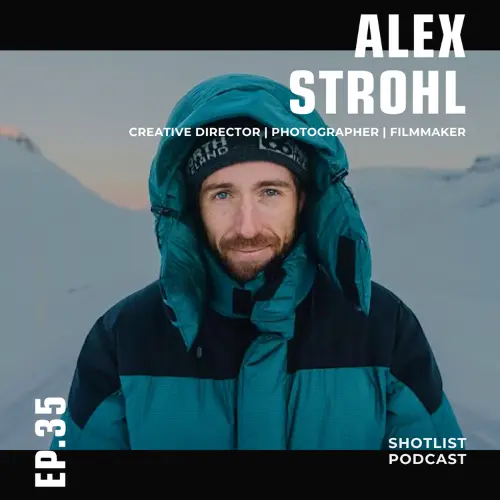
Episode 35 · February 13, 2025 · 1 hr 22 min
Alex Strohl’s Business Blueprint: 10+ Revenue Streams, 2 Million Followers, and the Value of Knowing Your Worth
with Alex Strohl, Creative Director, Photographer & Filmmaker


If you're stuck on day rates and wondering how people build real freedom with a camera, this one's for you.
Alex went from his first photo sale to Microsoft to 2 million Instagram followers and more than ten revenue streams. It's the longest episode I've done and honestly one of my favourites. We get into the reps it took, knowing your worth, usage rights, and where things are headed with AI.
Key takeaways
- Get out of the time-for-money tier. Alex moved himself into the higher tier as soon as he could, where you can charge a creative fee instead of just a day rate.
- Diversify how you earn. Brand partnerships, retreats, online education, an agency. Each stream makes the others less scary when one dries up.
- Self-worth shows up in your pricing. How you value yourself affects what you charge and how you handle usage rights. Negotiate like it matters, because it does.
- The reps come before the luck. Routines and putting in the work set Alex up for the lucky moments to land.
- Find your people. Long-term relationships and accountability partners have driven his biggest opportunities.
“I didn't want to just trade time for money. If you can put yourself as soon as you can into the higher tier, you can actually charge a creative fee.”
Alex Strohl
Try this today
List every way you could earn from what you already know.
Workshops, presets, a course, consulting, licensing old work. Write ten ideas, even bad ones. Pick one you could test in the next 90 days.
Chapters
- Building a Career Behind the Lens
- Photography as Freedom
- Transitioning from Agency to Personal Projects
- Finding Your Tribe in the Creative Industry
- Future Trends in the Creative Industry
- Building Meaningful Relationships
- The Power of Accountability Partners
Connect with Alex
Connect with Marshal
More episodes like this
Transcript generated automatically, with names corrected. It may contain small errors.
I didn't want to just trade time for money. I think that there is a need for that and sort of the most tiers of photography and filmmaking. But if you can put yourself as soon as you can into the higher tier, you can actually charge a creative fee. Hello and welcome to another episode of SHOTLIST where we talk about how to make a life and a living behind the lens. I'm cinematographer and photographer Marshal Chupa and today I'm speaking with creative director, photographer and filmmaker Alex Stroll. In this episode Alex and I dive into the incredible amount of reps and a bit of luck it took him to get to 2 million Subs on Instagram, 10 different revenue streams Alex has created for himself in the creative industry, how self worth plays a big role in how much money you can earn as a creative, and where he thinks things are headed as we enter into this next unknown season of AI. Alex has been someone who has led the charge on so many different facets of the industry such as the influencer marketing space, both on the agency side and as a photographer himself. Creating insightful online education content on YouTube and through paid courses.
Shooting large scale campaigns for brands and now building a second agency. This is the longest podcast episode I think I've done to date and honestly one of my favorites as we dove into some very important points around the business side of how we make a living doing what we love. Let's dive in. Alex, thanks so much for coming on the show today. Appreciate you being here. Thank you. So for people who don't know who you are, which they probably should know if they've haven't lived under a rock and they're listening to this podcast, can you give me a little synopsis or brief overview of of who you are and what you're up to? Yeah, You know, I've spent the last 12 years of my life being, well, yeah, the last 12 years being a professional photographer, really filmmaker, well into traditional filmmaking sense actually.
So I enjoy all parts of the filmmaking process, not just the directing. So I prefer to say, you know, sounds cooler to say director. So I do direct some stuff, but I enjoy just also filmmaking, you know, take a camera, make something out of it, edit it and share it. So that's also been a great part of my life making YouTube films. You know, I think that the focus of of my life, you know, photography has been the path that has allowed me to build freedom, right? I mean, at the end of the day, all I wanted was freedom. And I always talk about this, but it's just the the best tool I found to be free. I kind of fell into it. I never planned it out like that, but photography was the best path to freedom for me. That's what I've been up to, just trying to live a good life knowing that they can be the last one.
So I try to think about about that every day. Yeah. And I like to jump like straight into the topic of of putting in the work. And I say that because when I was doing a bit of research yesterday and you know, you look at your Instagram profile, you see, OK, 2 million Subs. But the number that was actually intriguing to me was the number left of that. And that was 3000 posts. And when I looked at that, and if I was to equivalent someone who walked into a gym and did 3000 days in the gym, they're jacked, you know, like they've put in the work. So you when I look at what you've done, it's not without an extreme amount of reps and hard work. And for fun, I did the math you 3000 / 365 days. That's 8.2 years of posting every day and having content and showing that to the world.
I don't know if you ever looked at that number. Jesus, no. But 8. Years. Wow. 8.2 yeah. 10,000 hour rule. Yeah. So when it comes to reps, I mean, when people look at high numbers of Subs and all that kind of stuff, it's just like, I think the important part is also look at reps. And so looking at all of that, I mean, what has driven you to put in that many reps? Because that's insane. It's funny because I've deleted a few photos over the years so maybe there's actually more reps but honestly Instagram is just the tip of the iceberg. Like the archive, it's got like 300,000 photos, 60 something TB and counting. Like it's starting to be an issue. It's just too much stuff. Like I can't even go through it. It's a tool and photography has always been a tool for mad memory because I live so many different things that I couldn't remember it all.
So thankfully I've got photos to remember. I also have got terrible memory for this kind of stuff, right? I couldn't tell you where it was last year at this time. And you know, three years ago, man, I completely lost. But I think what's pushed me to put the amount of reps is nothing glamorous. It's just the old monkey trick. You know, where you do something and there's a feedback from it, right? You press a button and something happens. So social media has been was built that way in the sense that it rewarded people who used it. And like I said, I fell into it. My plan was my plan was to share photos. I was happy to shoot. I'm a bit obsessive, I have to admit. So when I got into it, I started. The funny thing is, I started photos way before Instagram. And I know it sounds cool to say that, but when I say way before is like, you know, it's not that.
It's like the flicker days. I didn't grew up in a newsroom shooting film. I wish I did, but I'm just too young for that. Yeah, I'm getting 35 S Yeah, Flickr days shooting my 18 millimeter wide ass lens with a polarizer on at sunrise in random places, right. Just trying to see what came out of it and then playing with them on Photoshop because there wasn't any Lightroom. So what motivated me really, again, is what photography enabled me to do. If I put 10% of the, of that amount of photos, 300, on a website that nobody ever looked at, probably I would have stopped at 300. Right, Right. Like it's, I want to be transparent and honest. I was incredibly lucky to be at the right time and the right place.
Yeah. So this is a segue, but I was thinking about it today, so I'll make it quick. The sort of social media for creators slash influencers back in the early days, I mean 20/14/15 it was like a party, very select party on some block. You could hear the music far away. Very select people will be there. Everybody was getting drunk slash rich, you know, drunk be equaling rich in my metaphor. And then came 2019-2020 changes of essentially it stopped being chronological, right? That was 20/17/2018 like the feed stopped being chronological to a more sort of ad friendly format, right. Because these guys wanted to monetize at Facebook and that's when the hangover, that's why it was the hangover at the party. People were waking up headache like what's going on? And I, it's not the same.
And now we're completely past that 2024-2025. The room's empty, there's four people there. Everybody's left to find some other party. A few people who are here are trying to get drunk on like 0% beer, right? That's my metaphor. So it's like it's not working anymore for, you know, that's your mindset. So that's my metaphor today. I was thinking about today. It's like, man, this is the phases we've been through. But yeah, so again, I just want to say I've been incredibly lucky to to be here at the right place by the time and and that's fueled me to kept to keep going, right. Yeah, that makes sense. And that kind of leads into my next point, though. It was like, so I'm, I'm friends with Callum Snape, who I know you, you know, and I remember speaking with him and he, he said you were the one that encouraged him to start posting every day on Instagram back when it was the cowboy days before, like you said, before everything changed.
And again, was this just like, oh, I'm posting on Flickr one day and Instagram's the new Flickr, so I'm going to start posting. Or was there some sort of a, a nudge or like you had some sort of like how did you know that being consistent in that place over and over was going to be something of value or you didn't and got lucky? Like how does that? How did that begin in the very beginning? I don't think I knew. I didn't know. I just liked using it every day. Back then you'd follow 30 people, so you'd go through your feed and by 10:00 AM you'd be done. You'd see, you'd seen everything, so you'd be sitting on your thumbs for the rest of the day. And so you're like, well, I'd better share something, you know, make the other people see something because everybody's waiting for something to happen now, right? There was no unlimited content. It was just like you made it to the end of the feed you cut. So that was one thing. And there's also the fact that I'm very routine oriented. So after dinner, you know, we'd do the dishes with Andrea and I would sit down on whatever rental house chair there was club chair. Remember this club chair Montana? I would sit there and I would try to come up with a caption and I would pair that caption with a photo, you know, so it was like a backwards process.
I would really give importance to the caption because I just wanted to share kind of, I don't know, some, some thought I was making content talking about photography for photographers. I would just feel like writing stuff and find a photo. You know, I'd be, I, I would shoot at every almost every day, 2020, 12 to 2018, nineteen, 5-6 years of almost shooting every day. So I'd have tons of content. I'd be like, man, let's get this stuff out. What else am I doing? You know, you have to remember, you have to imagine I'm working 60-70 days a year at that time. The hell am I doing the rest of the time, dude? And when you say 6077 days a year, what else are you doing or how does that, what did your life still look like then? Oh, I'm really lazy. I'm not doing anything.
You know, my goal was to get big jobs for good clients, get great, great rates, and then chill, right? I'd be on or off working. So obviously I'd be frantically pitching people and things like that. But that wouldn't take that much. You know, out of the 365 days, I would work seventy of those in the field shooting for clients. And then after that, I'm just going to pitching stuff to people. And then when you're pitching concepts to brands, you need new photos to put in your deck. You just go into your archive and then, yeah, you have ideas and you're like, let me share that stuff. Let's rewind. How far were you a working photographer before Instagram came in this whole this whole other version showed up of of your life? I wasn't this is for me.
The the thing that happens is that I would just be lucky. When I was working, I was studying in Quebec in a newspaper. People know this story, but I was working in a newspaper. They hired me to be the video editor because my friend was the graphic designer. Big newspaper in Quebec, it's called the Soleil, the Sun kind of cure big local newspaper, you know, with like 200 people on staff and back then and they're looking for a video editor and they're like, you know, this guy, my friend is like this guy knows how to edit video. I'm like, I guess I do. So I just went there, told that to the editor in chief and the army. So I was the video editor, you know, when I was wasn't in school. And so I was already making good money as a video editor while I was studying. So it was great. I was going to the field two days with a journalist and edit at night, go to school, you know, you could build your own schedule. For me, that was new too.
And this is, I want to mention this because I first went to school in Europe, that's where I'm from in France. And then you don't get to build your schedule. The schedule was the schedule. So 9:00 to 5:00. Do you have school every day even at a private school design school? When I went to Canada to study at a public university, they're like, build your schedule. I'm like, what? So I just built my schedule to obviously go to school three days a week and have the rest of the time to go shoot photos, work. So I was already a working guy at 1920. I was already making a salary from editing video for this newspaper and then out of the blue this was the breakthrough for me like as this like Microsoft bought this photo from from me that I had put on 500 pixel 500 PX Toronto based flicker competitor back then and I think they bought it for 50 grand. So wow, so significant as a.
Yeah, as a 20 year old, you're like what? Shoot. So then right, I'm out. I tell Andrea we're out. You know, this is the end of the season anyways. I just have one more credit to do at this school. I'm not coming back next year by newspaper, by everybody. We're hitting the road here. So I took that money. I took that money to just shoot a portfolio. I mean, just to travel with Andrea. For years we went everywhere, all across the world, shot photos, have fun. And that gave me a good archive of photos that I just started sharing on social. So it's just like a perfect storm for me. Well, yeah, that's like that's like that one little tipping point moment that you weren't expecting, but then allows the freedom for like almost cracking the the shell of what's possible moving forward. So I feel like that moment probably showed you what's possible. Totally because I had no idea I never I didn't want to be a photographer back then you I was just putting photos on Instagram one point O their square stuff with the toaster filter, Nashville filter.
You know, that's fun, a shooting on the iPhone for Instagram, because that was the rule back then. And then I was, I wanted to be a graphic designer, an art director, and that's what I was studying. That's what I went to school for. And then these guys are like, you know, you want your photo, your photo's a good photo. I'm like, really, huh. There's money in this field. Cool. I shall be a photographer. That's how it went. Because I, I, I would build websites for local clients, like shops, you know, and it would be such a pain in the ass because everybody had an opinion on a website or on a logo. I don't know, photo people were like, do your thing. Much more freedom. Coming back to that very first thing, you said you chose this for freedom. Yeah, absolutely. So you had this moment, you're traveling the world, you got a, you know, $50,000 insertion. Your mind is now open to the possibility of photography could be lucrative and create freedom in my life.
What was that next step between that? Was it like a cool I'm all in now on photography and then the rise of Instagram happens or what was that piece in between there? We moved to Vancouver. I remember we always wanted to be. I always wanted to be in Los Angeles. How was my dream? My aunt Junie lives there. I would spend summers with her when I was young, like 10 year old. I would take the plane by myself and spend the summer with her. Just my parents would send me there, see you and I would love it. And you know, I just came back with blue hair and skateboarding, right? That's what you said, Blue spiky hair and huge baggy pants. So I was like sold on the American Dream at 1010 years old. I knew already that was me because again, I thought it was cool. I just wanted to do cool stuff. I wasn't really cool, but I wanted to do cool stuff.
I knew that. So with that in mind, we moved. So that's just to give you, you know, zoom out. That's where we moved to Vancouver, because to me, it was a better, easier way to get slowly to America, to the United States of America. And when I went to Vancouver, I didn't know I wanted to be a photographer still. I had no idea. But I met my old friend Maurice Lee, who was a venture capitalist. Nobody knows how old Maurice Lee is, but he was older than me for sure. Way older. I don't know how. He's probably 100 now, but you couldn't tell if you saw him. But he was also shooting photos. He just came back from shooting the royal wedding back then, you know, Canadian. Yeah, the royal wedding because they honeymooned somewhere. Yeah. Yeah. So he was kind of high on that gig. And he's like, man, I'm dealt with venture capital. I'm going to sell my shit and do photos. I'm like, great.
And then I always, I've always had to sort of pass on the business of it. And I was like, all these, you know, we would do instant meets back then in Vancouver. It sounds kind of lame, but it was really fun. You just meet people and shoot photos. And out of the 100 people you'd meet, you'd keep somebody one one person's phone number every time. You're like you, you know, you and I can hang and hang out. I don't know about the other 99 people, but it's still cool you get to hang out. So I told Maurice we should do an agency. We should represent all these guys who come to these Insta meets because they all have an audience. You know, they're all building their audiences and they're getting ripped off by brands. Like they're getting free sweatshirts to do stuff. I've already told this story about to make it quick. It's like, let's do an agency and let's represent all this talent because they have no idea how to sell themselves. So you know how to yeah, you're the VC guy. You know how to make tags. You know how to talk with boardrooms. I don't really, but I can talk to the to the guys. They're like me, right?
You talk to the business guys, I'll talk to the, to the creators. I'll tell them like, we'll Rep them, we'll make them some money. All I wanted was for these guys to make money. And then so we just, you know, as any agency, you take a Commission on the gigs and you kind of go out pitch these guys. That was my the closest thing I had to being a photographer at the time. So you transition to an an agency model. Now how much time did that take of yours? Are you just like, OK, now I'm representing all these photographers and not shooting or how? How did that look? We rented an office at this fancy building in Vancouver overlooking the sea, and I would just walk there every morning for a year. Maurice and I would meet up there, go buy wine, candies, the local store downstairs. He's a very candy Connie, Sir. And you know, we'd go for lunch every day. You know, he was like my brother at the time. Like we were just totally into it day in, day out. Maurice had no kids, so he had time to do this kind of stuff. And we were just brainstorming constantly. How can we kind of achieve world dominance? That's the joke.
It's like, how can we make this bigger and better? That's what we were doing. It took a lot of my time. 1 full year. So what happened is that I ended up going on a lot of the gigs that I would put people into as a quote UN quote producer. I was just glorified driver, you know, make sure everybody's having a good time. The clients are there, being the liaison to the clients and all these guys. You know, back then I had a lot of, I still have a lot of items. I was like, man, I want to meet this person. I want to meet this person. I always looked up to people like because I've never had an older brother who I lived with. I have an older brother, but he was way too old to live with us. He didn't grow up with me. So I always had like looked for this brotherly figure as like, man, this is the person I want to know. I want to learn from this person. So I had all these American based photographers. I was like, these guys are good. I want to meet up.
I want to meet up with these guys. I was like Chris Burgard, there's Jared Chambers, there's all the old cool school names, Chris Ozer, Michael O'Neill, OG. So if you remember these guys, but early days, I was like, I want to bring these guys on gigs in Canada. And what was really taking off at the time is tourism. Like tourism just got word of Instagram and they're like, spend it all on social media. He has like a fee for him. So that's how we met our third partner, Rishad Daruwalla, who was the marketing guy at Tourism Canada, Digital marketing guy. I mean, it wasn't, it wasn't even called digital marketing back then. I think it was called social media. Yeah. And then we pitched him all his ideas to bring these these people from the US to the Yukon to Alberta and make some sick photos. So these guys have even way more audiences than I had because they were like in the US, they're close to Instagram, they're kind of connected to the people at the company. So they had, you know, if I had the temporary had 30,000 followers, they had 300,000 followers already. So I would just leverage that for the clients, our clients and be like, these guys will come and photograph EU Conn, I'll come with them and make sure everybody's happy. So I ended up being associated with all these trips and these guys would tag me in photos.
I would sometimes be the talent for photos because they don't shooting photos. I'm sitting there with my jacket on. Yeah, Yeah. So I ended up growing the audience thanks to that. Thanks to all these guys, too. That was never my goal, but it was a byproduct. And all these guys would be like, thanks, Alex, for this and that. And that's how it happened. Right. And the cross pollination of everything on. On the energy you couldn't. You couldn't top. That energy was unstoppable. Right. So then what was the point where you were like, cool, I'm being Leonze, you know, running his agency? Like, what was the transition point to be like? I believe it's called Stan Wandra, correct? Yeah, yeah. Correct. Yeah. Stan Wandra. Yeah. So what was that piece? Where are you? Have you left that like is that still going in the background? Have other partners taking that over? No, to zoom out while all this is going on, I'm still trying to entry up. My wife is was born in the US, She's French born in the US, so she has an American passport. My childhood dream was to live in the US and somehow we met up in the world and things happened. I was like, so she's like you, her mother, I think was like you could get married with Alex.
You guys get up, she needs a passport. You guys all move to the US, right? I'm like, let's do it. So I'm doing all these visa petitions. It's called AK1 visa. You know, like the joke was like, oh, you're my green card. Why right for her? Never, never was the case, but it was just my joke to her. So as soon as I, we were able to do that, you know, I had my eyes on, on the, on the ball, which was LA, California. So as soon as all this paperwork that took two years, we take two years in Vancouver for the paperwork to be done. Also enjoyed Vancouver really very much. But I was never losing sight of what was the goal. You know, I'm pretty focused with the goal. So once we got the permission to go there and get married, boom, we're out. We took all of our shit into a rental car and drove it down to LA. That was the pivot in 2014.
And so from then it became photography after that. Yeah, once I was there, I'll be in already all these contacts. And honestly, because my audience has grown so much in those two years, I was just getting reached out to go shoot and be the yeah, the person shooting. Be the person. Yeah, so Maurice ended up being, you know what? I'll represent you. You go shoot. All right? Yeah. So that's what happened. And it's like, so it kind of happened by accident. You know, I remember the first gig I did once we moved to LA. How do so many back-to-back gigs? You know, back then you're like young, you take it all, you do it all hungry. And first one was it was pretty sick. It was like Land Rover as a Land Rover that had this platform called well-storied.com and it was just about owner stories of Land Rovers. So they want to meet you. She was the agency was called Gray, which is probably still around.
Yeah, they want to meet you. Shoot this this feature and for social anywhere in California. And what's what's pretty striking is that everybody would give me total freedom and creativity, which was a pain in the ass, to be honest, still is. I mean pros and cons. Everything's possible. Everything's possible. You kind of end up being stuck in the rut of the same things. But back then, I didn't care. It's like, this is sweet. Yeah. We'll rent this car and go to the desert. And what was it? We went to the Sierra. Yeah. And shoot that at the Sierra. Yeah. These photos are still pretty iconic when I look at them. It worked out great. That was my first gig when I moved to the US. Yeah, I could see how that all kind of came together naturally and cohesively. It feels looking back, yeah, but when you're doing it, you have no idea what's you know. Of course, yeah. You don't see, you don't see the end of the tunnel. You don't see where it's going.
You just keep going. You know, you got that hustle to drive and it sounds like you, you know how to put in the reps If you do enough reps, I think it's impossible for something not to happen. So. Oh. Yeah, the reps we do, that's for sure. So when we originally spoke an e-mail about doing this podcast and I quote you, you mentioned I feel it is a very inspiring time, but there are also a lot of changes for us in the industry and it's important to talk about them. So we're here. Let's talk about them. I'll start with a metaphor. It's very timely. So if you follow the stock market, you know, Target and Walmart both released American, huge American retailers. If you're in Europe or Asia, Target and Walmart released their earnings right now at the same time. And it was really a tale of two different retailers. So Target is blaming the industries like people are not spending enough money and stock went down 20%. They're outgrowing they're, you know, shit. Shit's bad.
Walmart crushing it, that people are spending tons of money, We're happy. So you have one blaming the macroeconomics and another one saying the macroeconomics are good. So what do you make out of that? And I think it's a similar story where we are. So I want to preface it with that because everybody wants to be a influencer and create work for the Internet. I get that. There's a great piece on The Economist about that, you know, but the saturation of it and you know what the future is like, so should look it up. It's called Why Everybody Wants to Be an Influencer. I linked it in my newsletter, by the way, shout out to my newsletter. Yeah. So to be there's a pessimistic side of me and the optimistic side of it. The pessimistic side is like all this shit is going down with AI. You will be right now.
AI is terrible at making photos. But you know, in six months, what could it do? And in 12 months, crazy, who knows? So I'll take the example of a friend who launched a product. It was like a bag and he didn't even bother doing product photos. He's like, you know what? This, this, this kid did a render of it that's way better than any photo. You can zoom in and he zoomed in there, you can see every bit of fabric rendered and it looks very photographical, right? So that kid did that using obviously, you know, a lot of knowledge, but once AI figures how to do that stuff, it's not very hard. If you you could learn that, then there'll be no need for product photography. It's like we're not shooting any product photos. This is way better and nobody can tell. You couldn't tell. Then once it, you know, it could start cannibalizing a bunch of stuff.
So there's the sort of the quote UN quote threat of AI. There's some people that everybody loves to lead with the threat of AI. And then there's the macroeconomics of it, which is like, you can blame, you know, brands, well, brands, brand marketers, there's always people at brands have since never a brand somebody had a brand has has done their share of that's kind of work with creators and and maybe they're spending less because they've had bad experiences because it's time to chase something else that's shiny. So I know that a lot of people in the industry have had pretty bad years the last few years. And then obviously there's the odd man out. You know, there's always the, the people who were like, you know, the, the 2%, the 3% of specialists were like, no, and this was a great year. I'm speaking about specialist automotive guys or whatever. If you have a specialty, you're good for now, right? That's fine.
So this is the rise of the specialist, I think, and I think it will be even more important. So for generous, it's getting harder. Let's say it started getting harder in 2019, just to be fair, right? Like it's not like we couldn't see this coming. But I think the pandemic threw, you know, threw some problem. Like that was really like the factor of a lot of people. They started to stop hustling and then they it was hard for them to recover from that, right? The last momentum, last all momentum and from them has been hard. So there's my pessimistic side. And then when I say that, I'm like, you're just looking for excuses, right? And then the optimistic side is like, there's a bunch of opportunities out there. You could start looking for other parties, quote UN quote. You could do focus on other channels, but namely channels where you own the audience. That's why I've been hard on my sub stack because I own every single person in the audience.
I mean, I own quote UN quote, right? Like I have the direct contact to this person. Can you imagine if I had direct contact to all 2 million people who chose to follow me? I'd have 2 million emails. I'd be in a different place. You'd be talking to me from my boat at the end. Yeah, the power of a mailing list is something incredible, I do know that. Oh yeah. And we're actually starting a business around that pretty soon. It's called Studio FRR. OK. That was one of my future questions. I'm so only brought it up. What? What's the vision for that? So Studio FRR is it's basically the, the premise is that the cost of acquisition CAC for brands cost of acquisition means the cost to acquire a customer is very high and it doesn't it's higher than the lifetime value of said customer. So this LTV as a marketers call it. So essentially bunch of people like companies are spending more money on acquiring a customer than the money it will bring. So that's broken already.
Yeah, yeah. So there's there's pretty good data about that if you do some research. But that's the fact that have to have the traffic on the Internet is bots. 80% of people don't use tracker, you know, use trackers, I mean blocking to block trackers on their phones. So you can't really track sales even with the Facebook pixel. So this whole sort of the whole sort of economics built around this form of advertising where you pay a bunch of money to Meta or Google is broken. So we realized that. And I mean, man, like brands are constantly spending money to reacquire the customers they already have, right? Yeah. But 1,000,000 followers, your brand, you have a million followers. You paid for those, man. You put so much content, you fed this content machine for years, spent 1,000,000 millions, 10s, hundreds of millions perhaps on content, right Sing about GE.
They used to rock Instagram. They spent all that money on it and then they got nothing to show for it because they don't, you know, they have to now if they want to address everybody, they have to pay because otherwise only 2% of their people will see it. So if they're cool with that, they can keep going with that. But we're trying to, you know, but we're trying to find a solution and it's focusing on channels where you have direct access to the audience, whether it's in person, events, even apps like Strava will give you, if you market on Strava, you can have access to the audience newsletter, focusing on newsletter, proper newsletters, not like there's transactional e-mail marketing and there's newsletters which we differentiate. So essentially we're doing all the deep thinking for brands in the newsletters. You know, we run the brands newsletter, we'll do all the deep thinking, come up with a few stories per week, month. And from that bulk of deep thinking, we came up with assets that feed other channels.
Sure, you can use those assets for social media, that's fine. But that's not where the sort of the money spent, this money spent on the big thinking where real brand, real connections with consumers are made. And for us, it's three of the newsletter. Yeah, that makes a lot of sense to be honest. And I've definitely learned a few business lessons in that. So I'm a bit, my biggest successes have been partnering with people with massive mailing lists and but also I've experimented with partnering with people with massive followings on Instagram and falling absolutely flat. So I think I have been given the insight of what you're speaking to, you know, and, and I totally understand that a mailing list is extremely powerful, whereas a following, like you just said, they can shut off that button anytime on their own platform where the mailing list is always, those are your people that you're speaking directly to that person in their inbox. And no one's ever going to get rid of their e-mail. You know, that's just how we operate as humans these days. So what next platform it is, who knows? So I think you're definitely speaking to some powerful things there.
And in that note, you seem to have your finger on the pulse, whether that be back in Instagram days or right now. So with that, where do you think things are going? My prediction prediction for the for 2025, I think we'll see the spending on social, you know, can decrease as it's done past years in general. The thing is to do what right. If you ask brand marketers like, yeah, spend money and put it where right, they need to spend it. So that's why we're coming up with solutions, so they can spend somewhere else on something perhaps wiser, not chasing the wrong things. So obviously my prediction and perhaps the fact that I can illustrate that is the fact that Patagonia and Tony Caldwell are starting a newsletter together. Like he's going to be tell me he's going to be writing a newsletter for Patagonia. I think that hints at where we're going. You know, it's like to me, that's one of the things I'm like, yes, good.
This is the the shift is happening, right? So obviously podcasting also think it's a strong outlet because it's not too filtered for now, like Spotify and Apple going to deliver it. I think where you should correct me, but I think you don't get there's really nobody in between you and the audience when you share your stuff. Just a feed, right? RSS. Feed. Yeah, straight, straight up. My prediction is that we will see more spending in places where people, brands, marketers can control the audience. And I'm really pushing, I'm really bullish on also in person events and personally also we will be more bullish in private label stuff. So meaning brands making, you know, let's say you're not a clothing brand, you're just, I don't know what you are. You make cars, whatever. What if you developed, you know, and you're seeing this with Porsche and Emily Hondor, you know, making a custom jacket for the 9/11 together. That to me is private label Porsche jacket with Emily Hondor.
That's like Porsche owners galore, right? So, you know, Porsche doesn't care about the money that those jackets will make. They just want to have this connection with the, the the the owners, right? That's like, sweet, I'm going to send you this jacket. Can you imagine, Porsche owner, you get this jacket sent to you for free or you buy it for, you know, well, whatever it is, I think that kind of thinking is brilliant and we'll see more of that. OK, so we've kind of got like really far down attention of the business side, which I freaking love and coming back to like creatives who are listening to this, people who are want to hold a camera for a living. Yeah. How can we help? I guess now what do? What do you think is important? We talk about as a creative community and how we could help each other with all of this. In these matters, I think it's important to always start with empathy, right? I feel, I feel for both sides. I feel for brand marketers kind of needing to spend their ad dollars on ads so they can keep making those sales. I understand like you need to have the Black Friday stuff, right?
Like if you're e-commerce retailer, you kind of bleed money all year and then you make all your money in this in this month. So you have to run a bunch of sales and kind of feed in the machine. But are you chasing the right stuff? So when it comes to the community photography community, I have to give advice. I would just would like most people to be focusing on direct experiences with our audience, right? Not sort of empire building, which is like, let's get the most amount of audiences as fast as possible, but more in creating meaningful relationships. That's that's what I hope will happen. Not super shiny though. That's like doing, you know, that's like eating your vegetables, right? It's more fun to just try to make viral reels, right? And I just don't know what those reels translate into, right? Let's see, like any brand can have a million views on their reel if they pay for it.
But what's next? Like what you show that to your boss. Sweet, you got 1,000,000 views. Did you did you move the needle? Well, we think so. We don't know. So I hope there's going to be more, more meaningful work, but you know, help each other. I'm always big on collabs, right? Like I'd like to collaborate with more people on my newsletter. I'm trying to bring people in, you know, do interviews or meet, learn from other photographers and share their what I've learned from them. So that to me I find extremely helpful and people resonate with that a lot. So I know that photography is sort of feels like this solo endeavor, but there's really only upside to doing a collab with some somebody else, whether it's through photos or written form or a video together. So I think that's the most powerful thing we can do is just collabs. Yeah, even just two days ago I did a live event in Whistler, you know, small, it's called Coffee and Creatives. And it was just like, you know, I think 55 people there in a small room and I was interviewing a panel of three producers, you know, speaking to pitching and production. And just like the energy in that room, the connections in that room, like, thank God we can get off the screens for a second and just have human connection and, and enjoy just sharing our journeys and like troubles and like, you know, being connected again.
So I think I definitely share your vision for, for this and is also why I started this podcast. Is that the piece in around how I learned was through these connections through 1 to one beer or coffee or whatever it is. Like those were the moments that actually shaped my career like that. So that is why I started this podcast because for me, you know, I dropped out of photography school semester and being like, I can't learn from a chalkboard. Like this isn't how I do it. And I learned more from 1:00 person assisting them in one day than I did in the whole semester of school is like, well, what am I doing? I'm just going to go assist people. I'm going to, I'm going to go take them out for dinner, whatever the heck it is. So that is what inspired this podcast. So sounds like we resonate on that. Yeah, and I think you bring up a good point. It's like doing hosting these panels is sort of masterminds is so powerful. So if you have a space, you know, or a big living room, you know, what's stopping you from hosting other creatives from around the block?
You know, for just some beaters, even. Coming back to your party metaphor, right? Yeah, yeah, yeah, yeah. Starting new parties, Yeah, I think that that's huge. Like also the, you know, getting coached, hiring mentors is always important. I encourage everybody to, you know, spend money on themselves, like continuing continued personal development, that's what mountain guys call it. So you're going to continue spending on yourself and find an accountability partner I would say as well. That's a good tip. Actually, that's a really good tip. Yeah, yeah. I think it's super powerful if you can find somebody who you look up to who knows your problems. Not too much, not your best friend, but somebody who knows some of your problems but can bring an outside perspective. See if they you can be their partner and they can be your accountability partner.
Talk every two weeks. Totally. Actually, I just joined a mastermind with three other guys and it's just, we're meeting once a month. On the second week though, we check in just, you know, video call and it's just holding each other accountable to like where we're going, what's the vision, where we like checking in. And it's been actually crazy. So for me, getting up in the mornings is challenging. I've never been a morning guy, but since we started this mastermind like one month ago, you know, I was like, Hey, my goal is 6:00 AM alarm goes off and I'm then diving into building a structure for my day, having that on the calendar. And I'm moving into like vision, you know, doing some visioning on journaling and then I'm diving into work. I'm at my desk by like 8. And without a doubt, it's just been, I've been so focused and so dialed. And honestly, the, the reason I can say that's happened is because I had accountability.
I was like, I literally told one of the guys, I said I have to message you every morning, my scheduled plan of what I'm doing blocked out on the calendar and before 7, before 7 or I'm doing 50 push ups. And so I think it's just like if it's a simple thing of like, oh shit, I'm going to have to do. I have to do the thing because someone else is going to notice. And it's so simple, but it actually works. So just going to throw that out there. 50 push ups in a row. I mean, if you can, yes. So yeah, yeah, depending on my my energy, I can, you know, you can hit it or not. Yeah. That's how it really is. That's really good. Speaking of like the education side of things, I just kind of bashed photo and film school. Like what are your thoughts on that from an education perspective? Because you really dove into and I would say when things weren't, when there wasn't much on the Internet in regards to like how to learn how to do this stuff.
You were filming behind the scenes vlogs and you started putting and pushing out courses. Like how do you think creatives should learn these days? Like what is the most bang for your buck when it comes to like should they go to film photo school or should they be? Where should they be tapping into? Well, I don't know which U.S. President said that, but my answer is yes. So I love that one. So I'd say do it all as much as you can. I don't want to discredit school. To me, it's really helped me a lot, especially if I had stayed where I studied, I'd have a really strong network there, right? Like, so pick, why is it where you're going to study? Because if you stay there, it's going to be hugely powerful. All these guys gals you study with will go and start businesses and you'll be working with them. For the rest of your lives, some of them.
So don't try to go study somewhere that you're not going to live in and it's hard to know your life's plan, but try to pick up a good place to study if you can afford or you know, you can get a good loan. I think that higher education at prestigious schools will always be better for your resume. Like that's just the community you get there is very powerful. I think it's a worthwhile investment that I didn't do because we couldn't afford it. But if you can, obviously you're probably already doing that. But, you know, those schools I think are very still very powerful. And you know, it's, it's still a cast, still a cast thing. But if you're a member of the cast, it's good. Right. You know, I'm not judging it, I'm just saying it's, it's good to be a member of that cast if you can. It's helped you tremendously. It would help me tremendously. Now, I'd say yes, for sure. Study film school, study photography, but then hope that it's going to solve every problem.
You'll get maybe 20% of what you need to get, but you'll get friends. You'll get routine hygiene, you'll learn things you want to learn somewhere else. Like I learned a lot of Photoshop stuff that I still use nowadays from my old photography teacher. You know who that's like habits, You know the way you use. Like my proficiency with those tools came up from university. I'm really fast on any of those Adobe tools and that just comes from doing it early. So that said, obviously you always should also intern with people, assist people. The so you said the best bang for your buck, the best bang for your buck is to intern with somebody like my insurance. Most of them do really well. Like, yeah, I'm really, I don't want to use the proud, the word proud.
So it could be belittling, but I'm really happy of, you know, where they are. And I'm not saying it's thanks to me, but they've got really good things from the internship that they're still using now. But again, the interns you hire are the ones that anyways have the right thing already, right? So it's kind of a biased, skewed thing, but because you get a lot of interesting applications, but you only hire a few, so you're already getting the the winners. Yeah. And obviously there's only so many assistants or yeah, people you can hire being Alex, you know, and there's only so many professional and I think that's one thing. OK, so let me just zoom that back. What are the qualifications? What do you, what should people have in place in order to kind of be able to assist and step into that role and really take advantage of that? Well, I'll say that to you, you know, if you're out there listening to this and you want to be an intern for somebody or an assistant, listen carefully because I've gotten so many interesting applications and 99% of them say the same shit.
Here's my resume on a war doc Don't care. Great get now here's My Portfolio on my website. Don't care. Two things I already don't care about because I'm not hiring you to be a photographer and I'm not hiring you for your resume. I'm hiring for personality, you know, not skills. I'm hiring for fit. So all I want to know is can you and I have a coffee and have a, you know, a decent moment because I only want to work with people I can hang out with. And I think that's probably for a lot of people. So if you can show somebody on an e-mail, I made you this video, whatever, I'll carry your heavy fucking cameras. Just make a joke. But what you want from an intern is somebody who's going to do everything you're not doing. And they just seem to forget that. They're like, yeah, I'm a real good photographer, got all the skills and cool, but that's not why you're happy. You're not hired to do that.
You're just hired to do all the stuff that's not glamorous just so you have a chance, the privilege, the opportunity to learn, to learn when it's time to learn, when we're doing a shoot and you're actually on the go and you're doing stuff that's useful and fun for your portfolio. You're getting to Add all these brands to your portfolio. You're going to get a lot of value. But you need to show whoever's hiring you that you can walk the line. That if the trifle was forgotten in the car because you forgot it or I forgot it and it's, you know, an hour down the fucking mountain, you're going to have to go get it. And you better have a good attitude. That's all I need to know. I agree, it's just like understanding and what the role in which you're applying for. Yeah, it's an internship. I've assisted guys when we lived in Australia for a while. I've assisted guys. Terrible assisting.
You know, I really feel for those guys who hired me to be their assistant. I was just hopeless. But I learned a lot on those days of talking to clients, you know, it felt so awkward to see them all looking at screens and tethered. And I'd be putting all those photos on the tethering screen. Yeah, but I learned a lot. So you you're going to be terrible the first times you do it. So you better get some reps from the beginning. Yeah, and if you're lucky enough, someone will give you a chance. You know, I think one of my hacks was offering behind the scenes so early in the days. Like, how do you add value is always. The question I'm asking is just like, you know, instead of just showing up and being like, hire me, it's just like, well, how I can just like here, I'm going to make you some assets that are going to make you look good, help you sell you on your next job. Like I'm, you know, originally to build relationships was like, I don't, I'm not even going to charge.
Like I'll just show up, you know, and that was like the quote UN quote coffee conversation and proving myself like, Hey, look, I'm a good guy to be around. Here's some free assets that can help you build your brand and let me know if you're around like and with no pressure. And so that seemed to be a bit of a kind of an angle I took that was helpful. Yeah, you show your value and there's no risk. Absolutely. So it's clear speaking with you that you are very business minded in the way we think you think about things. And, and I had that assumption from doing my research and like, you know, watching what you've been doing for years. So yesterday I went through and I actually like tried to break down all the business models I could see within your ecosystem. So I'm going to take a stab at listing them out and I want to see if I miss any and then speak to them. So I found 10 nice work. So the things I see you have is obviously #1 like you have a, you have the following so you can do brand deals as an influencer and you have that angle, which I think you know, not everyone has, but you also are a brand ambassador. I see for brands.
I see that you have an agent, so that is helping with usage for your photos. Like so they're dealing with that for you. Syndication, yes. You also have online education so like you know you, I've watched you push out courses and create a bit of a platform at one point with that online education piece. I see you pushing in person retreats now, which are a bit more high ticket, but also like an incredible experience for someone. I see Lightroom presets, so you know, residual income coming in quietly in the back end. That can be once it's made, it's made. I see you selling prints. I see YouTube. So there's probably a little bit of ad revenue, but maybe not much. And then sub stack, which you just talked about, which is your mailing list that you now I saw as I subscribed yesterday. I see you have tiers. You have tiers that you can sign up for and different price points. And now full circle, you now there's Stan wander, of course, and now FRR, you know, being the the new version of the next agency.
So how'd I do he's. Great. Nice work. Yeah, nice work. Yeah, that's really, really valuable. You missed what you can't see. You missed the. You missed the bottom of the iceberg. You missed what's under the. You just saw the top of the iceberg. Yeah. The bottom of the iceberg is consulting. So I've been the director of content for this project in Colorado called Siena Valley Club. It's a big community real estate development and I've been the director of content for two years and that keeps me busy. One day a week you spend 40 to 50 days there on the ground shooting. And so it's it's sort of my day job that you know, it's not easy to see, but that keeps me really busy. So the rest is kind of nice to have. But that is that is one consulting. So work with Adobe the light from board that's on my website. If you could have missed it, so, and I also put money in some companies as an investor and slash advisor. So I also sometimes get retainers or, and, or equity in those companies.
So if one day there's an exit, you know, I'd say those are the things that are harder to see because it's not like I publicized them. They're just there. But hey, if you have a core brand and you know, you want to want to work together, I'd love to, to see it. I always love to to add value where I can and you know, yeah, work on the strategy with you, so reach out. So then I would say now to to go back to your list. You know, the the way you could see is, yeah, obviously the most fortunate part is having the having the audience that's big that you know, I do a couple times a year, probably a couple of those deals a year depending if they're, I don't, I don't really seek them out. If they come, they come. If they don't come, they don't come. I decline a lot. You'd be funny because a lot of cell phone companies reach out to me.
Why don't you meet you advertise the cameras of their cell phones. But if you segue into #2 as a Canon explorer of light as they call us, well, I can't work with any other camera brands, including phones. So, so that's a big one. That's that's a few of the year that I say no to big paychecks, but you know, get by loyalty Canon. So but I, you know, I they shouldn't, they shouldn't stop reaching out because most of the time another friend shoots it. I'll just send it to somebody else because why not? The I think the latest one was in Bali. I think Taylor Michael Burke did it for the oppo. Yeah, Taylor on the on the pot as well. Yeah, yeah, OK. Well, he just did it. So see, it just always works.
I'll just whoever's on the stand, Wonder Network will get, you know, get those. Oh no, there's brand deals. Well, sorry, there's a brand ambassadors again, those that don't really seek them out, but when it is a really good fit, like Salomon is a French company, I am French, I do run and I do ski. They it's just a no brainer. So we've been together for almost 2 years, going into 3 now and I go shoot UTMB whenever they have ski events with their athletes. I just show up and shoot stuff and share it. It's yeah, I see them in time, you know, a couple times a year now. It's a great relationship. Love the guys that are. Yeah, that's definitely a great side of of what I do. And when it comes to usage, I think this is something that I see when it comes to my friends who are just photographers, you know, they're charging day rates and that's it.
You know, they don't even think about usage. And like, I know that's there's so much money in that part of it. And I think a lot of creatives get overwhelmed with like, how much do I charge? And how would you even approach approach that? How do you write down the contract? And like, there's so many some million questions around that. Like, can you speak to like yeah, usage and photos? Yeah, usage and photos. You know, there's a friend who does all this work for a big pharmaceutical company, a beauty pharmaceutical company. And one day he figured out that in one of his bids that the people who pay for usage are not the people who pay for the shooting. So he started making two bids, big bids for each, and they just paid them for usage. And he wasn't doing that before. And then one day they wanted to buy a photo and he realized it was a different almost arm of the business who bought the photo from him. He's like, hey, that's an example of how it works. He's like, well, guess what?
He's just not included anymore, guys, they'll pay for it. So that's an example. So if companies are very big, there's usually different budgets, different heads working there. And you can totally do that. Yeah, as we never include flat out business in the quotes and this is a Maurice thing, so he makes sure that that's, you know, he's the business arm up there. But yeah, we usage is never sort of morality free forever enjoy unless it's specifically requested. And in that case, we'll be heavily discussed and negotiated. It's happened, you know, a few times. But namely Apple wants that. For example, if you shoot for Apple that just want to own everything, give us the rows. Thank you. Bye, right, but but you know, not everybody wants that. It's also a pain in the ass to do all these bras, right?
People don't want them, but it's also a negotiation factor, right? If somebody wants perpetuity for all medias, well, the quote is this much. Let's say the quote is 100 and then they're like, well, shit, our budget is 50. Well, instead of you being like OK man, you price is 50, but in any negotiation you don't take stuff out for free. This is not like a Teletubbies world. So yeah, OK, you have less budget, that's fine. We will take out licensing then it gives you this huge tool of negotiation and it's real stuff like yeah, sure you want for Prosciuti very expensive. Oh, you only want one year now? Cool, yeah, maybe we can align closer to 50. So make sure that the usage you give and if they don't know what usage they want, then just give a two year usage for the media they want.
If it's for digital, to skip digital and unless a specific request, don't make it because they could come back down the road and be like, you know what, we want to print these photos on, you know, whatever. And I go, you want to put this on your private investor decks and print it and send it out to all the investors? Well, yeah, there's an extra fee, Yeah. Do you have any advice on how to come up with that structure? Because I mean, you have Maurice, I guess kind of doing the business arm, but I think a lot of photographers just are like, I have no clue about this stuff so I don't I won't do it. Like is there any how? Yeah. How do you even begin? You just mentioned a few things, OK, two year social media, but I know what it's about like how do people learn about that dude I. Bet you there's a class on that. I mean if there was, I should find it and link to it because I don't know. I've never found one personally. But or you should make one. We should. Make one, I think go to Creative Live or one of those e-learning speciality websites or YouTube or follow a photo editor also is a good one about sharing that stuff. The bids are always very enlightening in there and you can see how bids are built.
So check out a photo editor on Instagram, Google. I mean, it's I think you can figure that out. You know, Getty used to have this usage calculator too. I don't know if they're still out there, but everybody used it back in the day. Although I find a usage calculator. And if you have no idea, then start guessing or has the brands or be genuine, like you know what, what's your budget for the usage? I don't really know. Yeah, when Microsoft came around, I had no idea how much it was worth, right? They wanted to buy this photo for all these things. You know, the biggest amount I could think about in my head was like $5000, but I didn't say anything. I was like, what's your budget? I'm like, oh, OK, that's your budget. Oh, yeah, OK. Yep. Deal. Right. So I could have missed out on 10X right? So.
You I was very candid about it, so I have no idea. I never sold a photo for this much usage. You want worldwide in perpetuity. A worldwide exclusive for four years exclusive. That's a big one. That's more expensive. Usually you double the quote if it's exclusive. Yeah. So maybe have a had a lesson early on. I did have a lesson early on, so I always ask for the budget. If you don't know, ask. I don't think brands are out there trying to squeeze you in general, in general. I mean, that's. A. That's a. Loaded question or loaded statement? OK, I'd say big companies are not out there to squeeze you. Local coffee shop is maybe not trying to to squeeze you, but they've still got no idea. So don't ask that. All right? Yeah. That makes sense. And when you look at all these like revenue streams, what is the one that you're, I mean, you kind of just said you have almost a job and then all these are extra on top. Like for someone who is just making day rates as a photographer, like, what else should they be thinking about to get out of this feast or famine life cycle? You live in a day rate lifestyle. Well, don't live in a day rate lifestyle, right? No, nothing, full stop.
I'd say don't live in a day rate lifestyle. I've never done that from day one because I never liked the perception of trading time for money. And that just felt, I don't know how to say this just felt a bit not degrading. It's not degrading. I just don't know. I just don't like it. I just just doesn't leave much room for imagination. It's very black or white and creative work is not black or white. I'm like, sure, these guys can pay me for a day, but I'm going to spend who knows how many hours thinking about this shit. And I can't put that in a in a bed because it was like, Oh, I'm going to track the hours. I'm thinking about this project. No, So I was like, you know, to me, this is more like this is how much it costs to be bothered. It is definitely work. And it's it's painful to sit down and sort of bleed out information and thoughts about this project. So Charlie Munger, rest in peace.
He passed a few months ago was big on that. He was and I'm not taking his side or not his side. I just appreciated the fact that he said, sure, we're you know, we're we're rich and but it's not because you're rich that it's easy to give money. And he's talking about him and Warren. It's not because you're rich that it's easy to give money away. This money cost me a lot of pain, sleepless nights to acquire it. It's not like you went and came here for free. So I understand that perspective is like, man, this was this cost me something, whether it's emotional, physical. So I didn't want to just trade time for money. And I think that there is a need for that and sort of the most tiers of photography and filmmaking. But if you can put yourself as soon as you can into the higher tier, create your own space there, and you can actually charge a project fee, creative fee. This is the like when somebody asks me how much it is to do something, it's more like, oh, you want me to go next week? Well, obviously it's more expensive because it's more annoying, right?
Like I'm going to drop everything for this thing. OK, maybe I can do it, maybe I can, but then it's more expensive already, right? So it's, it's all like, do you have to be honest with yourself? How much is your time worth? So it's, it's more like a real conversation you need to have with yourself. And I know that that stems from having some kind of self worth. And I have a lot of empathy. If you haven't been given that a childhood, right? Because that's where that's that stuff's given. So this is really difficult, like friends that have, you know, low self esteem with that like, man, it's not worth anything. It's my you know, it's I get it. It's tough. But for at least I was lucky enough that especially my mom gave me a lot of self esteem. It's like, you know, whatever you do, you know, don't believe them kind of thing. Like you got this right, Right. So thanks, Mom. Yeah, yeah, that's great.
Something really good she did is like, I think, I hope, you know, because that would be a troublemaker and she'd be like, yeah, I don't know what they're talking about. Those teachers, bad education at the time, terrible. But right now I'm really thankful because it gave me this sort of independence of thinking. Once teenage came, I was like completely detached in my head. I was like, man, I can't do anything. So I know it stems from having some kind of self worth. So to me, I think I have, I don't know, a bit of self worth and I'm like, man, I think my work's worth. It is worth something. You know, I've I deserve it, right? I deserve it. This is when you ask ultra athletes, you know, all the prep they've put before a race. And I love asking these guys these questions like, you know, so how do you feel on race day? You know, a lot of people will say, well, I deserve this, right? I fucking train.
I trained for this for years. This is the combination of years. I deserve to win. I deserve to race as fast as I can. I've earned it. So this is the same. If you put all these reps, you deserve it. I agree. 3000 reps and many more that we haven't seen and I mean that just speaks to something so important. And that's just the mindset in which we yeah, you're just speaking to that. The piece around self worth, self-confidence make yeah, like that is like, I can't tell you how many photographers that I know should be shooting for the Nike, the Apple, the whatever. And it's just like they're shooting the small business that you know, for the day rate and they're struggling and I'm just like, man, your work is freaking incredible Like it. But the bit like the mindset and the business acumen isn't there to combine those two. And I mean, that's also why people get agents sick, you know, balance those two out. But I think you sounds like from your perspective, you or had the ability to see that in the beginning, which is freaking incredible.
And it makes sense why you are where you are now. Yeah, I think it came down to a good childhood, honestly. That really helps. I had a great childhood. I was really left alone, total freedom. So it kind of developed independent thinking really quickly, and I taught myself to learn things myself. So I think that I'm trying to teach that to my daughter is like, you know, you have to let them fail, right? Not like helicopter parent them. Yeah. They didn't figure it out for themselves. It's painful to watch, but very painful. But. No, it's saying that this is the tragedy of life and I've had fights with friends over that. I remember Tim, who I don't know how many years ago, many years ago, we were on this Ryanair discount airline from Europe going to Norway to shoot the Northern Lights or something.
And my friend Julia is very, so he's a romantic French, hopeless romantic. And I think the world is unfair and it is, but he believes that every day he feels that. And you know, there's this this flight attendants, you know, kind of started rapping on the microphone. And you know, at the time I'm like, whatever, 18 and just total asshole. And you know, I'm like, dude, this guy sucks. Why is he rapping? He's like, no, dude, I think he's good. I'm like, no, bro, if he wasn't good, he would be, he wouldn't be a flight attendant. And he's like, no, no, you missed the point, right? It's just like the tragedy of life is that not everybody has the mindset to think like that, right? He's like, no, maybe he's just a flight attendant because he doesn't know what to do. But to me, my instinct sort of asshole 18 year old, I'm like, no, bro, he wasn't he. If he wasn't any good, he wouldn't be a flight attendant. Not that it's a low level job, but he'd be a rapper. And, you know, within hindsight now, I understand that I have a lot more empathy for all that because most of my life was about driving.
Every decision was driven with the goal and I felt like I had total control over my life, just putting inputs. And I thought everybody would do the same. But that's not the way it works. So I'm learning now to be a better person around that, you know, I'm like, so I think half of my life was like trying to develop perfection in, in, in my life, like build the perfect life, I'd be the happiest. And, and I think the second part of my life starting now is about embracing imperfection. So there's balance in there. I can relate to that a lot. So for someone who's listening to this and just like, well, you know, I'm a bit lost. I'm trying to make this creative thing work. I love photography or I love being filmmaking and directing. It's just like, how do you even begin to shift that mindset? It sounds like came natural to you. So maybe there's not the right answer here. But I mean, I'm just sitting here thinking about all my friends, you know, peers in this industry, and they're just, I'm just watching the talent levels that exists.
And I'm just like, man, why? Yeah, again, why are they not shooting for the Nike, the Apples, all the things like how does someone build mindset, self-confidence, you know? Do you want to know why they're not shooting for the Nike or the Apples or you already have an idea? I have an idea. OK, The reason they're not shooting for the Nike or the Apples, as unfair as it is, it's it's because it's always about who you know. And if whoever his buddies with the person at the agency of Nike or Apple always been in contact with them and is frequently in contact with this person and is moderately talented, that's the person who's getting the job. Yeah, I I agree with that. So thank you for calling that out. It's a people business, it's a people business. You go out, you meet people, you stay home a bit harder.
OK, so let's tangent off that. That's important, OK. If you don't know the person to get the Apple, the Nike, then you're never going to get it. So then. No. Oh, I shouldn't say never things. Things can happen, but to tangent into the relationship building, how does 1 build a relationship with someone who has the power to give them that opportunity? Who is it, my friend? My friend Chase Jarvis will say that, you know, the best tree was the best time to plant a tree was 30 years ago. The second best time is now. So think about it as planting a tree. And this is something he's big on. But you should identify who those people are, who you want to work with, not Nike. Who cares about Nike? It's like who is running the whatever department you want to work with, right? Who's the boss there? Not the low level, just the boss who's who's going to, who's got the checkbook.
And then identify those people and then follow them on LinkedIn on whatever and just be there, interact with those people, leave comments. I don't know, just be present for a whole year. See what happens. Genuine present, not just emojis, just generally present, interact with them, offer, offer thoughts if if they're good. And if they're saying something thoughtful that you agree with, just tell them that's it. And you know why? Because all of the interns that I've hired, assistants, all the assistants that I've hired are people who've done that with me. There's got to be 20-30 people that are revolving in my comments, my DMS, my emails from long time ago. We're like always leaving a little nice comments saying DM. There's no way I'm going to ignore them after three years of this person. Do that every week, right?
So the day I'm like, well, shit, I'm in New Zealand. Who do I know in New Zealand? Hey, no, this guy Rich, Yeah, Rich is good guy. Yeah. Hey, Rich, you want to come shoot this for me, right? That's the way the brain works. That's the way human relationships work. You need to be top of mind. So it sounds far fetched, but if you put in the reps, there's no reason this person will at least ignore you. Obviously then what you need to have is the site. They will see something once they click your profile, your website, whatever, they need to see something good. If there's nothing to see there, you've made, you've blown it. You've wasted your time, everybody's time. So make sure obviously you've got the back end portfolio, whatever, everything, that's fine, everything. Everybody's got that, but nobody's got the relationship. Agree. I feel like the talent and the skills and all that, it's like table stakes.
And then it's how do I stay top of mind and like in front of because I think it's like you need to make some sort of rule. Like you need to make eight impressions on someone before they trust you enough to actually, you know, connect and bring you onto something or whatever that is. So like the little, like you just said, the, the quick comment, maybe the e-mail, the opinionated opinion on something that actually mattered to them, something that, yeah. And then someone happens to refer, say, your name to them, and then they're like, Oh yeah, that person. Yeah, rings a. Bell Yeah, it rings a bell. And all of a sudden you build more trust because there's a connection there. Like all those little things. Whatever you do, don't be needy, don't ask for anything. Don't say, hey, I'd love to shoot. That's for no, no, no. It's all about this. The other person, you, you're just supporting character does. The moment you start to be transactional, then you blown it. I mean, that's super important when it comes to. Was it like dating is the same, you know? I was going to say that.
I was just going to say it's just like dating. Yeah, yeah, it's the. Same thing, same mechanics. Again, show up, add value that. That was my ticket. Be present, Also be present on the Instagrams. This other, this other guy I work with calls it corporate flirting. Heidi, she calls it corporate flirting. I love it. She's like, you know, before we reach out to somebody, just be on their BMS, be reach out to the company's DMS. So three months before, leave comments, whatever. Just be active, interact. So then the moment they you reach out, they're like, Oh yeah, yeah, we've been yeah, who's seen him, you know, his familiarity. You've built it. Start now. I agree with all that again, Yeah, thinking about dating, same thing, right? You just show up first point of contact, you know, that's always like a bit of like nerves and like it's, you know, you're trying to, you know, and people can feel if you're trying to be, you know, transactional about it. Oh, I'm just going straight for the number or whatever the heck it is.
It's just like versus just showing up and being like, oh, I'm just like a good human. Who are you? Like, how's it going? What's life like? Let's connect. And then if that feels good, then you're like, well, maybe we should keep in touch like versus like I'm going in with the mindset of the number. You know, it's like a different, again, transactional, it's a different energy, a different mindset. And I think they both lead to different places, so. Yeah, honestly, if you're listening, just Google roller necks, right? That's what people did. They had the Rolodex. You know, presidents would have very big roller decks because they need people to raise money. So there's the same idea. This is nothing new. We're not inventing anything. It's the idea of reaching out to people here and then, you know, going through your list of contacts. I got old school people like that who send me emails about cool videos of Land Rovers or whatever. That's their way of roller decking me and like cool man, but you know what I mean?
Like there's, there's just good people, salespeople, people who had sales do that. You just be a salesperson. Learn from them, get some sales training. Good one. Read the books if you want, obviously. Yeah. And then the same talk about money. I like to even just because I know you're a business guy, I want to expand even outside of the creative field, like there are stocks, real estate, like all the things. Like what other things have been able to support your life that you've done maybe early on or because I think, I don't know the creative chat I was doing live the other day. I just, I think a lot of people want to know how you build a foundation of financial success. And often times I think as creatives, like sure, we have our creative things we do, but then there's other things that are holding our foundation together. And I'm curious what yours might be. It's very simple. I've always tried to save more money than I spend.
Great. You can't do that every year. I'm not saying it's it's possible every year. Some years you nail it and you say even more than you spend some, some years you don't, you fail. But that's the that's the, the version where you have, you know, you get big project checks come in and then you have nothing for a few months. But this is the great right time to throw that money, you know, put it, put it aside already. And my way of doing that so, and I can never touch it is like I put it in stocks. So opportunistic dollar cost averaging, you know, meaning opportunistic, meaning that if it's, you know, if there's an opportunity, I'll go a bit heavier one month than the other, for example, right, If something's undervalued. So I do follow a lot of financial education just because I'm interested in like keep tapping on the markets. I've always been interested in that I started investing and, you know, whenever I had a bit of spare money in probably 20/20/14.
And you know, if saving more than you spend sounds completely out of range is fair. Maybe you're a big spender. In that case, you know, try to put 10% of your paycheck every month into the markets, just some index funds, you know, Vanguard V, what a VTF is called VIX. Pick a few of those. Yeah, I'd say that obviously low level, low level thing that you know, we've all heard the story of the UPS driver who retired a millionaire just by putting 15% of his income every day. I think they call it like couch potato investing, right? You pick your ETF and you know, it's diversified based on that basket of stocks that you know, and you just, if you auto set, well, here's the thing, you can't really auto set when you're a freelancer.
This is something I learned. So again, the percentage thing you just mentioned I think is important because if you're like, OK, 10% of my paycheck is going in there versus every month I'm going to allocate whatever $502,000. Some months are so dry that you're like, there's no way I can do that. But when you have a big paycheck come in, you can. So I think the percentage have been like 10% of paycheck X paycheck. Like that's been a really good method for me. So that's cool that you also mentioned that. It is painful and nobody wants to do that, obviously. No, it's not fun. Because then you have taxes and all that shit. So that's why I try to put it into into work as soon as I can. So I can, I don't touch it. I don't want to sell stock. And then you have pay capital gains. So I've rarely, rarely sell stocks. I only sell the duds at the end of the year, the bad stock picks. And this is the probably the time where people say this is not investment advice. But yeah, I sell my duds, write it off. Yeah, nobody wants to do that stuff. But again, there's no better time than today to start doing that.
Yeah, I think aside from that, I'm not, you know, big into crypto. I've always been interested in it. You know, I've always been interested in the sort of the new thing, Flickr, Instagram, whatever. I'm just the early adopter guy, so that's my thing. So I was like, oh, crypto, let's go, whatever. So out of time, I was 50% crypto guy, 50% of my whole things for crypto. Yeah, Yeah, it's painful. It gets painful and it gets good. You know, you just live and learn like one year people think Bitcoin's done and then the year after, like, Oh my God, best thing ever. And then come will come the next phase. So you get a lot of. You get, you get to write out a lot of. Emotional waves. It's nice and I think as a freelance, you learn to ride those emotional waves like some of my friends, like 9 to fives and they're plugged in and they're like, you know, the only thing they'll ever invest in is a, you know, an ETF and that's secure and like returns experts small percentage year, whereas like I feel I'm quite risk adverse because of the career path I've chosen. I'm so used to like insane fluctuations of like a bunch of money and then no money and like learning to emotionally regulate myself between those moments.
Don't get me wrong, sometimes it's like, wow, this is I don't know how I'm going to get out like this dark valley or whatever it is, but all of a sudden you're like, wow, I'm on the most beautiful mountaintop. Like where did this come from? And so it's such AI don't know I there's like a certain emotional regulation that comes with freelancing and the stock market that I've correlated, which is really interesting. I think it's a great point you make that there's a correlation, like we're almost like more trained for IT, people in the freelance industry or more trained for those ups and downs of the stock markets because it reflects the hard jobs. Yeah, that's a really good point. Never thought about that. Just wired for risk. Very much. Yeah, yeah, yeah. Painful. Yeah, well, this has all been really awesome. I think the last thing, if you're open to one last question here, is in around your systems and processes. OK.
You have like when I look at all those things, you got 1011 revenue streams. What teams do you have in place or processes in the systems have you built that allow you to manage all of that? Because for me, I know I get really overwhelmed when it comes to like, let's say you have the mailing list and you got the Instagram post and you got the freaking every, all the little facets like you only have so much time and energy in a day. You're being a dad. Like all those things, like what have you put in place and who helps you with all this? So I'd like to say that I have a great system called the Pomodoro whatever, whatever. But no, I actually don't have a system. I work off of intuition, right? There's like 2 two options. You're either very structured and rigid and you run with the schedule. I don't really do that. So I work off of intuition and magically, amazingly, at the end of the year, everything that needed to be done has gotten done. I don't know how well your prodigy. Congratulations.
Well, everything, everything that's important, that's only 10%. The 90% that I wanted to do hasn't gotten done, but the 10% that's really important somehow gets done. The one that keeps my clients happy and weird. That's so I think that it comes down for me talking priorities. Every week. I check on my priorities, what needs to happen the end of the month, by the end of the year, and I just take a piece of paper and I write the stuff that's in my head there. So I had this obsessive thing where I keep things in my head and I get them out on paper. It feels great. And then I need to go back to it next week and do it again. But that keeps me on what is really important, right? And you know what's important when you've decided where you want to go. So for me and you never you've decided as if it's a permanent thing.
You pick a direction and in a way, like for me, it's about less reliance on photography and and more because I don't want to have to be in Bali next week, although sounds great, but it sounds like a pain in the ass as well. So I want to build things that I can run from anywhere. That's why the agency, FRR, it's going to be great for that. So I've picked that. That matches my goals. It's like, man, I want to run things from anywhere. I'm a creative, creative director. I don't need to be in every shoot I can creative director, good. So let's invest in things that do that. So what does give me that? Well, like you said, education, presets, the agency, those things support that. So that I'm keeping that in mind. And if I'm working on that, I am well aware that I'm stealing stuff from the other part, right? I'm stealing time from the other part of the business. But if it's a part that is not as important because it doesn't match my goals, it's OK, but I have to live with it. So as long as you don't know exactly where you want to go, like man, I want to, I want to do more of this or less of that, then it's hard to know where you're going. But once you know that and it's very easy ish to prioritize. So I do those.
Just check insurance. There's no, the team is, the team is fluctuating. Although Grand McDonald is an amazing producer. He runs the retreats. He's a producer of the Retreats, my friend Isaac Johnston. He runs the No one sees videos like films and edits. So that's great. So you just need to have a few people you trust in place. If you can't afford to pay them, just make them partners. Pay them. You know what partners in, you know, profit share and then that's it. If you have people you trust in place, then it's Black Maurice, 12 years in the in the making out. Trust Maurice with anything. I know that he's got my good, my interest at heart and that he'll do everything to protect that. So you just need people who you trust them. I'm a trusting person.
I generally trust people. Yeah. So alignment, business partnerships, like, yeah, finding those good people that you really do trust is like an important, at least in my personal journey. But you know, you also also have to like try things. I think in my personal dream, it's like, OK, you, you try a little business partnership. And one of my maybe pieces of advice is don't over commit in the beginning because there's always like a a phase of like, is this going to work? Is this not like does it feel good? I think. But if you get enough reps in with someone, you're like, OK, yeah, this is an obvious fit. Like let's go the distance. It sounds like you found a few of those people for you. Yeah, I'm always, I'm always looking for new more, but yeah, yeah, once you find somebody. Keep them. Yeah, well, as we wrap things up, you mean where can people go to find you? I mean, you're all over the place. So and where, where do you want people to go? Because I have a feeling it's. Sub stack.
Sub Stack. Yeah. Alex stroll.substack.com or just Alex Stroll. Sub Stack on Google. Hell yeah. There's a newsletter 1 every two weeks. Most times that's where the most value is given in YouTube. Alex Stroll. Awesome. Oh, and if you're a brand, sorry, sorry, you're from Europe, this is a new one. If you're a brand manager, check out Studio frr.com to see what we're up to on the brand side. Yeah, amazing. Well, Alex, this has been a depthly conversation and I appreciate all the insights and intricacies of what's going on behind the scenes. So thanks for coming on. Yeah, of course, being transparent as I could. Thank you so much, Marshal. Yeah. Thank you. OK, that was creative director, photographer and filmmaker Alex Stroll. I have a deep respect for someone like Alex who has had an incredible amount of success throughout his career and yet still remains humble while being vulnerable enough to share with us his inner workings of his journey. I encourage you to check out some of his work at alexstroll.com.
Find him on Instagram at Alex Stroll STROHL. Or sign up for his newsletter on Sub Stack, which is really well thought out and you can tell he puts a lot of love into it. And that's at alexstroll.substack.com. An effort to continually grow this podcast and help you make a living doing what you love. I have a request. I want you to DM me on Instagram at Marshal Chupa and let me know what is one thing you're struggling with most or who do you want me to bring on next as a guest. In future episodes, I'll be speaking with photographers, cinematographers, directors, producers, reps, and anyone who has decided to take this ambitious leap of faith and making a life and a living behind the lens. I have some big dreams for SHOTLIST much beyond this podcast, so if you're interested in staying in the loop, DM me your e-mail at Marshal Chupa and you'll be the first to know about live events and helpful resources to take your career to the next level. This podcast is fueled by love and passion, so if you heard something of value in this episode, please share with a friend and help them along their journey. Thanks for listening and we'll catch you next time on Shortlist.