
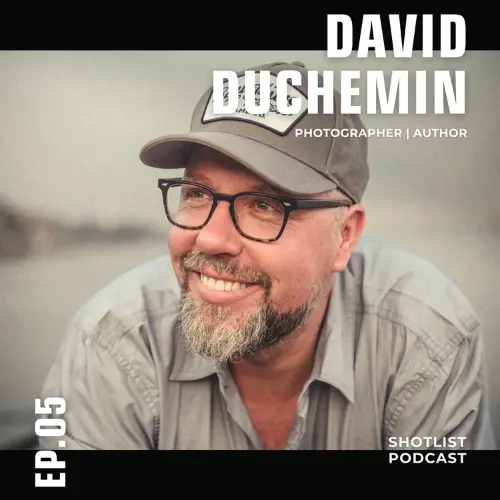
Episode 5 · December 10, 2022 · 1 hr 6 min
David duChemin | Photographer / Author
with David duChemin, Photographer & Author


If you're wondering when to quit your day job and go all in on photography, this one's for you.
David is a best-selling author, speaker and passionate educator, and one of the biggest influences on my career. This is a spirited conversation about earning a living from your craft, honing your creative vision, when to quit your day job, and how to price your work.
Key takeaways
- Hone your creative vision. Knowing what you want to say with your work is the foundation for everything else.
- Know when to go all in. David talks about when it makes sense to quit the day job.
- Price your talent, not just your time. He shares how to think about pricing your work and your skill.
- Earn from your creativity. There's more than one way to make a living from your craft.
Connect with Marshal
More episodes like this
Transcript generated automatically, with names corrected. It may contain small errors.
Hello, and welcome to SHOTLIST where we talked about how to make a life and a living behind the lens. I'm cinematographer Marshal Chupa. And today, I'm speaking with photographer, writer and author, David du Chemin. If you're looking for someone to speak to the soul of photographer, David's your guy with many published books on the shelves at Chapters, and a Weekly Newsletter that goes out to over. 80,000 people David knows how to Connect with and move the creative soul in this episode. We talk about what his journey look like starting to build a career. As a freelance photographer. How one begins to make a living from their craft? My vision is so important when to quit your day job and go full time and how to price your work and yourself. David is a great speaker and educator and I'm excited to share this episode with you jump in David. Thanks so much for coming on the show today. Marshal, how are you?
I'm doing great. So we know each other from a while back. I mean how long have we known each other? Probably yeah it feels like forever, man. Maybe even a decade. I'm not even quite sure. It's been a while. You just recently I think got back for we both on the east coast of Canada, on a trip. What were we up to there? I was teaching on the Beautiful the idyllic and overly quaint island of Prince Edward Island on the east coast of Canada, teaching a couple back to back. Lecture style workshops and I remember you mentioning have a couple trips coming up. I think something to do with maybe Bears or all y'all Bears all the time in the in the fall. So I head out to head out to the chilcotin, which is sort of the central interior of British Columbia to photograph Grizzlies as the as the salmon return.
And then I'll do that for a couple weeks and then come back home and you know, do some image work. Then fairly quickly, get back out to Churchill on the shores of Hudson. Space subarctic Canada to photograph, the polar bears, as they head out onto the sea ice to get there, you know, to do their hunting and stuff. So all bears all the time until I had to Kenya in January again, for, for a month. So it's, I don't know, I started as a humanitarian photographer and increasingly, there are no humans in my, in my photo. Graphs. Now that sounds like a cool trips coming up, that's for sure. Mmm, so I think for those of you who don't know David David really speaks to the soul of the photographer, at least that's how I describe you.
When people ask ask about you and I definitely have you've written a few books over the years, or, I mean, how many right now and enough that I've kind of lost lost track. I think at this point in print, I've got eight traditionally published books, you know, people Is that you can purchase and they're out in about a dozen different languages around the world. And then I've got a handful of ebooks as well. So I probably 20 20 books over the years and ten or so written books, and numerous courses, and that sort of thing, a million blog posts. And I feel like a sticker that I've seen you slap on pelican cases. Something goes like you're as good vision is better. Is that correct?
That's yeah. That's I mean. Certainly it is corrected that is the sticker. I stick on things whether that Mantra, you know, applies to everyone or not. I'm not sure. But certainly I, as a voice in the photography world, I have been focusing on the human and the creative rather than the mechanical and the technical. So while those things are important, there are other voices that speak to those things more passionately and frankly, more informed. I do I speak to the creative and really encourage photographers to pay attention to what they're trying to say with their photographs, that, you know, the photographs themselves. I think it's astonishment that when we learn photography, we, the first lessons they're full of words about the mechanical and about the technique and those things are important was a little bit like learning to play the guitar.
And I never actually having a conversation about music that's at a certain point. If in fact, what you want is to Music not just be a guitar collector then you need to learn that part of things. And what it what music is really about as a language and a form of expression. And so those are the things that I like to talk about and teach about more, the the visual, and the visceral, rather than Technical and mechanical. And I'm curious for those who are listening, you know, this podcast about how to make a life in a living behind the lens. And I'm just curious to hear a little bit of your journey, story into this wild freelance entrepreneur. All creative journey. I think I've always been. I've always loved entrepreneurial kind of Pursuits.
I remember when I was a kid. I mean, there was not a time when I wasn't trying to convince someone to, you know, mow their lawn or dig their dig their driveway out from snow. I remember one year, I came up with these government Christmas Critters and of course, Christmas with a cake orders with a K and And I made these like arts and crafty things out of dried plants that look like little snowman and stuff. And, and I just went, you know, door to door and I guess I was pathetic enough. That the neighbors all bought these things for a couple years in a row and made some really good cash until, you know, one of the neighbor kids decided that he wanted in on the action. And frankly, he pulled it off better than I didn't. I was out of the market, but I've always Always loved the idea of, you know, what can I do for other people and if it's a valuable enough, can they contribute, you know, can they do something for me in return?
IE pay for my time, pay for my talent, the value that I bring them and so before I was a I've been a photographer all my life you know since I was 14 but professionally before I began making a living in photography, I spent 12 years as a comedian and specifically a variety of He acts. So I did Magic and juggling and straitjacket escapes and I did, you know, I juggled flaming torches on a 6-foot unicycle and and all that. And, you know, if you can sell, if you can sell juggling to the world, you can you can sell anything. And and so I love, I love the entrepreneurial aspect of it. I think a lot of photographers make a mistake in going so-called, you know, professional in that they love photography and they figure if they go pro. You know, they'll just get to do more of it. And the reality is, the moment you decide to go pro, whether you know, in whatever.
Genre that is, whether you're doing videography or Stills. The reality is, you're talking about two different crafts here. You're talking about the craft of Photography which of course, you need to be on your A game. You need to be at the top of your game and increasingly so, but you also need to be at the top of your game in the craft of being an entrepreneur. More and that is a whole different set of skills whole different set of time demands. And if you're not conscious of the fact that one is going to one's going to rob the other you. If if you don't understand that in going into this, you're actually going to spend more time doing the professional part and less time doing the photography part. If you don't understand that, I think it'll eat lead to disappointment disillusionment.
But also, if you don't understand that, Going to be putting the effort and the Really the front of mind like learning that goes into actually figuring out. What does it mean to Market myself? What does it mean to grow an audience and price my stuff accordingly? And, you know, I what does it actually mean to be profitable? I think a lot of photographers, they don't have the financial language, they don't have the marketing language and they're wondering you know, posting on social issues Is. No, that's not a marketing strategy. It's got to be much more robust than that. Hmm. 100% agree. I think I wanted to speak to the person who is, you know, just picked up DSLR. They fell in love with photography and they're kind of just like now what like how do I even start this thing? I think I see people making money at it. I have a few photos like or where do you, where do you start?
Well, I would say you start by going back to your craft and being really, really good. At it and I buy that I don't I don't actually mean the technical and the mechanical as you would probably expect me to say I think you've got to know what you offer it. Look everyone you and I know this everyone is a photographer and I don't say that in as a - I that's not a criticism. I celebrate the fact that photography is democratic in a way that it it's always been but it's even more. So now anyone can pick up a camera And get over very quickly quicker than ever get over the mechanical hurdles. It is. The question is, do you have a voice? Do you have a vision? Do you have an ability with that tool in your hand to transcend that tool to go beyond it and serve people? What value do you bring?
So until you have got to a point where it's not about the camera for you anymore. And it is about making visual assets that Kate something and that people want and will pay for until you get to that point. You don't have a business model you just have a hobby and so you've got to get to a point where your stuff is attracting attention from people if that's what you want to do. I mean the first thing I would say Marshal is, like I would encourage people don't be don't do this professionally. Like you've got to, you've got to want it so bad that you that you're willing to disregard, that kind of advice because it will cost you in terms of your Time. It will cost you in terms of your money and it could be that your love for photography. This is why I didn't become a professional photographer. When I graduated high school, I was on track to do it.
And I realized I was going to lose the thing that I love the most. If it became bogged down with, you know, like if I wish what was I going to shoot weddings? At that point in my life, probably something like that. I didn't want to lose that the love of that. So it took me another, you know, 14 years before I really kind of figured out. Okay. Now I know what I want to do with my photography, like and that 14 years was very instructive. You know, I didn't, I would have flamed out, I would have there would have been nothing left of me if I'd gone straight into whatever form of photography I could make a living at that point. I needed a little maturity, I needed some time to figure out my voice and what I really was all about it turned out when that happened. It was in the humanitarian. Field are very For someone who you know just wants to really start building some semblance of a portfolio. Yours sounds like yours wasn't humanitarian space. Where do you where do you begin?
Because I feel like you know, are you trying to narrow down on something specific? You kind of going a bit broader so you can you know, preach to the choir. Or how do you kind of begin to shape things? I again I think you really got to know what you want to be about. You have to it's not, it cannot be about the cameras. It's got to Be about the people that you will be serving. So if for example in my case it was the humanitarian field. I needed to develop a portfolio that showed not only showed that I could make photographs in that context, but she'll did I understood that context that showed for example, you know my place in while I was still doing humanitarian photography for clients. My place was as a photographer whose Shooting the hopeful stories. I told clients.
I will not do that. You know, the flies around the eyes. I'm not a photojournalist, I have too much respect for photojournalism to claim that, that's what I do. I made photographs that help them tell their story and showed the hope that any of the money that was donated to these organizations, was going to actually accomplish something. So my photographs were bright and colorful, and they were filled with laughter and showed dignity. And And creativity in the people that I was photographing. So I occupied a specific kind of Niche. And I told clients, look, if you want the, you know, the distended bellies and the flies around the eyes. That's not me that you need to find someone else for that. In order to find that out, you got a photograph a lot. And so if your question to me is, where do you start with that?
I say personal projects go out and shoot this stuff at your own cost so much so that you you end up with bodies of work that Show how well, you understand that and that you have a specific voice because the question that the client is asking is why this guy why this gal, why should I hire you to tell these stories? And the answer has to be much more than what they know how to use a camera. So what are you bringing to it? Do you bring other skill sets? Can you write can you produce video assets as well as Stills. Can you create multimedia? Can you help them? Understand the social landscape? These are just examples. Do you speak another language? Can you say? I can come, you know, out onto the field and and speak both English and French and Spanish, or Hindi or whatever it is. These things are valuable to them but the most valuable, even if you don't speak another language, the most valuable is going to be.
I understand your context. And I can work within that context and deliver something that is that comes out of like a really Bust understanding of it. So you gain that by doing personal projects, you gain it, by really understanding your context, and the people that you're going to be working for. So, if you're a food photographer, do you understand restaurateur is do, you understand the, the marketing teams? And what like, do you understand the food industry? That's actually more important than how well, you understand the photography industry. You know, wanted a little bit more into the specifics of something, stood out to me. Me that you've spoke to in the past is creative constraints and little bit of a back story, David, and I spent around two weeks in India, together on Varanasi creating an online photography, trouble course called traveling lens. And I remember when we're filming some of that educational content, you something that really stuck with me was the idea of creative constraints when creating a body of work and I love for you to speak a little bit to that specifically. Yeah.
I, you know, one of the things, I mean, I do a lot of teaching I do Of teaching an international workshops at least I did before the pandemic. Who knows what they were where this is all going to go. But the, when my, when my students come, they have very specific projects to do. We go for a week and and it's I encourage them. Well I mean it is the whole point of the trip is they come up with a theme and then they Embrace some very intentional constraints so it begins I give them. I'm the first one and that is you have to have an articulated theme or idea for the body of work. And then it's going to be 12 images, which is, you know, is a pretty tall order when you're first wrapping your head around creating a body of work in only six seven days but then they need to create their own constraints.
So that's an example of constraints would be. I'm going to do a 12 image body of work about life on the river. Varanasi which would, of course, in this case, we require me just to focus on the river. I'm not going out into the city to see all the other sites. I spend every day walking up and down the Ganges River as you, well know. But then, additional constraints, for example, most of my photograph. Well, they're all horizontal in orientation. They're all two by three aspect ratio and most of what I photograph in a series like that all of it for the series would be black and white. Occasionally, I'll make a photograph. It's like, okay, that one stands on its own as a really great color image. But I'm looking for horizontal images shot, roughly in the 16 to 35.
Mm, Optics. And so, and then black and white with, with that particular aspect ratio, I'm not cropping them to square. I'm not going to 16 by 9 and it allows me to create some visual cohesion but those constraints are what keep me on track. So the the Clearly articulated theme is the beginning of that. And then asking, okay, how can I best? We're going to best Express that particular theme. Both in terms of what is effective and in terms of what my own personal tastes and preferences are, and this is where voice comes from. Like if you go to any, if you the mistake of beginning photographers and I'm going to assume that this is very similar with beginning, videographers in terms of, you'll look at their website, you'll look at the demo reel and it's kind of a Collection of greatest hits and there's nothing wrong with that at the beginning but there is something that there's a missed opportunity there for those that have been doing this a little while and want to use a portfolio as their best foot forward and and show clients, hey look I can do this and that missed opportunity is bodies of work.
It's ideas if you go to any of the photographers who you really respect like people that have been doing this for 20 30 years you will see themes. Their website. They're they're actually photographing ideas over a long period of time. And so for a great example of this is a Canadian photographer, Edward burtynsky. He photographs big large landscape but he's got a very particular theme for almost all of his work and that's the hand of man on the landscape. So he photographs, you know, Corey's and Mining sites. He photographs log booms, aerial shots of log booms, in British Columbia, photographs saw, Salt pans and India and ship breaking yards in Bangladesh, he has a very specific voice. He's got a through-line in his work and his work is very consistent.
He knows exactly who he is as a photographer and who he is not. And that's, I mean, if you want to sort of convert this to a conversation about marketing and that sort of thing, that's branding, he knows exactly who he is. And if you don't know who you are as a photographer, what you do and what you do not do And that's not visually apparent in your work. Your hoped for audience or Market, they're not going to know either and that's why you need, never mind just the personal. Like if you don't have your own voice then who are you as a photographer? Your audience is looking to you for that consistency to go. This is what we're going to get. We're going to get this, got this person's thinking. We're going to get this person's technique but but it's the whole package and so that's where I think constraints are really important. You got to choose who you are and who you're not, get to choose what you shoot and what you don't know. It can change.
I'm a little look at Picasso, he had a very consistent voice but he had periods where he just kind of went. All right, we're done with that. We're moving on to something else, it could be in five years, someone like Edward burtynsky, changes up, what he does. But I'd be willing to bet it's sort of a, an evolution of what he does. Now not, you know, he's not going to suddenly go into, you know, doing finer new. It's from what he's been doing. He will be consistent. The market will understand who he is, and what he does. So that's where the conversation of creative constraints Beyond, just how it helps us creatively. Those constraints, help us Define our brand as a photographer. They help us Define our voice. And if we can do that for us, our audience, our Market will understand that and that's one step closer to them seeing the value in US and having confidence that we can deliver.
/. Hmm. And so how does one begin to understand how to make a living from this craft? After, you know, the kind of figured out of their portfolio and their Direction their Vision? I mean, the craft and the money thing is always a left brain, right? Brain thing. Yeah. Where do you start to or how do you begin to think about the money side of making a living from this? Well I mean it's all about people at the end of the day, someone on the other side of the transaction is cutting you a check. And so it's about connection to people. And if you can get that connection then you need to show them your value. And this is again this is where you need a business model and not a hobby. You need to be able to say, this is the value. I bring not, you know, have camera will travel, that's nonsense and everyone's got a camera, everyone's willing to travel.
What do you bring to this? And and that takes, I think a little bit of, you know, navel-gazing you've got to be able to kind of look at inside and go. Okay, what do I want? What do I really want to do? Do I want to be a wedding photographer. And if so, what value do I bring, what makes me unique, I'm not thinking of what makes me better than the other guy. I'm thinking what makes me unique and then you gotta find those people, you gotta go where they are and so you need to start sharing your work in the hopes that it will get shared by those that are interested. You got to start. If you have any inclination of right, maybe you start writing something for wedding in Three magazines. You've got to find a way to insert yourself into that world, find where those people are, if you're in the humanitarian industry and I dislike the word attached to, you know, humanitarian, but it is an industry.
It is a, there's a professional kind of bubble there. You gotta find out. What questions are these people asking? What problems are they struggling with? And how can I solve those? How can I meet them where they are? So that I am a voice in that industry as a A visual communicator and I'm helping them understand the landscape. And then, you know, providing myself with a camera to help them translate some of this into photographs, but the beginning is asking, like if you don't know where your audience is you have no hope of speaking to them. And so you've got to find your way into that whether it's learning to public speak and present slideshows, and become an expert, whether it's finding your way onto industry relevant podcast, whether it's getting into magazines or whatever it is, you have got To get past. I don't mean not be on social, but you've got to get past social posting to social, as I said before. Marshal, it's not a marketing strategy, it's part of can be part of a marketing strategy, but it doesn't have to be. I mean, I've been I haven't been on social for three years and I've never been happier.
I love not being on social for some people. They can't imagine not being a social but that's fine. Stay on social but you've got to be doing other things. So, How are you getting connected to these people? Otherwise you're just sitting around waiting for the phone to ring and that to that also is not a marketing strategy just that's just hope and hope is great by look. I went bankrupt once and I like to think I went bankrupt because I had, you know too much. Hope I was optimistic and combined with being a total Financial more on at the time, but hope is not going to get you. Bookings. Hope will not make the phone ring. You've got a Will your audience, find your audience, connect with your audience and then understand where the value is? Yeah, the brings me to may be speaking a little bit to the like left brain, right brain.
How do you find or Flex both at the same time? Because I found that at least my journey myself, it's easy to get either stuck in one, the creative or the business, and it's this may be a balancing act of both. That really helped things sing, you have nothing to speak to that. Well, yeah, I do. I can't use the left brain. Right. Brain. Brain thing because I don't really work that way and I don't I kind of, you know, use both sides of my brain and in conjunction with each other and or at least that's the way I see it. But I will say this. I think it's a mistake to not think about business as creative. I think that if you are not being creative with how you make your money, if you're not putting yourself into this as a, how can I think about this differently? How can I make you were making a business in the same way as you might make a demo reel. Or a film or of, you know or a photograph it is a creative Endeavor and yes there's math involved and that I assign that to other people, I my math skills are atrocious, the mean, I can barely keep track of, you know, f-stop numbers. But the the business stuff the writing of great emails to connect with my audience writing, great ad, copy, all of that is that stuff is creative.
And so for me it's not a chef to oh, now I got to do the non-creative Of stuff. I actually really enjoy sitting down and going. Okay. How can I creatively approach developing and building my business and connecting with audiences at? In fact, everything is changing so quickly now Marshal that, you know, the and the canned amick is a great. I mean it's a great case study on how limber we need to be before the pandemic, people always talking about, you know, the need to be able to Pivot. I think you can over pivot and you can under pivot and It however, you do it. You need to be limber. You need to be able to, sort of turn on a dime and go. Oh Jeepers. That the, you know, the market has suddenly changed the business model has suddenly changed. That's creative thinking, that's problem, solving.
So for me, I overcome partly, I overcome the problem by, not even thinking it of it, as there for me and there's no Schism there. It is all a creative Endeavor, but maybe that's it. Maybe it's a personality thing. I just love thing. Going about this stuff. I really like for me photography as a form of communication, but then so is writing and so, you know, all to me, it's all communication. But if you don't see it that way, I can I certainly can see why some people think oh you know the business stuff is that's the, you know, that's the really kind of the cold and impersonal. I don't see it that way. I think it's a tremendous opportunity for connection, you know, and and then you know, the building of marketing materials and playing on a website, the visual communication it all for me. Just one big kind of sandbox, and I want to talk a little bit about intentional living and kind of building your roadmap to your desired destination. What are your thoughts around that? Yeah, I think you should.
I'm a big fan of intentionality. I mean, the reality is we will always be reacting to things and there is so much, call it luck, call it circumstance, whatever that comes in a play on, on a daily basis. You know, I'd love to be able to look back at my career and go. Well, apparently these are the 12 things I did to make me a success but the real reality is I don't actually know like there's a survivorship bias there. Like I made it. I happen to luck out and live the life that I want to this point. So the things I did must be the contributing factors. I don't know that, that's always true. That there's so much luck. There's so it's so much about not again, not just what, you know, but who, you know, it's in But I would say you got to be, you got to be really willing to do that pivot.
You got to be limber but you also have. You also have to have dreams. You also have to sort of go. This is where I'm going to go and then be really intentional breaking that down and go. Okay, I'm not going to wait for luck, I'm not going to wait for circumstance. How can I reverse engineer this if in two years I want to be at this point? What is that going to take? I want to publish. I want to have a book published. In two years, reverse engineer that make a timeline back it up and go, what do I need to be doing today? Tomorrow, not know month. I mean, you're going to plan that out too. If you can't figure out the first step today, you're not going to wake up tomorrow and suddenly it be doing the things you need to do. So, you know, there was an author and I wish I could remember his name, but he had this great idea of living a life that is, is inclined or predisposed to action actually doing. Stuff.
I have a list every day and I put things on my calendar. And if I need to have, you know, a book published in a year, I know exactly how that's going to happen. I've got it on my calendar. I've got when I'm going to have a contract signed with my publisher. I know when I need to have my outline done and I've reverse-engineer so that I know. Okay, this month, I need to have X number chapters, which means this week my deadline on Friday, you know, I need to have this much accomplished which means on Monday. It needs to look like this. On Tuesday. It needs to look like this. I don't leave anything to chance. Chance, does layer itself on top of that? And there are times when you know something happens, you know crap that that did not go as planned but without the actual goals are good. But steps are important like break it down and just friggin do it.
If you're not willing to do the work every day, it is it's mind-boggling that I actually have to say this but it just won't get done. And people, you know, I have friends that are like this, they look back and they're like, yeah, I was gonna, you know, I was gonna write an email to my, you know, to my list every month and I just didn't do it and and they almost say it as though. Gosh, I can't understand how that didn't happen. Well, I know how it didn't happen. You didn't put your ass in the chair and you didn't write the email because you just kind of waited. I don't know. Did you wait for inspiration? Did you wait feel like doing it? I never wake up and go oh man, I I really, I can't wait to write that email when I'm writing it. I'm I enjoy the process, enjoy the challenge but it's not inspiration.
That leads me to do it and it's not even motivation. It's my calendar. I look at my calendar and it's like, okay, today's Monday, it's 9:00 I need to be writing my email because that's what my calendar says. And I'm not waiting for the phone to ring. I'm working if the phone rings great but you just you got to be doing and so that's where And comes from, or is important because the intention what you actually want your life to look like and I would say, go all the way to the end. Like what do you wanted? Was this need to look like for you. If when you die, you want to be remembered as the kind of person who did this, this and this, or accomplish this, this and this were like, who do you want to be? And then as best as you can reverse engineer that, I never have dreams or plans or goals.
I don't have a Five-Year Plan. Man, I don't know what five years going to look like, but I know who I want to be in five years. I know the kind of story I want to live and in the short term Marshal that's where you go. Okay, what do we really want to do this year? That's about enough for me, especially with the pin down. My I don't know what it looks like in two years, but I do know that this year if I want to get to the end of the year and I want to have, you know, accomplished a couple of important to me important personal projects. I want to accomplish certain things with my business. My business connected with my audience that means x amount of emails, out to my audience, I sent an email out have several email list, but I sent an email out to my big list of about 80,000 photographers once every two weeks, that's what I do. And that's the way that I that I saw my courses, that I get interest in my workshops and that I connect with the people that have become my audience. It does not happen if I just wait for that and I know. Okay, every two weeks as you know of T2 that's 26 emails in a year and I put it on the calendar and I put my personal project on the calendar.
I go if I'm going to shoot a bear project, I need to actually put their project on the calendar and booked the plane tickets and without intention with if you're just responding to every kind of change of the wind, you're just going to end up doing either. Whatever you want else wants you to do, or I don't know, I don't know. I so I've been living like this for So long that I'm not really sure what it looks like to not live a life, that's very intentional, not just reactive though that too. But proactive and be like this is what my date. My week looks like my month looks like and then just do the work. That's how you get there just and it's not sexy. Right is just, everyone wants to hear. Why you first, you go out and you buy you like, or you buy your red camera and and then you, you know, shoot some sexy stuff and that may be part of the work. It's not the big part.
It's the life of intention is like, really proactive and you got to put your ass in the chair and get it done. Like it's they say working for your you know, being self-employed is working for yourself, 80 hours a week. So you don't have to work for someone else for 40 hours a week. That's kind of it. And now I love the work, I love it. It's not a job to me. It is work, but it's not a job, but I put in more time than I would, if I it would be so much easier. A just to, you know, get a job at Costco and, you know, put my 40 hours a week in, but I wouldn't love it. The way that I love this. There's so much the challenge just lights me up on the inside. There's something so important. I found in my life to the whole reverse engineering thing, just kind of seeking out and dreaming up that destination and then breaking it down backwards as you've described here. And then this structure thing is something that I think, you know, took me a while to understanding and put things on the calendar and break it down.
I mean, I remember my first three years of study, You know what? I don't even think I used a calendar. I didn't even know that was a good idea. But, you know, now six years into doing this full-time. Like I, you know, I live religiously to have things scheduled and thinking about reverse engineering it. It's such an important part. I think of the structure to actually getting things done. Absolutely. And if it, and if you know, it's the way we think, right? Like if you're thinking, oh, I'm a photographer. I'm a filmmaker. Well, that's great. But you're actually more than that, you're also CEO of the company that you're Running and the CEO does not sleep in till 10:00 in the morning and then amble into the office. And I'll when they feel like it, you know, everyone works differently. So you know, I'm not being prescriptive here, but I would say at least start with the, get your ass out of bed at a reasonable hour and get into the office, you know, I have a hard start in the mornings, I have a routine and a ritual, and I am in my office at usually at 8:00 every morning.
And I know exactly. I got my coffee and I know exactly why, because I put it on the calendar from the day before. Here's what you're doing tomorrow, Anna and the CEO gets up and does the photographer wants to sleep in but the CEO gets up and gets to work. Yeah, I never said and a little funny thing that I do religiously is just because of Cohen work at home, getting to the office every morning before I usually have breakfast. And then I go for a 10 10 minute walk or something like that. And in my head I'm kind of thinking about the daily tasks and 10. I want to accomplish but it helped break up that difference of being at home and then transitioning into work for me, it's like, oh, when I come back home, I'm actually at work, you know, and it's just a little, little mental trick. I do you. Yeah it's great you've built in a commute right? And I mean and I do the same thing. I mean I love my office but every day if I like I've got a schedule every day around 4:30. I shut the door.
I go out, I do some yoga, I stretch, you know, sitting around all day and then I have happy hour. I thought with my wife, I have a schedule. I don't respond to emails at 10:00 at night. I don't respond to emails on the weekend. I mean every now and then I'm sitting around, but I run it like a business, and yes, if a customer, if a client needs to be responded to absolutely. I'm 100% there. But just keeping those, you know, like keeping a door on your office and making your office, your office and how whatever works for you, you know, having space knowing how you best. I work but my CEO does not show up late to work, and he doesn't wear his pajamas and that puts me. And you may have a different way of working, but it puts me into the mindset of, okay, it's time to work and the work gets done because I know what needs to be accomplished. And then, of course, there's also, you know, you need a little time in there to react to things in the email, you didn't expect to get and all that.
But if you don't put the time aside and if you don't create some discipline, I just don't see how it gets done. And and I my friends tell me I'm prolific and I don't exactly know what that means. Because I don't feel like I've certainly not a workaholic, I take naps, I have an app scheduled into my day after lunch for an hour. I can't be working that hard Marshal yet. You know, I publish a book with some frequency, I put out a new course with regular frequency. I've got, you know, my output is scheduled and therefore gets done. I mean, I've got ideas, I don't feel so bad. Bad. I want to speak a little bit to the photographer and transition so you know, they've been shooting for a few years. They build a portfolio, they start to make some money. But there's this scary part where you need to kind of take a leap of faith and I want to speak to little bit. Your thoughts around, like, do you quit your day job? When do you do that?
When is a good time to essentially, jump II would say as best as possible, make the jumps as small as possible, and don't jump. Until you well okay. If you're asking my opinion, here's the opinionated. Don't jump into the absolute last minute. Especially if you've got benefits from your current employment, just absolutely hang on as long as you can until you were so busy that in order to properly, serve your clients, whoever they were are or do your work. You need to quit. Not want to quit. You need to quit because you can't do both. Don't do it until you've got But I would say, six months to a year of money in the bank, like, saved and do not do it one while you're in debt, don't go from. I have a regular income and I'm, I'm chipping away at this debt to, I still have debt and I'm not sure how I'm going to pay the rent this month.
I just it would be so foolish to do that. I think too many people jump in with the same kind of optimism optimism. That led me to my bankruptcy, just don't do it. Like, get your house. Order financially, if you can't do it. Now while you have full-time employment, you will not be able to do it later when you not only are trying to draw a salary from your income, but you're putting aside x amount of money for, you know, maybe for payroll for taxes insurance for that emergency fund for when that, you know, that red camera just dies and you got to send it in, to get fixed and rent, one like the, the overhead that it requires to do a business. And do it relatively stress-free. It's astonishing. And I cannot imagine going into it with debt and the sudden loss of income.
So you got to build a buffer and you've got to be already, you have to have proven your business model. Don't jump with with hope jump with a proven business model, right? Like you don't, you don't jump out of a plane go. I hope this, you know, I have a parachute. You jump out of a plane having packs, your parachute. Your Parish, you know what, color your parachute is, you know, exactly what's going to happen when you pull that. Ripcord, I just think it's it. It's insane for people to go into this with more hope. I don't get me wrong, hope is fantastic but hope has to be built on something. And in this case it's a proven business model. So people are already knocking on your door to the point that you're like man I just can't I can't keep my nine-to-five job and Do the work.
I want to do that is in demand, then it's it makes sense to go. Okay. You know I've got a buffer here, I've got money in the bank, six months to a year, it's worth of income. Including what I'm going to have to pay to the government for taxes, including, you know, all the things then it makes sense to me. But I just don't I just honestly I don't see how you can do it, otherwise, unless you're just willing to live on, you know, Ramen Rules and, you know, rent out your house to Airbnb or something. Yeah, I think that's, that's great advice. He's got to go in with your eyes open, right? Like fully open because it will hurt a lot less to do that now than to have your eyes opened against your will later on when you're filing for bankruptcy, and this is the voice of experiencing speaking.
Just don't, don't do it. Like it's, it is so painful. If if you, hey, if you're going to go Go, bankrupt, go bankrupt. Now, and go walk into that fully with your eyes, fully open, and, and allow that bankruptcy to create your own am not advocating bankruptcy here, but some people have no choice. I had no choice. I walked into a creditors office and I said, I want to straighten this out. I want to, you know, get straight with my creditors. I don't know how to do it. And they looked at my finances and what they know about, you know, credit proposals and that sort of thing. And and they gave me she gave me two choices. She David, you can either go bankrupt this month and I said, well, that's that's out of the question. What's the other choice? You says, or you can go bankrupt next month? It's like, okay, well, I can have any color I want, as long as this black, of course, that is an option for some people.
It was forced upon me at create created a great deal of freedom, but I've watched a lot of my friends, walk their way out of debt and the freedom that that brings don't get into that. And if you're in debt, get out of it as fast as you possibly can, because that's you, That's future. You paying paying the bill for the for present use stupidity and financial mismanagement. I don't do that to Future you because the possibilities as you grow and meet people are going only going to increase. And you don't want to be the guy that's like I got a great opportunity to go with my camera to, you know, to shoot this thing. And that thing and then you're like, yeah but I can't I'm tied to my debt. I servicing debt until I'm 100 years old. Just don't do it.
And while we're on the topic of money, I'm just curious and it's always the funny sticky question that. I mean it doesn't have a direct answer, but it's like, how do you price yourself and obviously, depending on the market you're working in as a lot of different answers to it. But I'm curious just in general what you were. You think about that? I think you price yourself as high as you possibly can. Look pricing is always going to be subjective, you know? That's like saying. Well what should a car cost? Well, do you want? Do you want to 1973 Gremlin? Or do you want the latest Porsche Boxster? And you know with all the options, there is a market for everything. But I would say this, do everything that you can to not be a commodity, you need to be a brand.
If you're just another photographer, if you are have camera will travel in your portfolio shows that you shoot everything you're going to make a commodity income. You are going to be competing in the Costco or the Walmart. God. Help you of photographers videographers creatives and you will not make a living wage. You will you may as well go work at McDonald's. You've got to be a brand. You've got to me. You cannot be someone. That's like, well, we could we could hire this guy or we could hire this gal, I really doesn't matter. Just pick one if you're in the six of one half-dozen. The other category you were a commodity your interchangeable with anyone else in the marketplace. You and your knock, it will be. That's where you get the actually. I was going to say long race to the bottom is actually pretty short because then people are undercutting each other, everyone's competing on price. You cannot hear me very very, very clearly here people. You cannot compete on price.
If you are competing on price, you're screwed. It's just as simple as that. A, you have to have some value is not just what people pay, it's what they get for. They pay. And so if your value proposition is not only I make pictures, I make videos you need to have something more than that. And so how you price it in your particular Market. I don't have a lot of wisdom on that. Except to say, if it were me, I'd be the luxury brand luxury Brands, make money luxury Brands, promise a lot, and they work their asses off, you know, to deliver. You know, Chase Jarvis. Used to always say A, you got to under promise and over deliver and that's what, that's what a luxury brand does.
You got to be the one that had is working your way into the biggest and the best gigs not competing for the crappiest, the crappiest gigs that you can possibly get now. I understand that there is a sort of a survival line, you got to get to a point where you actually are pulling it off. Whether your, your business model is proven, your value is proven. And again, I would say that's Got to be the stuff that you're figuring out before you. Let go of your full-time job too dangerous to do it otherwise and you will if you're doing it otherwise you will end up taking the Costco. Gigs you the Craig's you'll be competing against God. Help you, Craigslist photographers? I'm not saying, there's anything wrong with being on Craigslist. I'm just saying, good luck. If you want to make a living with him, You've got to consider asking, what do I charge is way? Less important than asking?
Why am I charging? What, I'm charging figure out the why first? The what will follow? Yeah, and on that note, I want to talk a little bit about the marketing side. I think it's a dirty word in the creative space. People just hate the word marketing but I think you some guy I've read in your work a few times is focused on serving versus selling and I think that's some of the key to speak a little bit to Mmm. Yeah. II. First of all, I have the same reluctance to use the word marketing but I don't see it as a dirty word. I just worry when what other people are going to hear when I say it. But the reality is if you're selling something that you believe in, if you know that what you are selling, for example, you're selling a fifteen dollar thing, but they're getting 25 or 30 dollars worth of value for it. That should be something that you're like, raising your voice about you should be on the roof.
Cops. If you don't believe in what you offer, of course, marketing is going to be a bad word because you going to be afraid to get called out on, you know, charging money for this, this piece of crap offering, you know, but if you believe that you're giving way more value, if you believe that you are giving everything and that customers life in whatever industry, they're going to benefit from it and be grateful for having hired you, which look, if you don't believe, That you shouldn't be in business anyway but but you really need to Galvanize that thinking go like am I over delivering am I really giving people what? And then then selling is just offering I'd rather use words like you know I have a course that I offer called standing room only and it's about exactly this selling and marketing and building an audience for creatives.
Who don't want to talk about selling and building an audience and I'm always talking about look when I build an audience is What I'm doing is I'm I'm sharing, what I do, my work and I'm inviting people to, to get more of that. And so yes, some of that is free content. Some of that might be, you know, lower value, lower price stuff but then there's also the premium stuff. I'm constantly growing that audience and helping them experience more of what I make as a creative. And if that's That's my mindset in and it's not I got to sell, I got to constantly be selling but it's inviting it's serving, its solving their problems like that, that's it.
If you can't say as a photographer as a filmmaker, this is the problem that I solve, you have no value in the market. But if you do, if you can say that then it becomes a matter of how can I present this with Integrity creatively to a single person or group of people a corporation, whatever. Look, I can solve your problem and we could have a great time working together. They won't be able to get to their checkbook, quickly enough and everyone benefits. I think you can make money as creatively and beautifully as you make your art. It's just another creative Pursuit. And as long as you're giving value and in my mind, it's just to kind of help me through the process. It's got to be more value. I, they've got to be getting 30 bucks if they're paying 20, you know, something.
I feel like I Confused in the beginning and it feels hard to charge High rates. But when you reframe it in your mind, on what value Are you delivering to the company or to the brand and you understand what they're going to use it for its really helpful. Also the numbers going to fall away. And you realize that, oh, if you can create this marketing campaign for them that then makes them another half a million then of course you can charge, you know, three thousand dollars a day or whatever it is, you know. Absolutely. And if you can charge a little bit more and therefore do a better job, you can squeeze in through Four days in post-production or you know, four more days on the field or rent a slightly higher caliber piece of kit that will actually have Returns on that investment then. I mean I can they will run to their checkbooks in order to get that return on investment. And you have to remember there are people that will, you know, they're of course there are people in your who you believe should be in your Market that aren't and I'll look at your price and go, oh, that's way too much. But there are also people that will react the other way and go. What's wrong with him?
What's wrong with her? If she's not charging that much, she's not the person for us, right? I it just is, there's a mental game and you just got to decide what field you want to be on. I just strongly encourage you to be on the the just don't be on the Costco. Craigslist Walmart field beyond the the field that leads you to better opportunities and allows you to do your absolute best work and don't confuse price with value. They're very different things. And I want to hit on a little bit of the art of communication and relationship. I think one thing that, you know, I really kind of upsets me that they don't teach us in school or in life, in general, is just like how important communication is learning to communicate whether that's with your your partner, or in business, or in with collaborations or just in general. How important relationship is in the growth of your business or your craft.
I would say relationship is almost everything certainly, in terms of the Business. The craft stuff often happens. In fact usually happens in kind of as a more solitary Pursuit for me, but in business, it's absolutely, it's everything. I am astonished by the lack of empathy out there people not putting themselves into other people's shoes. When it comes to communication, especially in marketing stuff. But II in marketing, I include every daily conversation. I include the emails and if you're on social social thinking, how People going to perceive this, how, what is the gift in, what I'm giving them and can I even in a conversation? How can I bring value to them? How can I make their life richer?
Even if it's just I want to make them laugh. I want to tell them a great story. I want to encourage them but more so you know how can we put ourselves in their shoes? That's the only way you're going to know what your value is. It's the only way that you're going to be interesting enough that people want to talk to you. And Increasingly the marketplace, especially social. I hate to keep harping on social, but it's all me. Me, me, me me, people don't come to you because of you, they come to you because of their needs and the things that keep them up at night and so, your marketing, talk your language on everything that goes out into the world needs to be. Not. What do you think about me? It needs to be. Here's how I can help you. Here's how I can serve you. You are facing this problem. Let me show. That I understand that problem and can help solve it for you without empathy.
I think you don't have much, especially, as a single business owner, where you're kind of doing everything. I don't see how you can Market yourself, or communicate, and then just relationships, like people might greatest opportunities and in my business have come from relationships, they've come from responding to comments on blogs, especially my own blog and then turning that That into, hey, you're going to be in town. Let's have lunch. Not because I think they have anything to give me, but because I think I might be able to help them in some way and often, it's not until years later. I'm like, oh, okay, there. That's where that's where the relationship was heading. I have so many examples, most of them, I can actually say, you know, because the people that I'm working with are kind of in, you know, High positions and for companies with nda's and that sort of thing. But so many examples of people that I just built a relationship with and And one day there was an opportunity for me to serve them in a bigger way than I ever expected. It's like ah wow, look at that.
Now we've got a professional working relationship and it all begins with this humble little seed. It's not like you meet someone and you see their name tagging like, oh they're a VP of this and that and and you, you know, you'd try to kind of get your way into that. It's just all the relationships in life. The people that you meet, that you served, and we're kind to just all comes back to. Yes, of course. It's You know, but it's also who, you know, and collaboratively. I think the more conversations you have, the more chance you have to see where that might go, you know, creatively and business-wise. I will always be more personal than professional P, marketing, copy people that write marketing copy. That makes them sound like some, you know, big Ad Agency and they're a one-person operation and they're like, yeah, you know, contact us and we will do this for you.
It's like, you're not kidding anyone. You know, strip that this Lick out of your your marketing copy and be personal talk to that person. That is going to hire you and write the check personal Trump's professional everyday. Still got to be professional, but personal comes first. Absolutely, it's all. It's all about relationship. No one is making unless you're just selling widgets on Amazon in our business it's personal. We are working for a person and solving a person's problems. And part of the reason I look I when I was a comedian I I hired a headshot photographer every year for 12 years, and I went back to the photographer that I had a relationship with. I was like, I and I probably went more than I needed to. I just really liked going into the studio and being with this person and, you know, the photographs were fantastic, but I had a great time and we became friends and new opportunities came out of that. It's all about people.
There's something you said there that took a while for to click for me in my journey, but just like reframing, like, how can I help you versus? What can I get from you? And I think that's When approaching any kind of conversation or building a relationship or reaching out to someone. You hope to work with in the future instead of kind of approaching it like picking their brain. So to speak, I think approaching it like really listening in depth, what they care about what they're doing in their life and then understanding how you can potentially help or add value in. There's that's something that Is drastically. Help me in my path? You nailed it. It's very counterintuitive. Everyone wants to get to their elevator speech. So, I'm just going to go out on a limb here and be very opinionated. Nobody gives a shit about your elevator speech, they care about themselves. So like you nailed it.
Listen, just listen when it gets to the point where they say and, you know, tell me more about what you do, now, you have a frame of reference. Now you, they've just told you all about themselves. Now, instead of the scanned elevator speech, you can say, well, here's what, I Here's what I would do. You know for someone like you here, the problems, you just said this. I had an interesting story that Loops into that you've listened, you understand the context and now you can tailor, not even it's not a pitch, you're just talking to them about the problems that you solve. But instead of being really abstract about it, you can be totally 100% there for them and give them a actual examples. Why were you not were so quick to jump to the No. Okay, I just gotta I gotta wait for an opening and then I'm going to squeeze in my elevator pitch. Just listen, don't worry about what you're going to say. It'll come to you.
When the time comes, just listen to the. Same is true on social. By the way, the same is true for the emails people, right? Listen. They will tell you what your value is, they will tell you where you dropping the ball, they will tell you where there's an open window of opportunity and they'll give you the kind of language when they say, this is how you helped me. That's the kind of language you start putting into your elevator speech, not The stuff you think about yourself, but what they think if you can let go of the ego on this stuff and just listen and make space for God, I can't believe I just said that make space for, you know, the other. It is incredible. The Depths that that will take you to in your relationship and I do truly mean, like I do six-figure Consulting contracts for, you know, in this case, a very large multinational corporation who you would all know. And that came out of just a relationship. And I think that something is so undervalued and under spoken about in our journey and I don't know why don't they don't teach this stuff in school but Dan would it be helpful. But you know why they don't teach at Marshal because it's not a it's not a formula because you can't reduce it to if this, then that it's very soft skill stuff and the you know, I've just hit 50 this year and so maybe I'm that old guy who's suddenly, you know, figured there's some value and wisdom. But the more I do this the more Or I look, I know this is not rocket science people, anything that you need to learn about the, the, the hard skills, you can learn the soft skills, the empathy, and the listening, and the care, and the actual giving a shit that that is what's missing that. Like if you can just do that, you will find a place in the in a market and be able to charge what you need to charge, a hundred percent agree.
So, as we wrap things up here, is there anything else you'd like to share kind of for that person who's just trying to Break into this world and understand their vision and little portfolio. And, you know, potentially make a life in living behind the lens. Yeah, II would I would say, you know, think of think of your potential Market as an audience, think of them as actual people and then figure out how you can connect with them and serve them. And then when you've, you know, then when you've sort of started, wrap your head around that then start reading from start reading marketing books, you need to hone up. Up your craft. And there were so many good voices, talking about business and marketing. And you know, Seth Godin is one of them. You just need to start studying the craft of marketing and business and and I would also say having been there and been, not this person, you need to learn the languages. One of them, those languages is financed. You need to know whether your business is running a profit or not like you need a spreadsheet that's constantly Like if someone said to you, are you profitable you could say yes. And here's how I know because I've got x amount in my operating account.
I've got x amount in corporate savings. I've got my payroll as covered. My taxes are covered, you would know exactly this wishy-washy kind of, well, you know, we got a little bit more money in the bank this month. And but then next month, we don't and you've really got it figured out. I have to have it figured out there was one book I read called profit First, which was a little hard to wrap my head around and I didn't agree with absolutely everything he wrote. But it really got my hat around, like, profit is what you have at the end of the month that's left over. Not the little bit in your bank account, that is going to be used next month to pay for, you know, whatever. It's the bit that you put aside and in a whole separate thing. It's the equity you build into your business. It's it's not well, I Hope we make the books, you know, balance this this month, like it's a very there is a way to achieve profit without being so reactionary, and maybe this speaks to that intentional living, but I found that book particularly good profit.
First it basically encouraged me. Open a separate business account, a separate one from your existing business account, that becomes your business or your corporate savings. And you pay just like you pay yourself first out of whatever you make It as a business person you pay your business first as well and whether that's, you know, 10% 20% Then if there are things like boy, you know, we really need a new office chairs, this this month but you know, we can't because we've already taken our Prophet out first, we don't have enough, you have to save God help you instead of putting it on your credit card. But that way, when there is a shortfall, the thing that takes up the slack is the office chair upgrade. Or I'm going to have to not buy the IPad this month. It is not the Prophet.
The Prophet is always going into that bank account and you are constantly growing the prophet and maybe you know trimming the fat on the overhead a little rather than the opposite most people that keep building into their overhead and they keep making less and less actual profit. So anyway, there's a bigger conversation to be had there but I found that book really helpful for someone who has always wrestled with the you know we you mentioned the left brain, right brain. Brain stuff that mathy stuff. Never been my my thing, I've had to learn it. Figure out what you need to learn as a as a business person. Whether that's marketing, whether that's, you know, how to really use social how to use email. I would say if you're not using email, you're missing out, social is always changing. You don't own the platform, get an email list and learn to use it really well.
I make money when I send an email that's, that's my business model. Well, It's more complicated than that. It encompasses all things. We've just talked about but know what your real business is and you like get at it. That would that would be my advice. Well thanks for coming on the show today David. I really appreciate your time and I think there's definitely a handful of nuggets. I can help those who are just coming figuring out their way into this journey. Yeah, you're very welcome. Thanks for having me Marshal. Okay, folks that's it for this round. I hope you enjoyed this chat with David to Chemin and maybe take a few nuggets away that can help you in your day-to-day and the future. I'll be speaking with cinematographers photographers directors, producers reps. And anyone who has decided to take this ambitious leap of faith and making a life and a living behind the lens. Stay tuned And subscribe to the channel on your favorite podcast app.
And if you like what you hear, please scroll to the bottom of your device and leave me a star rating or review or just drop me a DM on Instagram and let me know that I'm giving something of value. Thanks for listening and we'll catch you next time on SHOTLIST.