
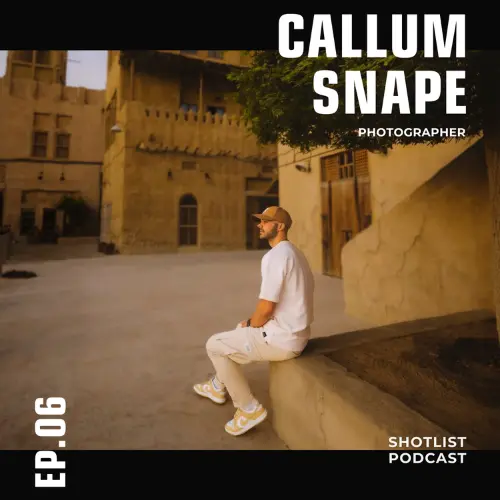
Episode 6 · January 3, 2023 · 49 min
Callum Snape | Photographer
with Callum Snape, Commercial, Tourism & Outdoor Photographer


If you want to shoot for tourism boards and dream destinations, Callum shows how he pitches them.
Callum is an amazing photographer with over 800,000 followers on Instagram. We dig into how he built a focused portfolio, got noticed by destinations around the world, how he pitches brands, and a simple way to start building work for the clients you dream of. Some big takeaways in this one.
Key takeaways
- Build a focused portfolio. A tight, clear body of work gets you noticed faster than a bit of everything.
- Shoot for the client you want. Callum's simple method: start making work for your dream clients before they hire you.
- Pitch with a plan. He walks through how he approaches and pitches brands and destinations.
- Write a winning proposal. The details of how you put a proposal together matter.
- Keep the relationship going. Landing a big brand is only the start. Maintaining it is where the value is.
Connect with Marshal
More episodes like this
Transcript generated automatically, with names corrected. It may contain small errors.
Hello and welcome to another episode of SHOTLIST, or we talk about how to make a life in a living behind the lens. I'm cinematographer Marshal Chupa. And today, I'm speaking with commercial tourism and outdoor photographer, Callum, snake column is an amazing photographer, and if you don't already follow on Instagram, we probably should along with the eight hundred thousand other people who are doing. So in this episode Sewed. Kalman, I dive into some of the ways. He began to build a portfolio of work and get noticed by big destinations around the world, the details and processes around how he approaches and pitches Brands and destinations one of his simple methods to start building a portfolio of work for the clients who dream of working with and some tips on how to build and maintain relationships with big Brands. I really enjoyed this chat with count and I think there's some big takeaways in this episode while listening to how he approaches his clients and photo work.
Let's do it. All right, well thanks so much for coming on the podcast today. Calum, appreciate you being here, thanks for having me if there's anything. I know bow Calum is that you are always on the road. Always find to some new destination with a camera in hand. Did you just get back from somewhere? Yeah, just got back from a week or 10 days in Greece and seven days in Northern Italy. Very cool. And now, I feel like I need a vacation after a vacation. It was it was a lot of traveling but it was a lot of fun, as well as a good It's of Photography and a little bit of downtime in between and getting to enjoy each place, which is rare for me. So that was nice. What were you specifically shooting there in Greece? There was one place that I really want to go to, for a long time.
And it's in northern Greece, has place called Meteora and it's these ancient, maybe not ancient, is the right word, but really old monasteries that were built up in top of the mountains and there's a I think there's about seven or Nine of them. And basically they just on these Cliff edges. And they, it's like 200, says up, 200 stairs down to reach these monasteries and you can drive up, pull around it and it's just really, really beautiful. It's kind of in Greece's like Wine Country and this olive trees everywhere and I've always wanted to go there so that was kind of the main focus. So actually we spent a few days in Athens photograph that area a bit and then headed north to Meteor and spent a couple of days up there as well, it was that client work or personal work or a mix fully Plus in the look how amazing. Yeah that's something I really appreciate about you is that you're always pushing even in the downtime to seek out amazing locations and creating that personal work that I think not only energizes Us in the down times but helps them create a bigger portfolio that then can show off to land more clients and gigs.
Yeah it's a challenge definitely come definitely working on. It's not And so every creative can relate to it, it's it's not easy to go out and take photos for yourself that mount that might sound silly, but a lot of the time we are getting paid for it and I find find it easier to create a fun being challenged by a client, I think. Hmm. Yeah I think you and I originally met on a trip in the Great Bear Rainforest. I think it was a shoot, we're hunting, not hunting dogs, definitely the wrong word, photographing or film. The elusive Sea Wolves out there which was Yeah, I don't know how many have light years ago that was but since then we've had we've done have lit trips together. Really get to know each other and yeah, it's been cool to see kind of how your work is evolved over the years. And I'm curious to actually step back though, to the very beginning.
And you know, I've been good friends, I know this story very well, but I would love to dive into it or audience here to just hear a little bit about your journey story into this life as a freelance creative because I think everyone is so different, especially someone who now travels around the world. You know it makes a living from it with a camera. I be curious to see where things start for you. Yeah. I guess it really started back in English originally and immigrated to Canada when I was 18 or 19, but I picked up a camera back in military school. I had a very strict upbringing. I was sent old way pretty much my parents didn't love me but they did really to a military school for seven years and as soon as I left there or you know towards the last two years There I go. I picked up a kid, a cheap camera.
Like one of these hybrid Canon cameras, that it's like, half electric half film. I don't know how to describe it, but pick that up. Really fell in love with photography and just going out and taking photos around where I lived around my school, back in England. Then I immigrated to Canada actually to pursue a career in snowboarding or teaching snowboarding. I was wanting to race as well, but went the path of teaching snowboarding and moved to the Canadian Rockies. And if anybody's not familiar with bamf, it is probably the most beautiful place in the country if not the world. And that's kind of where I really fell in love with photography and started to see that it was something that was bigger than just a little passion burning away aside from snowboarding because snowboarding was my main focus main passion at the time but Over the next few years, it definitely transitioned and I was drawn more to photography and kind of got involved with the local photography community in Banff and Canmore. Which is there are some quite well-known photographers, like John Marriott who's a wildlife photographer impose this girl who's very well known across Canada and North America and both from kind of took me under their wing and we went out taking photos together and that kind of opened my eyes up to the idea that this could be a career. And from then on I pretty much just join social media and started sharing my work and and then eventually transition to being a full-time photographer during that period. Yeah.
So I won't maybe back up. So how did you originally meet these other photographers with something just like walked in their studio and said, like, hey I'm passionate about making photos to like can we go together? Like how did that first Meetup happen or how did that energy start to happen? I think at least From my memory. It was a long time ago. But we had this Facebook group that was called caffeine and cameras, okay? And it was basically just kind of like this group of maybe 20 to 30 photographers, it was a secret, private group, you know, the one known as had access to this but we would invite a friend here and there and I was invited by a female photographer called any left Francois who's amazing photographer based out of Kenmore now, I think and we would go out taking photos together, you know? Every couple of weeks on the weekends and days off that I had.
And she invited me into this group and that's kind of how I got involved with the photo Community is specifically through that private Facebook group and every maybe every other month we would all get together and meet up for like Sunset and go for a beer afterwards. And that's kind of how I got involved in the photo Community. They're right. And then so you've got involved in the photo Community. You're building a portfolio. What was one of your first? Gigs like that, that actually made you think, oh, I could actually, this is money, I could actually do something with this. I think my Celeste have a paid, kind of job was for was actually for Canadian Geographic and it was a two-night three-day assignment in a place called milk river, which is in the middle of absolutely nowhere on the border of Alberta and Montana and it was a rafting trip. And I was hired to basically, Cross the images that would go along with the story with an editor that came with me. Hmm.
And it was a it was a challenging job actually because I my all my photography is Mountains, mountain lifestyle and then I was taking out of that environment and put into prairies and open Plains and I had no idea what I was doing but I tried my best and you know, the photos were okay it's a little painful to look at now but best that's still up there. I'm sure if you do some digging around, you'll find that story. Yeah, yeah. And how did that story car? How did you get that introduction? Or how was that work? How did you land that job? I think that's always something in the beginning. People don't understand how to get that first gig or feel confident enough to land that first client. Yeah, I think it was actually through My friends at Travel, oh butter and they actually been building this this is kind of right right around the launch of Instagram and social media taking off and I become quite friends friendly with the people are travel, our butter and I believe it was, they found my walk through some images that travel abroad.
I had licensed from the Canadian Rockies and the art director contact me through that route and had me tested for the job. But it was definitely Definitely a kind of from that travel Alberta introduction, I guess where they kind of been building this community, as local photographers that get out and go take photos together and that's something that they were trying to get the word. But they were like, just really focused on building a community that was going to share as much of this province as possible. And you did you mention your licensing, your work. And that's how they found found the photograph or how to Yeah, I had a few photographs that travel about our approach, me after I just had them on social media and I sent them over a folder of images and they picked out, I think two or three photographs from that selection of files that I sent over and they ended up licensed, couple of them and they got used in a lot of different places and they would always be really good about crediting the name.
So my name was plastered all over Billboards and on planes and magazines everywhere. So it was really easy for people. People to find me through those, you know, those little credits, which I don't necessarily require credit because the client has already paid for the use of the image. Right. So, but they travel about, it will always good about kind of telling you who took the photo and I think they were almost proud to have that in their Community. Cool. As it was originally you that had reached out and really pushed your work out there was that some of the in those early days was that where you doing that to a bunch of people? You know, region of trouble. But were there any other people you're reaching out to, or how did you get your work out there in the beginning? Yeah, so it was actually travel abroad of it taught me the process of pitching myself to different brands and it was quite a struggle in the beginning, because there's a lot of Brands and clients weren't aware of kind of this type of relationship that you could have with a photographer.
They back then it was kind of you. You hire somebody through an agency. There was never a direct relationship. Shapiro and instead. So what I started to do was approach some of these Brands and put together a little PDF for them, and tell these tell us brand who I was share, the type of work and images that I take and let them know, the type of relationship we could have if they wanted to work with me and I would send this out to back, then. My big Focus was kind of outdoor adventure. Its transition to travel now, but I still kind of get involved in that type of work, but so I Approach anything from like friends like the North Face, or kayak, companies and local tourism boards. And I started very locally and regionally across our border and western Canada to begin with.
And some people were really quick to take it up and my fees back then were pretty low and it was not much of a big risk and then other brands came back to me a year or two later once they kind of picked up on. The impact of social media and marketing content realized what it was worth a couple years later, right? So let's go to the point where okay, you're making a lot of photographs, you're building a portfolio, Instagram shows up. Tell me about how started that all felt because I feel like that's a thing that, you know, they call the good old days or something like that, you know, when Instagram became a thing and, you know, it's all kind of locked up now. But tell me about the start of how that'll begin how you. Building a portfolio there and then and how that grew for you. Yeah.
So I always been heavily sharing my images on a platform called 500 pixels and I don't Facebook to and that's pretty much all I was using to kind of share the adventures in the photos that I was taking. And then I had already developed quite a good relationship with a lot of photographers around the country. And one guy who probably a lot of people know now, Alex troll wanted to meet up for A coffee at Tim Hortons in bam. And how can anyone I know? Right, so I met up at Tim's for a coffee and a doughnut and he said this, this this platform gets cold Instagram, you should just post on there once a day every day. You've got this big portfolio of work, you should share it on there and I was like, no, I've heard that if you like if you share your work on there you can have your images stolen and they can be printed on mugs that, you know.
Oh this, this type of stuff and he eventually talked me into it and this is probably about a year into Instagram, being a platform that people were using. So I was a little late late to the show but I did exactly what he said. And sure enough grew an audience really, really fast, and it really took off for me, you know. And then I think we saw a big transition, where art directors were no longer using platforms like 500px or Facebook to find. Photographers to work with. They were just going straight to Instagram and I think that's where I saw the big surge of my work come from is that it was easier to find to hire for jobs and that makes sense. And so you start growing this, you know, big portfolio and Instagrams are getting traction and followers like what what was it like to then move into the getting clients from that portfolio or basically shaping that into a business model out of that work?
Work. Yeah, it was it took a while. I thought it took a lot of trial and error because I still being approached for things like free trips and, you know, back then I didn't know any better and I just love the idea of a trip round the other side of the world all expenses, paid, you know, flown over there, that those free cups didn't last for long, because I think that photography is caught on very fast. That this is something they can be paid for. And so we, I started to communicate with a lot of other Creators in my space. And we just kind of discuss pricing something that I think a lot of people are afraid to discuss because it can be a bit of a touchy subject. And I kind of got us a good sense of what I should be charging and travel abroad. I will also really influential and me pricing myself correctly because they were really at the Forefront of the industry and the content marketing world and that's the type of work I was trying to get primarily was To work doing content, creating content, marketing material sharing work on social media, you know, do it sponsored post things like that and started charging for it and gradually over time.
My social media following would increase, my rates would increase and I got a better understanding of the commercial side of the industry at the same time and I've got a really good foundation for licensing rates and things like that as well. So started to Peaceful that together and put packages together to offer clients. And then when clients came to I would offer them specific rates for specific things. And that's kind of really, how I started to piece it all together. That's cool Olympic makes a lot of sense. And so when you talk about, I love to talk a little bit about approaching Brands and like tourism clients like something that's something that you've developed a bit of a system for and over the years of getting to know you. I think that's something that's really stood out for me is kind of your ability to approach Brands and clients and kind of see it through the whole process. Because it like you mentioned, you're kind of taking, you're taking the agency out of the roll and yeah, filling that Gap. So I'm curious, what are some of your processes like when it comes to approaching Brands and tourism cons, I think a lot of us, myself included, actually, when I say this, and I have to remind myself that there are humans Behind These Brands, and it's really easy to think that a brand is not approachable because there's this enormous brand that, it's Just Way Out Of Reach for you but they're really not there. There are people behind there and a lot of the time they wanting to meet new people that could potentially be great to work with.
And so my process for a lot of it was to introduce myself to the brand and the way I would do that with be going to either LinkedIn or messaging. Very generic email and introduce myself and ask for a direct contact for somebody in their marketing department a while back. He used to be somebody in their PR department before kind of Marketing departments were really or seeing or photography Department reach out to those people introduce myself and just let them know that I'm interested in working with them. This is who I am where they can find more of my work. If they are interested. And if it's, you know, if it's a brand I really want to work without put together a pitch and send that over and basically try to assist them with any of their marketing needs. But I think one of the things that I Lee didn't do, because of think it's easy to focus on.
That is I didn't kind of cold call any of these brands or people that I wanted to work with, because I think there's so many people doing that now, that it's so easy to dismiss those people because they haven't taken any time to learn who, you know, even the name of the person that works at the company, rather than just sending, like, just sending this generic email saying, hey, what could me? This is who I am hired me for this job. I'm saying You know, you over an email that says, hey, John, it's nice to meet you. I've been following along for a long time. I love this campaign. You just did. I also know that you're based in Vancouver or wherever. And if you'd ever like to like to get together for a coffee, you know, you're just letting this this person know that you're also human, and that you're not just a company, just or a photographer.
Just trying to get work from what I hear from that. It sounds like you're kind of getting away from the cookie cutter classic like, you know, send a bunch of brands. Female, you're really letting them know you've done your research. You know, you really care about what they stand for and you're putting in the energy up front to to do that. So I think that that does make a huge difference to stand out amongst the crowd and I'm curious to dive into a little bit more of, I know you've come up with a specific process when it comes to pitching destinations and for any of those who are listening Callum and I actually put together a course called The Art of pitching and this is based on your awesome system that you you kind of had, I think built over the years. I'm curious to hear a little bit about that. Yeah. So basically it's a system that essentially helps you identify the problems or marketing challenges a brand faces and then create a solution to those problems. And then pitch your concept for that solution to the client to tell them exactly how you intend to help them. And it's a process that does require a little bit of work, involves doing some research into the And if they have a marketing plan downloading that going through that, and kind of highlighting any problems they face, then you use your creative talents as a photographer or fewer videographer, a writer, whatever, and using, those solutions to those problems to create content or photography or, you know, video for the brand to help them with their marketing needs. They really is all about solving a problem because once you solve a problem for a brand, they can't release. They know because they need to solve that problem somehow and if you can help them with that, then it's a win-win situation. You get paid to solve a problem and they get this problem solved.
Yeah I remember you explain that when we first met and it's kind of a seems like a no-brainer, but the idea of instead of just showing up and saying like hey here I am, this is my work, hire me, you know, it's kind of reverse process, you do your research, you find out who they are, what their, what their needs are and how you can help them. And then, repitch that problem back, then, I think that's It cool and smart way of doing it because it's a win-win, you're solving them solving their problem and they're hiring even do the work. Yeah, totally. I also think that like, there's something to be said about knowing that the person that wants to work with, you has really taken a lot of their own time to do that research and then not just, you know, it goes beyond are like okay finding who the person is that works there and finding out what their name is. This is like really deep stuff and really the diving into like the brain of the mission and vision and that lets you know that this person has done their work and their really aligned with the brand and they want to work with it. What are we why don't we dive in? Do you have it?
A quick example of something like like how you would, you know, approach a brand and, you know, find their problem and kind of pitch it back to them? Is there anything a reference? That might come to mind? Yeah, I guess so. Let's let's think about northern BC. I Give you an example from the job. I was hired for. So I was, I was hired by Northern, I was hired by tourism British Columbia destination BC to work with the northern region to promote tourism back into the area after a wildfire. And I've this wasn't actually a concept, I pitched, they actually approached me to solve this problem for them. So it could be that you know, I had I known about this before or I'd seen it in the news or whatever. I could have approached the brand and say, hey this is what I want to do for you, but instead They approached me this time and basically they said to me, we need to promote tourism back in this region and we want people that are Outdoor Adventure photographers to go in here and showcase what it's like up there.
And that really the Wildfire didn't do too much damage to most of the region but the news made it look and seem way worse than it was. And so it was, you know, the media portrayed, this Devastation up in Northern British Columbia and tourism just dropped overnight. And these companies up there and these hotels and independent businesses mom and pop businesses. Coffee shops, whatever. They're all struggling so much because I've been made out that the whole area has been wiped out and that wasn't the case. So I went up there and kind of share it on my social media channels that I think was pretty much open. As normal, you know, I wasn't Devastation in specifics in specific places but that it was business as usual up there and it this forest fire, didn't really take away from the beauty of the area, if any think you added to the history of the area now and it's for as far as our are technically a positive thing for the environment even though we try to prevent them but and it, you know, ended up being quite successful because they were up to Showcase that tourism that, you know, the area was accessible and they saw an immediate kind of return for people wanting to road trip.
So rubber tire traffic RVs passing through the region. So that was the fastest return. And then the second fastest was people flying up there and that took a little bit longer just because flights are a little pricier last second. So they saw more recovery from flights a year later, but immediate from abroad, Fictitious get in. There was also another way I've seen you approach it when it comes to learning about a brand or a business and kind of figuring out their problems, I had to do it like a marketing plan. You speak a little bit about that. Yeah. So marketing plan is essentially can be anything from like a 30-page to 100-page document that a brand, will I die? Outsourced to an agency to create for them or they'll create it in house and it's essentially a document that lists out Exactly how they intend to spend their money.
Their marketing budget for the entire year. What the goals are any problems? They face how they intend to solve those problems. And it can go into quite a lot of depth of the metrics of type of visitors are coming, how long they're staying for the age range, the whether they're male female families, solo Travelers that information that marketing plan is really key to you understanding what the brand is about and how you can help them. The way I look at these as I try and think of what strength I have in my photography and my social media audience and try to use that to my advantage that, you know, my dick. I mean the great thing about these marketing plans is that we just came out of a or just with technically still in it. But a pandemic and these marketing plans listed things that I would be able to use to my advantage to help these Market these destinations with the of what Have to offer them. There is any specific example of something that I think makes like just kind of something that would come up because of the pandemic and then solution just to try to come up with an example of that.
And we're yeah. So I think at least in the early days one of the biggest at least one of the first type of Travelers that were going to return to travel were people that were aged between 30 and the sorry, 25 and 35, because these people typically healthier strike, That's, that's a broad analysis, but there are people that are less affected. Should they catch the virus pre-vaccine? You know, these are people that are typically healthier fitter, should something go wrong and that people that have money to spend anybody. Younger than that, typically doesn't have the budget to spend on travel, especially when finances, typically a little bit tighter in a pandemic. The people older than that age range were More hesitant to travel purely because of the impact that it can have on their health. So what there was this kind of Niche Gap in the middle of people that fit into exactly who I am and what my audience was and those are people that were also not visiting cities, they were more interested in outdoor experiences which is again is really aligned with the type of photos. I take and the experiences I share. So those are some key things that helped me identify See how I could help Brands out of coming out of the pandemic. And that I was very fortunate to be in a position where my audience was a line for that Kiku. Yeah, it's really cool.
It's cool to. I mean there's just really not obvious I think as a creative or specifically a photographer or anyone pitching a brand or is just a not to really dive into and think about the bigger picture stuff like, you know, exactly like what you just said, who Their audience is and how you speak to them and how you can benefit. That's Really cool to know that yeah with a bit of research and time. And also I think if you're looking to learn a bit more about that specific process that you've come up with, I believe you can head over to your website. I Kalam snap.com and then a top right hand corner there is the course that we put together based on the specifics of this process. That's right. Yeah, that's right. Yeah. So Callum, Snape photo.com and on the top, right? There's a link called The Art of pitching and that will take you straight through to the course that we launched. What are some of the mistakes, I think, most photographers make maybe in the beginning with clients that you? You see, and that might be able to help them along their way to avoid that situation.
Tough one, I know, I think that one of the things that I learned along the way is to maintain relationships and that, you know, it's so easy. After a project is finished too. Think that you can just move on to the next and creatively, that's probably the case. But as a human, I found that unless I worked to maintain these clients, they wouldn't come back to me again. So it was, it was really a case of Just trying to stay in contact with my existing client base and the existing relationships ahead and I learnt some interesting ways of doing it. But, you know, adding their birthdays, adding my clients birthdays, to my calendar and sending them Christmas cards around the holidays things like that, that I picked up along the way to I, you know, it don't, I don't think it's a mistake, I think. Technically, but I would say that it's something that's definitely benefiting and I've learned along the way. Yeah, it sounds like making it very personal at the end of the day, like you spoke about before. I think, you know, not seeing the brand as some big thing, you have to win, win a bid with or a pitch or whatever, but it's really just a human at the end of the day behind ya brand and I think building relationship and connecting with that human, as we do, normally with our friends, and our partners, and all that kind of stuff, I think that's definitely beneficial. And probably something that's not quite obvious, I think in the beginning.
So it's really good. Point you made there? I've noticed after knowing you for a handful of years, you're a very attention to detail. Kind of guy what that's watching you, you know, with a spot remove tool on Blades of grass in Photoshop or, you know, the way you curate your Instagram feed or, you know how dialed those decks are that you're sending in or briefs to to a client's. I'm curious like how important do you feel Shin is or building of the brand side of things when it comes to like billion business. I think pre this year. You know I would have would be a really strong perfectionist and go over every single detail. That's something I'm actually trying to change. I'm trying to be less of a perfectionist because I think that it can hold you back just as much as you think it makes you move forward.
And I It's not, that's something I'm working on right now. It's just something that's bothered me for a long time. I can get hung up on like correcting one minor detail and just end up throwing away the photo, or that's just an example, but I'm trying to not care too much about but being perfect. Being close to, you know, is pretty important to me. I do really do care about the details, and I think that a lot of clients appreciate details and it shows when you put a lot of time and Into building your brand and things like that. So I think it's up there as being very important but I don't think you should spend so much time on it that it becomes a hindrance to your progression. Yeah, I hear that. I also am a perfectionist, so I know that the day getting the work out to the world is better than holding back but I exactly it will speak to the fact that no looking at your work and the way you approach to work like there is something that yeah really speaks just professional about it. You who show up on your Website or you. Look at your Instagram feed, it's, you know, it's got flow, you know, you've really put the energy and time into see how the visual experience is coming across. And I think this the consistency of work in your current portfolio, is really speaks to building a building a brand, which I think is really cool.
Thank you. I appreciate that. And I do a funny question, but you haven't agent for Instagram. I'm curious how that works for for those in the world. People don't understand how Instagram works, or making money on Instagram. My God, what's that? Like so I I've worked on and off at basically an agent is somebody that will negotiate the project and braids and deliverables for you. And I've worked with a few agencies. So companies that have multiple agents that work within that and over the over the years. But a few years ago, I moved to an individual agent based out of Toronto who I've never met. Actually, what was introduced? Through a friend of mine, maybe six years ago, back in Argentina. And when I found out who is Agent was and found out that he was in Canada, it was a no-brainer to kind of reach out and see if he would represent me and his name is Jacob he's really really talented at what he does. And if I get a job that I believe, will overwhelm me, I will send it to him and sometimes I'll get jobs. Typically the way I kind of the threshold that I put on myself, is if the job is under 10,000 dollars, I can typically manage the deliverables and the project myself. If it's over there, and you know, it's bigger money anywhere from 25 to 100 thousand dollars.
I will send it to him because there's typically a lot more involved and he is able to take away the back and forth emails. The negotiations, all of that stuff, you know, the fine print that sometimes I'll miss in a contract and he will just handle all of that for me and he represents. Maybe. I think if you want to say 15 at most influences photographers content, it has around the world and is very good at what he does. Yeah, that's cool. It's yeah, I mean, I'm sure he takes a percentage, of course, that's kind of how that works, right? Yeah. So and in fact, that was one of the reasons I walked with him is because he took a 15% cut were some of the agencies that I work with prior to get 25% cut. I don't know if that's still. Okay. So if I'm throwing him under the bus with a lower rate here, but that at least that's what our negotiated rate is for for him. And I Right.
You know, it's cool. It's cool to be able to kind of get to that level where you can start solving out some of the stuff that exhausts you I think. As creatives. It's really easy to get bogged down in the many emails and contracts, and phone calls and pre-production. So, it only makes sense that you've ended up finding an Avenue to kind of ham that off when it comes to bigger jobs. So you can be probably more, you know, more focused on the creative. So that's cool. Yeah, I think it's also helped exactly for what you said that. I don't have to. My focus can be on the creative side of things, but when things do get really busy, you know, I just career is, like, for me, I feel like it's a all they want comes at once or you're completely quiet, you know, it's it's fun. It's never like a nice balance. I feel like it's always one or the other and those times when it's really busy, he can maintain that left foot level of professionalism that I would want to give each client by responding to their emails on time, rather than if I might away or out of cell service. And he has full control of that and it's really helpful. You know, that makes a lot of sense. And that being said, you know, speaking about not wanting to handle all the phone calls and Logistics not stuff. I do, I have seen this in your, you just knowing your the years and traveling.
You are very good at the planning and the logistics and something I respect about you, is that, you know, you you research, you know, a place you're going, you know, you get really invested in it and like I've even showed up on who done a few personal trips together and you like literally showed up with an itinerary printed Like your branding logo at the top. And I was like, Jesus, you have a so I respect you for your organization and your kind of, like, goals of a trip. I'm just curious to speak to potentially maybe some of that it doesn't come natural in, the beginning for a photographer, is that a skill like what skills do you find might be useful. Basically to just get make photographs and then a because surely you can have a camera and know how to make a photograph. But unless you put yourself in the right location and actually get to that destination Nation get there at Sunrise and all that the photo doesn't get made. I'm curious to speak to a little bit about that. Yeah, I think there's actually I think it's quite a skilled 22. I'm not saying that I have got completely owned it. I really haven't because I feel like it's a struggle. Each time.
I do approach a trip or a photo that I want to take, but I think that there's a balance between planning too much and not planning enough and we'll start with the planning. I think that Typically you've seen a place, you know? Like that's let's say I went when I was just in Greece, in Meteora. I've seen a photograph or a couple of photographs is a place that I, that was enough for me to plan a trip that and finding the logistics of that was quite tricky because I had to book three separate trains. Take too long, haul flights and then rent a car and all those things that, you know, it's a process. And you just have to stop by Writing the name of the place down on a piece of paper and building a way out to building a kind of walking backwards. Essentially saying this is where I'm going to go. These are the steps that it takes to get there. But on the flip side of that, if you do too much research, and you've, let's say, you've screenshotted or saved all of these photos of this place that you want to capture. I think that it can negatively impact you because you go there expecting to take those exact same photographs, right? And if the conditions aren't like those photographs, then you can leave feeling really disappointed and I have done this quite a lot of times.
So, over the years, I think that found a nice balancing between of In doing my research and not over planning and allowing for like thing for adventurous things happen in between and for you to feel like it's an authentic experience rather than just you planned everything, you know exactly how you're going to feel every emotion. Every photo you're going to take, you know, like kind of thing. You know, it, I think there's a skill in finding that balance between Yeah, that makes a lot of sense. I think, you know, overwhelmed with as much access we have to, hash tagging a location, checking it out, or jump it on Google Earth and looking around like, you know, it's how they experience that even go in there which, you know it, but ultimately, that's the terrible way to lead your life. So I think the fact that you're putting like almost filters on that mixed makes a lot of sense, and it's cool to know that that's probably part of your creative process is to not be influenced as much as you know, others might be.
So that your Not making those same photographs. I think that's really a cool approach when heading to these places, one of the you like things that's helped me a lot is actually not using things like Instagram to do that research in a said, you know, Finding like an old guidebook or going on a website. And, you know, there are some great blogs that you can find that information. But going there with the idea that you're going to create something unique of your own, rather than having this perception of going and taking standing in the exact same spot as ever. He else take to take us to the same photo as everybody else can can really help you mentally as well. Yeah, that's that's really cool. And I'm so for someone who's just getting started, we spoke a little bit about building relationships and and approaching clients, what are some of the things you might recommend to those just getting started.
Like, how do you get your portfolio in front of someone for the first time? Or when do you know your Leo's. Ready. You have anything might help people and people in the right direction. Yeah, absolutely. So I in fact I've just read on this process myself, because I think it is really, really powerful. And the reason why I've done it is, I'm trying to transition from travel to Lifestyle more into the lifestyle travel world. And the same approach is done, no matter what type of industry or trying to get into. It's essentially writing down your five dream clients that are local to you. So here in Hoover. You know, we have so many outdoor Brands and travel Brands and I wrote, I found five that I really like to walk with in the lifestyle field. And I from the from those five Brands, I went and found the contact names and contact emails for the people that work at those Brands.
Mmm, and my goal now is to walk through that list. To try and work with them to at least introduce myself to each one of these brands in the hopes that we develop a relationship and work together in the future. And so, a person looking to get into this field, can do that. And let's say, you know, their photographer and they want to work. They wanted a dream. Clients could be PP Cannon, it's not so much local, but they should at least introduce themselves to somebody that works at Cannon and say this is who I am. This is Is the work I take. This is why you can find my work and at least the very least, you've introduced yourself and developed a relationship that you can hopefully maintain. And the idea is that you kind of go through this. These five local Brands.
You introduce yourself to all of them. Hopefully, they're able to either pitch to them or have them aware of you and then you pick five more brands that are maybe a little further away, either nationally or it within the continent work your way through those. Five and then pick five kind of international or Global brands that you dream of working with and do the same thing there. Is there something you're having created spec work for is? Let's just say as you're transitioning you might not have specifically the body of work. You're looking for, how do you do, shoot personal work in that vein, before approaching them, or do you kind of just say, hey, this is my work and let's create stuff together. Yeah. So it's you'd really need to ideally have a type of work. The corset a series of images that you've already captured that showcase your diversity as a photographer and that you're in the right Niche. And the way you can do that is a spice at least the way I did it. Anyway was build up a portfolio of work. I went out with friends and we photographed images of people, tamping to type try and Target outdoor Industries. I did the same just recently actually, while I was on this Spa strip of more trying to move into the travel lifestyle industry and so it's about capturing that on your own time and then if you do end up working with any of these clients, that's also more material that you can use to sell yourself to similar brands in similar fields and that will that will always stay with you until you look back in five years and decide you hate your own work again, but which inevitably happens to all of us.
I don't see ya. That's really cool. I think. Yeah, being able to motivate yourself to. I mean, it's the classic saying in my industry more as a cinematographer, but you can't get the car commercial until you have the car commercial. And so, it's kind of a catch-22. And I think that creating that personal work and spec work to be specific is something that I found very helpful in my journey When approaching clams. I think it's just, it shows a level of trust, you know, it's just going to say, hey, I already can create this work for you or here's an example versus like, hey, I'm a guy with I love to shoot some stuff with you, you know, I think it's a different different conversation. So it's cool to know that you kind of use that process and I really love the whole pick your five best clients thing because I think I mean it's it's kind of the question of, where do you start? And I mean, that's the perfect answer. Like, that's where you start, you write your goals down and then you, you look at those five clients and then you work backwards.
How can I create work for those people? You know, what kind of work are they looking for, and what kind of skills can I bring to the table? So, exactly. I think It's it's really cool that you that also that applies to me, when I was just starting out 10 11 years ago but it's applying right now as well. Which I think is is just as cool because I'm going through that process again and it's fun to find these brands that I now want to work with as a developed photographer. Yeah. I mean that's really cool system. Never gets old at the end of the day, I think we all need to stay motivated it on top of our game. So that's a that's an awesome. I'll practice and something. I'm going to take a note of myself right here for, for coming up in the next few months. And I'm curious just as we kind of come to a close.
Is there another any projects that are firing you up right now? Like what's really motivating you to, you know, you said, you just refresh these five clients or something that you're, you know you changing to Lifestyle World there. Anything specific. That's really grabbing your attention and you're focused on one of my big focuses right now is trying to become more of a online personality. In the photography and creative world and just share more of who I am. I think, one thing I've always done is kind of like hidden behind my camera, like most introverted photographers and we just allow our work to speak for ourselves, but I think over the past few years, I've been working on myself a lot and wanting to share my own voice, a little more. And I think that I have a fairly unique perspective on the world, so I would like to share more of that.
And And I have some fun projects coming up over the next couple of months. I'm really, really excited for and hopefully trying to build on some long-term relationships with some pre existing clients that it can see me through the next couple of years. Yeah, very cool. And for, you know, any parting words, for those fellow, you know, creative Freelancers out there. Just kind of, you know, either just getting started or, you know, in the middle of their career, just kind of, you know, keeping that gas going. Yeah, I think we are. In the middle of a huge transition of social media platforms, and not to allow yourself to be defined by social media. And instead, let your work speak for itself because I think that Instagram has kind of Fallen apart. Facebook is kind of no longer being used a whole lot that this platform is popping up like 0 and be real and it can be a lot of noise and it's Really tough to find where to invest your time to share your work.
So definitely focus on just creating walk and sharing it to all those platforms and also building a small community of, you know, a call 1% of for was social media users that wall will follow along with your work. Yeah, very cool. Well, thanks so much for jumping on the podcast, they come. I enjoyed our chat and I think there's a few useful things in there. You know. Always always cool to hear your specific journey into this. Create a Never, so, thanks for coming on. Thanks for your time. Thanks for having me. I appreciate it. It's good to get to chat deep again. Okay, that was commercial tourism and outdoor photographer, Callum. Snape column is such a, great human, and an inspiration, when it comes to building a life and a living around, what you love to do as a creative, if you want to check out calum's course, we put together called The Art of pitching that can help you to understand how to reverse engineer, the process of winning clients and solving their problems versus just being another photographer in the inbox head over to column snake photo.com and you'll see the art of pitching in the top right toolbar in future episodes.
I'll be speaking with Firs cinematographers directors, producers reps. And anyone who has decided to take this ambitious leap of faith and making a life in a living behind the lens. Stay tuned And subscribe to the channel on your favorite podcast app. And if you like what you hear, please scroll to the bottom of your device and leave me a star rating or review or just jump over to Instagram and shoot me a DM at Marshal tuba and let me know. You heard something of value. Thanks for listening and we'll catch you next time on SHOTLIST.