
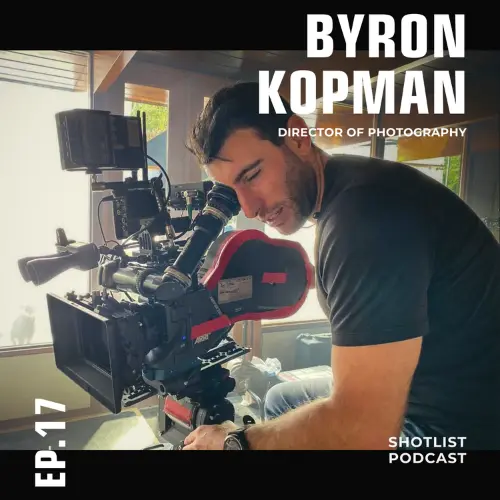
Episode 17 · August 21, 2023 · 1 hr 9 min
Byron Kopman | DP
with Byron Kopman, Director of Photography


If you're a DP trying to figure out agents, gear that pays for itself, or working in the US, this one's for you.
Byron opens up about the frustrating process of getting and renewing his US work visa, and what he learned along the way. We also talk about building relationships, the pros and cons of having an agent, the gear that's actually paid off, and why shorthand with a good crew is worth so much.
Key takeaways
- Learn while you get paid. Byron talks about growing his craft on the job instead of waiting until he felt ready.
- Agents have pros and cons. He's honest about what an agent can and can't do for a DP.
- The US visa is a process. Byron walks through the steps he took to get and renew his working visa.
- Some gear really does pay off. He shares the pieces that have given him the best return, and how to avoid the gear rabbit hole.
- Crew shorthand is gold. Working with people who share your work ethic makes every job better.
Chapters
- Get to know Byron Kopman
- Learning while getting paid
- Going job to job vs. a consistent income
- Pros and cons for working with agents
- Getting a US Working Visa
- The gear rabbit hole, the most-rewarding pieces
- The importance of crew
- Lighting diagrams and staying true your vision
Connect with Byron
Connect with Marshal
More episodes like this
Transcript generated automatically, with names corrected. It may contain small errors.
So then last summer I decided that I'm going to shoot something on 35 mil passion project, and it's going to be my piece that makes it raw and gritty and like the stuff that I gravitate towards. OK, so I shoot the project. Actually, I wrote it, directed it, shot it, funded it, I did everything. I finished it and it looks exactly like my other stuff on film, even though I was trying to be different, right? So from from that moment on, which is only a year ago, I realized that I have like a vibe. And it's the vibe is what's right for the project. Hello, and welcome to another episode of SHOTLIST where we talk about how to make a life and a living behind the lens. I'm cinematographer Marshal Chupa, and that was DP Byron Cottman.
In this episode, Barn and I dive into how we got to start in the industry and began to build relationships, The pros and cons of getting an agent and if it's worth it, whether or not purchasing camera equipment is the right way to go and what gear makes the most return on your investment, how to get your US working visa and the hoops you have to jump through, and how building relationships with your crew and creating a shorthand is invaluable. Barn is not only an awesome DP, but a very rad human all around. Which is no wonder why he's been this successful in his career. Today, I'm excited to bring this conversation to you. Let's dive in. All right, Brian. Well, thanks so much for coming on the show today. I appreciate you being here. Yeah. Stoked. So am I correct to say you're still on crutches from incident on a filming trip up north in Canada?
Yeah, that is correct. I'm 2 1/2 months post surgery. I had a little snowmobile accident shooting up a noon of it. Yeah, just like a classic accident. Nothing extreme, just snowmobile rolled over onto me. So could have been a lot worse. So I'm fortunate in that regard. Yeah, been a long time off of work and 1st a busy person like myself, not necessarily just in work busy, but just like life busy. I like being busy. It's being a major adjustment. So I'm seeing a bit of the light at the end of the tunnel right now, which is exciting, but I still have a long way to go. And how long do you think it'll be till you're back on set? I just booked a job two weeks from now. I had some caveats when I said yes to it, that I need to have an operator and that they knew I was on crutches.
So that one is happening. It feels a little bit premature, but I think like for me to be good back at work maybe three months from now to be like operating a camera and I think to be like how I used to be like running around with a Ronan. Yeah, I bet you that's another that's six months, I'm sure. Like, oh man, to be agile, you know, with weight add on so. What were you filming up there? We started off with one, and then we reached out to some, like preexisting clients that we shot with and then asked if they'd wanted to, like, piggyback on the costs of the adventure. Sounds like obviously none of it's a really cool place to explore. Not many people probably end up there. What was the project we actually were doing? It was like $7000 a person to fly up there. We had a very small team.
It was like four or five of us, so it wasn't crazy big production. But yeah, so we were doing Mustang survival. We did two pieces for BRP, so Skidoo and Can Am and then we did a piece for RCMP, which they're all like addons to things we've done in the past for them and other remote communities. So it just made sense for everybody. Very smart move of Carlo from Alterna. It was a smart move for everybody. That's cool. And then how long were you into that trip? When this incident happened? I was halfway. I'd say I left the trip five days early and had to leave the team. That was probably one of the hardest parts of it. I felt like I was letting everybody down, even though it's like not my fault or. But it felt that way, you know, Because, yeah, when it's such a small team, losing one is such a big deal for sure. What was it like getting out of there? Obviously, like helicopter.
How did that all play out? Yeah, another silver lining is that we were one hour of the seven hour journey we were planning to do that day One Direction like a one way trip. So I only had to get out one hour's worth of journey. So I actually snowmobiled back with my broken leg. Oh man, one hour. So me riding a snowmobile with a guide on his own snowmobile, if it was worse, like much worse. But our guide had all the sat phone and all the safety precautions to call like Mehdi vac or something. But at the moment it didn't. It felt bad, but didn't feel as bad as it got. Classic. Adrenaline. Yeah, right. You're in it, yeah. And I just wanted to get. Back what did you end up breaking or what was that a thing called tibia plateau. So it's like the top of your tibio right below your knee. So that came off and then my poor tibia got the working my the bottom of my tibia at the ankle. Also did the same thing.
Broke off there. Oh my goodness. So yeah, bummer. But it's my first major injury. Some of my friends that I mountain bike with or snowboard with or do fun stuff with, they're like we've lasted a long time, like if this is your first major incident, so there's another like. Silver lining for That's my life right now. It's just looking for positive Silver Linings. Yeah. And as a freelancer, how does that work? Like, was there WCB for a job like that? Or like you literally just dead out of the water? Like, I mean, that's probably something to think about for all of us freelancers out there. We don't expect these things to come to happen, and when it does, it can really. I mean the fact that you're saying out for six months, like, you know, that's incredible for us, living kind of like week to week and job to job, yeah. So two things I've learnt something I wish I knew before. This is luckily it was on a job.
So I got WCB, the program and they're being very nice to me and helping me out as much as they can. And if this wasn't, this is my learning. Us doing all this fun recreational stuff like that is slightly extreme. It's very beneficial, which I do not have, but I'm going to get is some sort of insurance that would, if I did this not at work, that would give me some sort of payback because like my mortgage has a I have an insurance I pay into. So I called them after this happened. And then there's such small print about like I had to literally be off work for like 6 months before it would kick in. You have to like, really hurt yourself for like some of these other insurances. So I'm going to look into finding out like I'm sure there's something where I could just pay 100 bucks a month or whatever and have a pretty sturdy fall back plan in case I hurt myself snowboarding or something.
Even just to cover the bills at the end of the day, like we all have mortgages, rent, you know, food, children, whatever it might be in your life and to knock yourself out of the game for. 5:45 months like that can really ruin someone. So I mean that's definitely a good point to just throw out there for all of us people who are reckless with our sports, but also freelance creatives, I'm sure that's a wake up call. So that's that's a rough one. But I'm glad to hear you're coming to the other end of that and hopefully back on set soon enough and getting back to be yourself. So diving back like I'd love to go from the very beginning, like, where did everything start out for you in this career? Becoming like commercial director of photography. Yeah. So I started filmmaking when I was 12 with the, like the family's camcorder. I think it was like high eight or something. Like it was like a tape based camcorder.
I'm 30, just almost 36. So like, that's kind of the age of when I was like touching cameras. So yeah, I'd film my friends. I was into mountain biking and snowboarding, so I'd film my friends, kind of the classic story. And as my friends got better, they would like sponsored and I would keep shooting and keep editing. Yeah, I just like really enjoyed it. I was quite good at biking, but I wasn't as good as some of my friends. Like as soon as started, backflips started coming out. I was like, I'm just going to stick to filming. Like I'm not. I don't have the the balls to be doing that stuff. I'm yeah. So I just kind of kept filming and out of high school. I was about to go to film school and a friend of my dad's recommended that I just go work at a rental house. So I'd already applied at a film school in Vancouver and pretty much got accepted because it wasn't like a fancy film school was like, you're going to pay the money.
Yeah, come on in. Right. So he's like, yeah, you should go work at a rental house. And I wanted to be in the camera department, so I, he gave me a list of names and like, go apply and just tell them I sent you. So I sent my resume to all these places and they all were like, hey, come on up for an interview because of this guy. Because he's a production manager, I don't even know what that was. But he doesn't big movies and he's the ultimate deciding factor who's going to rent from who. So, like people wanted to stoke him out. So I was very lucky. I went to a rental house called PS:. It's gone through two name changes since I've been there, MB S and SIM. But I went to go to the camera department, did my interview, and the guy gave my, my walkthrough. He's like, what did you think? And I was like, where's the camera department? He's like, oh, we got rid of it three months ago.
So yeah, we just do grip and lighting now. And I like, literally had no nothing to say out because I was like not prepared to do anything other than camera. It's like, you want to start on Monday and lighting. And I was like, sure. I was 17. Like, I had no clue. Like, so I just said yes. And all I knew what a light was was like the classic construction yellow lights that you set up for like shooting nights, night snowboard, rail setups. Amazing. Yeah. So I worked there 2 1/2 years minimum wage, 8 bucks an hour at the time, and I would just meet people that would come rent gear every day and I'd be like, hey, what are you shooting? Can I come for free and volunteer? And I literally worked. I'm not even exaggerating. Every single day, except for like 3 days in 2 1/2 years, five days a week at the place, and then weekends every back and forth. Like it was out of control.
But I was so hungry, so it didn't feel crazy at the time. And then from there I went. I just kept this lighting train going. I worked for guys doing MW, some movies of the week, like cheap feature films. And then I got an opportunity to work for a commercial gaffer named Ian Barrett, who I consider my mentor now. He offered me a job for eight shoot days, which I was going to make more money in eight days with him than six months at my minimum wage job, right. I asked the rental house, hey, can I take these eight days off and then I'll come back and and they said no, we can't do it. So I like the first time in my life I was like, I have to just do this for myself and I just had to bail on them like pretty pretty short notice, like a week or something. That sounds like a wild opportunity, that. Probably was a pivotal point for you making a decision. When I say because obviously that's a hard one, but what did it look like after that job for your career? Yes, I worked two years full time for Ian and then the writers or no, no, the writers strike. Something was going on with film industry and it wasn't that busy with him.
So I got offered to do a day call on Supernatural, the TV show, and then I went to do that. And then I just never left. They just asked me back every day, Can you come back? Can you come back? And then they eventually offered me full time. So I ran it by Ian and he's like, you should just do it. He was in it for me, you know. And to clarify, you're in camera department, you're in the lighting department at this time, still in lighting, but this entire time I was pursuing D ping. I was shooting on the weekends like, but I was making money in lighting. I wasn't really making money D Ping or can't doing shoots and stuff, just building My Portfolio. So it was nice. So I was still in the realm of film and very pivotal part of D ping is lighting. So I was learning, getting paid, but still pursuing D ping.
I definitely stayed at Supernatural. I worked there eight years, eight seasons, which is a big chunk of time, very tired. I stayed probably 2 years too long because I was so I just like the people we worked with. My boss was named Michael Mayo Brigham Gaffer. He was so helpful in my transition. The job with him was kind of my transition to full time BP ING. So eventually he let me like wean off of him slowly so I could still make money. But then he let me go do shoots when I got the opportunity paid shoots. Yeah. Eventually it became a hassle for him. So we mutually demoted myself down so that it was I wasn't like such a pivotal role in his team. So I was just like a day call hammer. You call it just like a worker. So I would just come and go. And then in the year after that I just, I went full DP. So I don't even know how long ago that was. The full time DP switch was maybe like 8 years ago. Since then I've just been pursuing mostly focusing on commercials.
I've done 4 movies, handful of shorts, tons of music videos is which actually where I was my main start. That brings us to today, where I'm just pushing for commercials. I'm interested in features, but I'm not super hungry for them currently. I mean that transition sounds a little bit natural there. I think that's a big the pivot point from like. I guess the trajectory that I see is a lot of like playing in the videographer realm, wanting to transition to DP Cinematograher. Not sure how to do it. It sounds like that happened a bit naturally for you because you're on these big sets with big crews and you kind of have that right. Transition bit. Yeah, it didn't feel as natural at the time, so it was so slow. It was very hard for me to decide to jump because working on the TV show, making decent money, you start getting a mortgage, you start getting things that are nice and then all of a sudden you, you're accustomed to income that you got to maintain or you got to step backwards.
So to go from making whatever I was making 80,000 a year, full time, 10 months a year on that TV show to go from that and then start off TP ING where you're not obviously going to be crushing it right away. You have to be like ready or have it planned to like potentially make 30,000 or something for a couple years or. Yeah. And then there's also the factor of like if you're freelancing, we have a consistent job in the union and then you move to freelance, like people like her handing up mortgages definitely don't look you the same, That's for sure. So I think that's also a big decision when it comes to going job to job versus a consistent income. Totally. So I was doing music videos. I probably did 50 with this guy named Mike Southworth, most talented guy in film as in general.
I think him and I did lots of music videos and then I was starting to do some commercials with friends. So like a friend would get a commercial and I would go shoot it because we were friends already. And then I was in Toronto and I'm like, I'm just going to, I learned this from my mom. He's like if you don't try you don't get in just like cold call and just don't e-mail phone call. So I just phoned production companies in Toronto, fully cold and I'm like, hey, I'm here on a job. I extended my trip a couple days to try and do these meetings which I hadn't even organized until like days before. And I got four sit down meetings with like someone at the production company. I sent them my reel and I'm like, if you want to chat, I'd love to chat. Here's my work. So I've got four sit down meetings. Every one of those meetings told me that I need commercials because I was trying to be in commercials, but I only had music videos and you need an agent.
And they all said this without me saying anything. And I was like, oh, damn, OK. And I tried, this is the thing. It's like, but the music videos like less money, less people, less time. But it looks good. Like, imagine what I could do with like the stuff and they're just like, no one's going to hire you if you don't have commercials. So from that point on, I started doing spec commercials. And I I've done a lot of them and I biasedly think it's one of the only ways to crack into the commercial market because people that are hiring want to see something that's a story told in 30 seconds or 15 seconds. Like, not necessarily that that's the D P's main issue. It's more like the director and the editing and and the base concept, but they just want to see that you've done it or been a part of it. At least, you know, there's a saying called wet white dog in commercials at least it's like, Oh no, but I've shot a wet white cat.
They're like, oh, sorry, we have to go with so and so Oh no. But I got a brown wet dog on my reel and they're like, no, no, we need the white wet dog. Like it needs to be exactly what we're shooting for us to feel comfortable hiring you until you get to a certain level where they're just like, trust that you can do it. For example, I now have 5 legitimate car commercials on my reel, but then I'll get put up against people that have 15 or 20. Like, who do you think the director or the agency are gonna lean towards? You know, like, yeah, it's a funny little game. Yeah. And that's tough because it's like, you know, you can do it, but when you look at it from their perspective, they're looking for like mitigating risk and trust because it's their name on the line. Yeah. So then I guess it really comes down to like relationship, getting those opportunities to shoot those first five like you have in the bag. And then just trying to, I mean, I don't know, a lot of this is a bit of luck and just relationship at the end of the day, I guess when it comes to building those. But I mean the spec thing makes sense because then you can kind of just make sure there's a few in the bag to start the momentum and then people begin to build a trust. Would you say that's how it kind of works 100%? That's biased in my experience, but I it feels to me unless you're very lucky or super talented like above average talented off the bat, then with a touch of luck then you can kind of like bypass all that.
But I feel that most people have to do that, some sort of spec or something like that to get going, right. And what's interesting now is that now that I've, I wouldn't say made it because there's so much room to grow, but I I now go back, I do like one passion project a year that I fund just to make my creative juices happy. But I find like, once you get in like the commercial, the majority of the commercials are pretty like dry. And like I'm kind of pigeonholed a little bit into the like bright kitchen, bright living room, like that kind of world. Like, that's kind of like my jam, which I enjoy, but it's like, I don't find it that cinematic as an end product. So I strive for doing like passion projects or even like specs for like friends. Companies that are not necessarily spec, but you can make them really cool, but there's no no one telling you not to.
So that's kind of like my my latest things, my friend Robin Taylor and I just did a piece for Olay Cocktails where we actually put our own money into it, Some of it. Olay put some and then we topped it up to make it cooler. That's one of my favorite pieces I've ever done. It's not out yet, but soon. And it all stemmed from me wanting to shoot liquid pouring stuff for my real. I worked backwards with Robin, the director. I'm like, I want to shoot this. I have this connection. I reached out to them. I'm like, hey, we want to do this, Can you pay hard costs? That's one way to approach it. Normally they don't have much money. Normally that's like 5 to 10 grand, and then you just like do favors. But you have some of that like base costs covered, which I've done successfully like three Times Now and it's worked pretty nice where you just reach out to someone like here's the plan, here's what we were trying to do. We're doing this for our portfolio. If you can cover the costs or the hard costs, at least here's like a rough breakdown of like what we think it will cost at a favor level.
And then normally they'll come as high as they can. I think when we when we first submitted a budget to Olay, I think it was like 26,000. Or something like that. And that was like no one making money. Just like gear and studio and like editing just like costs a lot of favors and they're like just like died when they saw that and I'm like what's the Max you can do. So then they took a few days came back with a number. So it was. It was less than half is what they came back at with. Which is funny, but then it just comes down to probably asking more favors or. Cutting the fat, so to speak, and getting a real creative around what you can do with very little. Is that right? Yeah, totally. And then that's why we we put, we dug into our pockets to make it. The concept wasn't cheap to no fault of theirs. It's just we approached them out of the blue. They weren't planning on spending any any money. But it's an Ave. that's worked for me a few times. So for anyone listening like it could work for you, I. Think it's a great idea?
Double whammy, yeah. Another issue. Say you do a spec like, where is it going to live? What are the eyes like? What's the purpose of it? So if you do these things that actually have a purpose, it's pushed on their social media. Like it gets more traction than just like sitting on your Vimeo page or your like whatever website with. 10 views? Yeah. No, I can attest to that. I would say I also like really am advocate of the spec spot, our personal work. I shot a spec a few years ago and honestly it is probably one of the biggest pieces people know me for and I'm just starting to see a few briefs come across my table. Of course, it's a few years later that it's now kind of established into my style and I'm like, wow, that brief looks like the spec I shot. That's pretty cool that it's actually translating down the line. But you know, that took years to kind of transpire and to see that even those trickle things come down to the ladder, so to speak. But I do think that's really cool to attach it to a brand. I think that's maybe something I didn't have with that piece I'm specifically speaking to, where, yeah, it does kind of just sit on the website or you have to really push it, I think. Would you agree?
And that's also a hard part, is like, you can shoot beautiful stuff, but if no one sees it, what was the point? Yeah, I guess half the point is for that time when someone's looking for the white wet dog and is looking for something like that, you have it in your back pocket. That's half the point. But yeah, you do want it to get some exposure and then someone ask, oh, who did that? And then then get hired that way. Like that's the dream for sure. I wanted to go a little bit down the idea of the agent. I know you spoke a little bit to that going around to these production companies and they don't want to look at you until you have an agent. I know from speaking to you in the past you've gone through a few. Tell me a little bit about that process of of working with agents for the first time and maybe some of the pros or cons. So I have like a very strong feeling and it's probably very unique to my experience. So I've had three total. I'm on my third one.
My first one was a company called Partos. It was stemmed from me getting all that input, saying you need commercials and you need an agent. So days after I got that those notes in person, I reached out to a bunch of agencies in like North America. And of course there's the big ones. And those ones didn't even respond to me like, not even like a thanks for submitting. We're not you're not right for our company. It was just like silent. I got a couple of responses and then one was like, we'd love you and I was like, oh sweet, cool, like someone loves me, like that's all you really want. So this company Partos based in LA, said yes. So with an agent in the DP World, it's different photography and different for directors, but for DPS you have to give 10% or more of your income and no matter what it is, as you come up, all your work is word of mouth and self brought in.
So for that first while you're giving them, say Marshal, you hire me tomorrow for $1000 and you call me right now and say we're shooting tomorrow. I have to give $100 to the agent for doing, in theory, nothing for getting the job in that circumstance. So no matter what, they're getting money for every single job. And you are now partners, so to speak in this you are not by yourself anymore. Yeah, in all fairness, like I do see the value in them now, but I think for me, I jumped into it too soon. For example, you are at the tipping edge of getting an agent. You get an agent now the agent is going to put you forward with, let's say 3D P's and then another DP agent is going to put another three. So all of a sudden you're the bottom of the the barrel in the experience and portfolio and now you're up against all these big timers.
So like for the first while, you just don't get work because you're just the least sexy thing on the website. New kid on the block? Yeah. So that's where I was for so long. So as the Partos went out of business, like I did get two jobs with through them that were, I call them organic. Like when a job comes like fully through the agent, like if you didn't have the agent, you would have never got the job. That's when you like yes, it's worth it. I had two through them which was really nice, but. What was the ratio there? Two to How many did you get for them? In the end, they made money off me because I was so busy with my personal stuff. It wasn't full rate crazy commercial budgets for my labor, but I was sending them checks monthly like 1000 at least and I was always scared to do the make a spreadsheet and see what I what the give and take was because it was very skewed right. So then part of us when our business or like scaled down, I'm not sure what they're up to now and then they put me forward or suggested me to Vanguard which is a Canada only agent. I signed with them February 2020. COVID hit March 2020.
I was with them for a year, year and a half, and I got not one job from them. And I gave them a year and a half. I gave them 10% of a year and a half of my life. So a lot of money. And I did really well, weirdly, during COVID, minus the first three months, right? So like, money just blown away. It was terrible. It was terrible. I don't have to say like, they were bad. It's just like finding the fit, finding if you're like going to stand out on their roster. And also this unfortunate to our relationship. COVID was three to five months of like kind of full stop down. So then I did a movie with Neil Blomkamp called Demonic and the trailer came out and then Sessler, who was one of the few people I emailed in the very beginning, they did respond, said I wasn't quite ready, which I appreciated a response slash honesty.
They reached out out of the blue when the trailer for that feature film came out and I've been with them and I have nothing but good things to say about them and the team just in love with them and it's a very mutual relationship as far as like finances. I bring in a lot, They bring in lots. And when did you sign on with them? A year and a half ago? I'd say okay. And they're in the States, so that must mean you've had to get your US working visa and all that sorted out. Yes, they're based in States and Canada like most their people work in Canada, but they have like a US agent named Michael Pepper, great guy and he so they didn't help me with my 01. That 01 is kind of like up to your own own person. But I had one before, so I applied for one before they last three years it expired and then I a year and a half into my second one.
That is a very nice thing to have. The one. It's hard to get, but it's so nice to be able to say yes and not feel sketchy about traveling across the border because it's. I have a friend who used to shoot snowboarding and then he was just traveling with some snowboarders and some camera gear, but he was working as the filmer for the team and then he got caught. And to this day, 15 years later, he still cannot travel in or through the States. Period. Oh my goodness, that's crazy. So crazy it's not worth messing around. So, yeah, let's talk a little bit about the 01. I am I'm sure a lot of people are curious. It's a path that I've been digging down myself, the US working visa thing and I know there's a couple options, the E1 and the 01 E one, you know obviously you have to as a treaty trader and you have to have do 50 to 100 grand in business with the US entity.
In the fiscal year and involves going to Toronto and doing like an interview. I haven't done so much exploring around the 01. I'm curious some of the hoops you may have to jump and some of the cost just for those listening it is very hard. So the cost, if you were to like pay expedited like kind of as all lawyers, I think you can do it with yourself without a lawyer. But like I couldn't imagine doing this without help. I think it was 12,000 Canadian for three years and there's no guarantee you're going to get it. So you pay this money and then you just wait and then like it could just happen or it can't. It could not. Oh man, one of the hardest things you need is you need two production companies in the US to sign for you saying that you are going to, they're going to hire you kind of full time, like a lot for the foreseeable future.
So in our industry, like even my best friend in the US, he wouldn't do it for me because he didn't. He felt not comfortable for on himself with the government. Like he's like I can't promise that I'm going to hire you every shoot like so yeah, that's a really, really hard one. So it just comes down to like meeting people with production companies in your travels and like just making friends. And then the the next hardest one for me at least was you need, I believe it's six, maybe it's three. I can't remember. You need articles that are published whether it's digitally or printed that are like heavily skewed towards you and that you are so special and you're you're written, you're written about in the article.
It's not like oh, Byron was the DP. It's like because of Byron's technical knowledge and da, da, da, it's like it talks about you and like like how special you are. So you need, I think it's six of them, those articles that is very, very hard. Yeah, that's not naturally something we seek out or have created on us without intention, so to speak. Totally, yeah. If you're in it long enough, you can dig it And then you need awards. You need like 3 awards. I think it is of any kind. It could be nominations or awards and then the referrals is pretty easy. You just need like people that are like cool in the industry or high up in the industry to, like, write you a little blurb. Yeah, that sounds like a lot of work I have. Like I'm nervous just talking about it. And what's funny is that when I renewed, I was like the renewal is going to be so easy.
Like I pretty much just copy paste it. It's going to be just a breeze. And it was like hard again, Not as hard, but it was like they wanted fresh stuff and like they had like dates where it couldn't be from way back when. They had to be like, more current. I was like, damn, I thought it was just going to be like, pay the money and like, just use the stuff from last time. Why does it have to be so complicated? I just that's frustrating. They're trying to protect the job market and what's interesting is Canada coming reverse. It's easy like I was. Going to say, yeah, directors, DPS, they can just roll up. That's what I've seen and. I'm not sure it's fair, but what can we do? We have to play the game that that's put in front of us, so we live in a great place, so we can't have it all. That's true.
We're Hollywood North for a reason. So yeah, I want to go down the gear rabbit hole a little bit with you. I think this is a topic that a lot of people are interested in and I just want to start out by maybe saying what do you think in the beginning from a gear perspective you should get into? Let's just say you're. You aspire to be a DP kind of where you're at, but you're just getting started out. You haven't broken in. Maybe you're in the still the videographer realm. Like what amount of gear should you be buying and what did you do in the beginning when it came to gear? Yeah, I think it's slightly different now than when I started because like now you can get like a really good looking image from like a fairly affordable camera. You could spend 3004 thousand dollars and get like 8090% of like $100,000 Alexa, you know like it's kind of messed up. It makes me upset because I own the like expensive thing.
So I think like the base things you would need is just basic camera. They're all awesome now. I feel like, you know even an iPhone minus depth of field is good. So camera with like DSLR lenses that are like fairly fast so your depth of field is shallow and a tripod like that's your base sliders nice. And then I never had this until like 10 years into my career but a gimbal would be next level. But it's just such a slippery slope when you're starting and also when you're at my level is like the cost is so much even no matter where you are in your level like it's just so aggressive. So like when you're first starting out to spend $6000 or whatever on a little base package is like so scary. Yes, I always had just a camera. I had like GL2 was like kind of my first like good camera. And then I had it HVX 200, Panasonic. And then from there I went to red and my first big investment, I got a line of credit for 30,000. I thought I was going to die.
I was like so nervous about it And I like bought set of lenses, big monitor, Matt box, so the camera looked fancy. So there's like a very basic stuff, no camera body, just like supplementary accessories because I was kind of pairing my package and another friend's package together to make one, like, better package. I teamed up with a friend is ultimately what I did and I still am today. So yeah, 30 grand. I thought I was like, doomed forever with the debt. I was like, I'm never going to make this back. And I had one older friend at the time, it's probably like 40 at the time. And he's like, you're fine, man, Don't worry about it. It's not a big deal, Be fine. And I was like hung on his words and just like kind of rolled with it. Now I'm just like slowly progressed and just got more and more and just slowly added. And what I try and do is per job, I buy like if the jobs are needing black arm, like majority of the shots need, like tracking shots of the vehicle.
I'll like, I'll buy the black arm. I'll buy the item that's going to help me and I will pay off like 1/4 of it. Right. It's like a guaranteed rental, guaranteed rental, and then it adds to my kit. So like, ultimately you're losing money, but in the long run it's helpful. What I would say the negative to owning gear is that I've heard this from a long time ago. I was messaging Larkin Sepal, who's like one of my favorite DP's. Never met him in person, but he was kind enough to respond about something on Instagram one time. And he's like, I don't like owning lenses because you just land up shooting on the same thing because it's convenient and cheaper, whereas like if you don't own gear, you shoot on what's right for the project. So that's one thing I've definitely fallen into in a negative way is like for the 1st 15 years I would shoot every single thing on the same package.
I do believe a lot of it is like lighting and production design and store. Like a lot of it is that it's 90% that. It's like that little bit of added something flavor. Yeah, from like the right tool, the right equipment. That's a negative. And it's also a slippery slope. I get to build my labor and I also build my gear separately and you're like, oh great, I'm making so much money. Awesome, so cool. But then like, oh damn, our Alexa's out of date. Oh, OK, $130,000 for the new Alexa And it's like, and then you're like, oh, I don't actually have that money sitting there. So it's like and then like a cable breaks $300.00 like, oh drop a filter $700. Yeah, it never ends. Really.
It never ends. And it's like, I love stuff. I love the gear. Like that's part of my draw. Finances aside, I love having the stuff and the initial start of it pre knowing like the financial reward is that like I wanted to shoot something and I was making money on Supernatural so I had like some income and I would just buy it to make my shoot better. Obviously you could rent it, but like my brain was like I'm going to spend $1000 on renting it and it's going to cost me 5000 to buy it. I'm going to buy it. Yeah, it's more of a longterm mindset too. Yeah. But now I've shifted gears in my mindset. Now that I have like a very good base package. We just with my business partner, the guy I originally started with, we just buy the like big ticket items and we don't really refresh the small stuff.
And then we just rent, we rent the lenses like obviously there's a big ticket, but like things that are like different per job, we're kind of like leading in towards renting. Yeah, that makes sense. And OK, So what are some of the ticket item or the packages? What are the pieces that you found most make the most income and that don't need to be refreshed the most? Or like what is the best purchasing items? Because obviously you can. Like you just said, maybe lenses aren't the best choice, although I know I think you do own a set of anamorphic crimes I think. What are some of the pieces that have been most rewarding for you financially? I guess because there's so many options, I've got a pretty straightforward answer for this with my travel I do a lot of like travel jobs, whether it's like a proper production or like commercial production, or if it's like a Arctic four person shoot.
You always need a camera body, you always need wireless video, you always need wireless focus and a couple monitors and like a director's handheld. So when I do a travel job that like has a rental house there and I I still want to like make some money on some of my gear I will fly with camera body, wireless, focus wireless video like a couple like 7 inch small HD monitors pretty much a roan into just stuff that like it would take up three check bags. As soon as you start bringing everything you ramp up to 9 check bags. So if you can do like two to three check bags your your luggage fees are 500 bucks round trip. Then you can rent big ticket rentable items to the production and then they just will rent tripods, batteries, big monitors, lenses of what you don't want to do.
And some rental houses are not into it is you don't want to like mow the lawn too hard. Everyone's trying to make money so if you can give like the rental house, the lenses, that's like a big ticket item so they're not too pissed off. I find sometimes that people get a little upset with me. It is all stemmed from them. The rental house is not giving me a deal. Like, the reason I bought the anamorphics is because no one in Vancouver would rent a small production anamorphics for a decent price. And then I was like, oh, there's a market here. Like, I know so many people that want to shoot anamorphics but can't afford it. So then I, like, partnered up with some friends and we bought a set. In the end, it didn't do well for us. We're trying to sell them, but that's how a lot of my like purchases happened, just to make my life easier. And how much of this has been like cash purchases versus like leasing because I know that's a route that I've gone down this past year getting into a couple of red bodies was and some wireless monitors and the bits and pieces kind of like the major stuff you're saying, you know I did that on like between three and five year leases. Is that how you've spread the load so to speak of like being able to afford that stuff or how have you business partnerships is how you've got around that or how have you done that? Yeah, it's so specific to everyone's like. Cash flow.
But for me, I did that first $30,000 loan and then I think I reupped. I paid that off and then I reupped it again. So I fully used it again. So I went to zero. Then I paid it off over time, working like my lighting job. From then on, I've just been, I've been paying cash for stuff, but I also have a business partner. So everything's half, but then you're also half the reward too. So it's like lower risk, lower reward. Yes. And like for example like since I've been injured my business partner and through our connections have been getting some rentals. Something I did hear though is that if you do go on a gear together, if that other partner is also bringing in more work for that piece of gear, then you would have been able to get in the 1st place. Therefore it is naturally beneficial to split the cost and you will make more because the amount of opportunity for that gear to work double s depending on who your partner is. So that's another angle I've heard for.
And then like my business partner leaves tomorrow on a travel job, which I would be doing, but I'm I'm injured, so I get to make a little bit of money sitting here healing and then my first job back because we don't do the same job together normally. Like we're removed these days. So my next job he will get half the rental for doing nothing on the job. So finding someone that you could, that's not your like. Right hand man for every shot, every shoot is very smart. It happened organically for us. We started off being very every shoot we were together. But as my career went a little bit more like bigger commercials and then he stayed in the like action sport, smaller commercial stuff, well we've like split a little bit.
Not a bad way, but just diversified. Yeah, when it comes to like refreshing gear, like I don't know, camera body is freaking, technology moves 1,000,000 miles an hour. How are you keeping tabs on flipping gear and stuff like that? Because you said we all of a sudden need to buy the new Alexa 35 for 130K. Like do you watch what the market's doing or when to flip cameras like I have. Any advice around that? To be honest, I don't like RED bugs me so much because they they just flip cameras so often I purposely. Don't pay attention to it. I wait until someone on Instagram or somebody's, like, raving about something or I see an image that's so cool and I'm like, oh, what was that shot on? And then that's how I found out that there's a new camera with red. It's like, red is out of control. Yeah, it's insane. Even with the Alexa 35, we didn't buy it when they announced it.
We waited for, like, a full release. I wanted to see it. It was, like, worth it. I didn't want to, like, spend so much money and move louder. Obviously it'd be five years newer or whatever the time differences from the old one, but I didn't feel like the Alexa Mini needed replacing. You know, if it doesn't feel bad, yeah, an incredible camera in and of itself. But yeah, I think some people have opinions of, like if you can get it on the release, you know, you can be the first guy with it. It's going to get rented out more in that first year. Like I know that's a strategy of some to try to get on it early or get it set up with a rental house who can just start renting it for you part time. Of course that comes down to your relationships with the rental houses and stuff like that. Have you ever stored your or got your sub rented with the rental houses at all or I've dabbled? Only with the anamorphic lenses it hasn't been great. I find like that scenario works better if you're just willing to like separate yourself with the gear. If you want to be using it once in a while, it becomes a hassle for everybody.
I have like focus puller friends that like own camera bodies. They're never going to rent them on jobs. They just own them to make supplementary income through the rental house. In that scenario, it's really smart because you just pay for it. You set it there. It's like an investment that's just, it's like owning a rental apartment and you're just like letting money come in. But if you want to use it like you and I, you have to phone them and and advance like. Hey, can you can I borrow? Oh, sorry. It's actually it's in Toronto right now. If you want to use it, we have to you have to pay the shipping. It's like I got to pay for it to come back to me. So it's good, but if you want to use it, I would not suggest it. Yeah, I also had that dream in mind when I purchased the Red Raptor and and the Komodo and they but ultimately like you just said, the hassle of trying to get it from them and they obviously want it sitting in the rental house to be able to hand it on a moment's notice and all those sorts of things.
It didn't make sense once I realized how much hassle it would be unfortunately. So I think that's, I mean ultimately maybe why having a business partner to split the cost with and then having that double opportunity to get it out there versus the rental house. I mean you know all different scenarios worth talking about I guess. But I mean it all depends on your personal Ave. in which your scenario is. So I wanted to dive a little in a different direction and talk about crew. I know from knowing you in the past you've kind of had your people and build some really good relationships. I've seen you kind of use the same people I know personally. You're Kelvin, who is your first A/C. It seems like, you know, I think you've joked before saying he's your working wife. We just spent so much time together. How is it having importance of crew that you have a shorthand with?
And then how is it like working now? Because you're getting into the US with Sessler and doing these two jobs, like being able to work with people you've never worked before and creating a relationship and shorthand, that kind of thing? The shorthand is the most important thing to me. And having someone that's your friend that you can lean on or they can call your bullshit, if you're doing something that like, dude, that's like not that good, they'll say it to you. Like, I really appreciate that. I literally bring Kelvin wherever I go and I pay for his travel because I appreciate his skill and his, yeah, the shorthand. So whenever I go to the US, we both work as locals. I really like it. I have another guy, Andrew Shirley, who's just so good at everything film and I try and bring him everywhere I can. Yeah, shout out to Andrew also. Awesome guy.
Yeah, both those guys. They've come up with me as my career has grown. So we've all come up together, which has been really nice probably the last eight years or so. We've been working borderline full time together. It just happened very organically and I just don't have time in my life for anyone that's like negative or. Actually, to be honest with you, my number one thing is work ethic. Just because I have a very strong work ethic and if someone's not, like, really pushing it, I don't like them very much is the truth. And that's I'm laughing. But but yeah, so Andrew and Calvin both have the work ethic like me, and then they're both good at their job and they're nice and like that's the trifecta in my eyes. I would rather have someone that's working hard and is nice, but not necessarily the best of their job and I would still hire them over someone that's the best.
Yeah, I agree cuz. You're spending so much time on a daily basis and if you're traveling together, it's like you wanna be able to just hang out 100%. Yeah, I agree with all that. And as you've been pushing into a new world, let's say down in the States, like obviously you can't always bring your people. So how has that been like developing new like relationships with let's say a new gaffer or grip or something like that and develop like showing up on set maybe for the first time or doing pre production with them for the first time. How has that been going for you? I've had some pretty bad moments, especially in LA. I've had like, really bad crews. I finally found two that I love. And in the beginning, you like, reach out to people that work in the States, and then you're like, hey, who do you recommend and? Always the good people are booked.
So it just takes time to figure out who works well with you and and then it's like it just comes down to availability. Like even in Vancouver where I know the most people, not always do you get your first pick, just the the good people are booked or are in demand. And then as far as like I believe very strongly in like lighting diagrams and just to make sure there's no confusion if they're not reading my mail like verbally. We're on this tech Scout. I make lighting diagrams and send it over and like very detailed just so that yeah, no complication or no excuses to not have. Hopefully no excuses to not have what we're asking for. And what are you using to build those lighting diagrams? Curious from a technical perspective. It's through Adobe Illustrator and it's a I think it's it's called Film Objects.
It's like a plugin you buy. I'm not sure if there's anything better. I grabbed on to this like. Four years ago I saw it on Instagram and I was like, this is perfect. And then it seems to be working. I'm sure there's probably something cooler, but yeah, it's working great for me because it's kind of just like a top down bird's eye view, moving simple objects and kind of putting arrows where the light might go is that it's kind of like pretty basic. Yeah, I don't even put the arrows. I just like light in the angle that it's supposed to like shine and then you use your mind do the illumination. And then I just like I write little like M18 with quarter blue and 254 by 4 frame and then I like have a little picture for 4 by 4 frame. And the obvious siders I don't put in. But like things that I like want to make sure the walls not getting beaten up with some light.
I like I add those in the diagram to kind of like emphasize the like the vision that makes sense. I was curious also because I think this happens to a lot of us DP's as the image goes through the pipeline. You know, we're here to shoot the image, get it in camera, get it on a hard drive, but then what ends up on the commercial or online maybe doesn't look like what we hoped it might be. I'm curious how much do you spend time to try to hold on to that vision? Like are you? And do you have any tips on whether that's like passing the LUT on to the colorist, or staying in touch with the colorist to the end, or like when it goes through that whole process? Like, how fussed are you about the integrity of the final image on projects? I've become less fussed because ultimately it's not your call on these like midlevel commercials. 0% of the time have I been invited to go to the color session on commercials.
I've offered to come for free and then they like. What happens is the agency is now in charge of the image and the color and the edit. Like even directors a lot of the time don't sit in on the edit. That's why everyone makes director cuts super messed up in my mind because like when I'm on set and I'm lighting something and like there's like this white wall and it would take us like half an hour to flag that off. But then sitting in on color sessions and knowing what's possible with windows, I'm like, let's not waste our time. Let's That's the color thing. Easy peasy. Then you just don't get invited back. You don't get invited to do that, and then it comes out and it's terrible and your walls overexposed behind your subject, so. I've kind of gone to like a middle ground where I I try and get it like I pick my battles and if we're not like super behind, I will like I'll fight for that kind of stuff knowing that I'm not going to get on, go to color and what I've noticed if you find a DIT that you like.
And you guys create like a decent like a look that you both like. You like I've noticed a few commercials I've done lately where I don't think they colored it. They just like used or they they use the dits like kind of like 1 pass or one light. It looks the same as my stills that I got on the day. I'm not a person that uses Luts. I don't know why. I just like kind of shoot wreck 709 and make it look how I want to make it look in the like base kind of color way and then like. Any sort of, like funky color in post is kind of a surprise. And I I quite like. I'm not sure if that's a detriment, but that's just my style. I don't know. I just came up that way, like I've never in my life. Put a lot on the camera and shot a commercial with like this. Like big plan. Interesting. I don't know what.
That means, but that's just the way I do it. Yeah. Because I know some DP is like, I mean, I don't know, getting real nerdy maybe comes down to be like how technical brained we are. But I know like some like you put like a under overexposure lot on there so you're like dropping your ISO and pushing like opening the blacks as much as possible in the camera. But of course that takes a bunch of testing and all that kind of stuff. It's even stuff that I have in the back of my head that I want to do and then I just never do it because it's so time consuming and I'm probably just not that technical, you know, when it comes to wanting to go down those roads. But I definitely. Know that everyone has such a different workflow. So it's yeah, interesting to know that that's where you land in the camp of that. Yeah. And one thing that I've like learnt the hard way and also like try to like combat is the way I like to light, and I'm sure most people do, is that you try to light it like middle ground where it's there's the shadows are salvageable and the highlights are salvageable. You don't want to like have it just unrecoverable. But what happens is.
Then in color they can go anywhere they want, they can make it night time, they can make it daytime like from anything. So I have this one instance which made me so upset as we did this like for Rogers wireless commercial we did this like. Cozy like Fort in a living room where it was like used bed sheets and it made this like kind of like TP thing And it was like, I was so proud of it. Like on the day I was like, this is so like I want to be there like I want to and then like it comes out and they just like amped everything up. So it felt like it was like daytime outside. It wasn't like cozy and like nice and I was like, damn, then like why? So there's like there's a school of thought where you you almost light it. Darker, like, unsalvageable, right? Yeah, you crush certain things.
Yeah. So I've heard some rumors were like with the Super 35, in the beginning, people were getting in trouble because they would like bacon, these nuts. They would try it and post, like take them off. But like, the DP was like pushing it so hard because of exactly what I'm saying. And then like getting, like, reprimanded on the back end. Oh man. Yeah, you can't really do it. I don't know. You can't really push it. But on the day, like if you do push it, they're going to call you out on the on Video Village, right. True. Some people go as crazy as like you said like put a light in that's under or overexposed so that the image that they're seeing is brighter than what the camera's capturing. And then you can it can be just darker because they're kind of forced into it because it. The noise ceiling hits too quickly and then they have to like they can't push it so hard.
Totally. I mean, I guess we got to choose our own battles and that's what directors or DOP cuts are for our own website stuff. But yeah, I've also learning that that's. Yeah. Ultimately you're making, and what I've learned is you're making it for these people. You're not making it for yourself. Like they're hiring you to do the thing for them. So like like I had this one instance with the agency. Agency quite often, especially in Vancouver, is always like, it's too dark. It's too dark. Out in the US, they're like, this is sweet, let's go a little darker. Like they're just more like they push it. No, it's totally, it's like constant. It's crazy. That's hilarious. But I had this instance in Vancouver where like, the agency, like called me into the tent and they're like, over lunch became professional filmmakers. And we're like, the eyeline's wrong.
The eyeline's wrong. I'm like, it's not wrong, I promise you like. I'm like. In my honest, professional opinion, I'm 1,000,000% right that it has to be this way and then they like they forced me to do it wrong. From that moment on, I was like, my heart's not into making this cool anymore, right? You've lost me. Yeah, and it's like in the edit. It's wrong, it's wrong. The guidelines cross like for no reason, right? They, like, fought me so hard and they wouldn't let it go. And I was like, well, you guys are paying me. So like it's not worth getting all bent over when I mean choose your battles. I guess that's the big part. I mean there's going to be battles doesn't matter what freaking shoot or set you're on. And so, yeah, ultimately that's where the that spec stuff and that once a year like you said or a couple times a year do those pieces that you have full control and you can make sure that creative part of your soul is fulfilled on our journey.
So when it comes to style, you know, you have a look, mood, feel to your work. Is that something that you felt came naturally or how did you develop that quote UN quote look or feel? And are there any kind of like recipes that you always go back to when it comes to like your lighting or your camera work or anything like that? So funny story is that when I watch something. Let's say on Vimeo or Instagram and I like, really gravitate towards it. It's always like moodier and like raw, more raw than my stuff. So then last summer I decided that I'm going to shoot something on 35 mil passion project, and it's going to be my piece that makes it raw and gritty and like the stuff that I gravitate towards. OK, so I shoot the project. Actually, I wrote it, directed it, shot it.
Funded it. I did everything. I finished it and it looks exactly like my other stuff on film, even though I was trying to be different. So from from that moment on, which is only a year ago, I realized that I have like a vibe and it's the vibe is what's right for the project. The project that I ultimately wrote was like summer and happy and like there's no need for it to be gritty and dark and. It's just like whatever's right for the project, I feel. And you get pigeonholed into styles and it's kind of where I'm at, you know, so like my style is whether it's like a a night interior or something, it's commercial. So it's it's brighter than like like a movie, you know. So I'd say my like general vibe is less, it's more polished. I'd say I definitely like strive for like a very like polished image.
I think it's hard to say because like when my wife looks at my, like when I was building my website like a few years ago or wow, I never knew you had like a style. But when you put all the thumbnails together, like, they're all kind of the same. And I was like, yeah, I never really thought about that. So to answer your question, I don't know if I kind of did, but it just kind of happens naturally. And like the people that you look up to that have like this style that you're in love with, try and mimic it, but like. You might find yourself like me, where you just kind of, like rebound into like your comfort zone or like what you find aesthetically great. I don't know. It's so bizarre. Like, I honestly, I don't know where where it's going to go from here. But there's that saying where you you got to like, master the rules to break the rules. I feel like when I look at stuff now and I'm like, oh, why wasn't I just like more like purposely rougher with the camera?
I would have just like edited better, yeah. I mean, when I see some BTS stuff of yours and Instagram or something or Stories, like, you know, I see a lot of dollies or sliders or stuff going on these days, It's like a lot more smooth, controlled or like is that kind of like the way you like to work having, you know, at the wheels? I've seen and stuff like that now with the ronin and all that. Yeah, I'd say my favorite style of shooting now is Dolly with ronin and then wheels and then headsets with the Dolly grip. Obviously depending on the shots and the location, but I just find it so good. I'm getting to the age where I'm like starting to feel the not such a big frame as you like. You're a bigger, stronger guy like the Ronan, and the ready rig has like, legitimately hurt me long term. I'm an inch or two shorter. I'm not.
I'm not even joking. I'm shorter than my wife. I was a little taller before. I used to just like wear the thing the whole day and like, it's more versatile, quicker, but it's just unnecessarily taxing. I agree. Yeah, the amount of weight on our body, I mean literally, I think is part of the reason I go to the gym is because just like literally strengthening your lower back and like being able to like, haul around big heavy shit all day is actually probably one of the things people don't think about this career path. That's part of it. Yeah, very physical, Yeah. Just before, you know, we've been to wind things down here, I want to ask you a little bit about the mindset of being a, you know, freelance creative. I think not everyone's cut out for this roller coaster of getting unemployed and reemployed weekly. So what have been some of your, I don't know. Yeah, your experiences and coming up through this sounds like you kind of had a stable career going on in the Union for, you know, the beginning chunk of your career and then moved into the freelance.
What do you need to do if you want to be part of this club, so to speak, and when it comes to like the mindset it takes? I think to get to a point where I'm at or a lot of my friends are where you just trust that it's going to be okay. So rewind to the like the building of that you need to just build like a rolodex or a catalog of like. People you know that know you that the quantity of people you know will eventually pay off in work. Some people say as soon as you decide you're DP, you got to just DP. If someone sees you like lamping lighting again, they're going to like think of you less. Like, I didn't do that. I would just go work or ever. Like I just wanted to be out there. There's two schools of thought, but more people you know, the more connections you'll have, the more top of mind you'll be to someone for some sort of income.
Not necessarily if it's where you want to go, but it's all related. Like everything you're doing in film is related to Deeping and directing. It'll make you a better deep your director. If you work in lighting, work in grit, work in art, you just will understand all the assets. And yeah, don't be precious over the title is my biased opinion because it worked for me. Yeah, I think trying to stay top of mind and then having enough different eggs and in different baskets where the heck that saying is. At least I found it so important because you know, you can have one great summer which is based on one relationship and it's everything is great and incomes coming in, it's all these jobs and then all of a sudden that just dries up and it's gone. You're like well, what what happened? You know, So I think having your hands in so many different places or at least, yeah, keeping that fire stoked, I mean do you find it hard to maintain all the relationships so to speak?
Like, I think that's like a bit of a juggling act that I struggle with a bit myself is like, how do you, if you're a busy DP, how are you staying in touch with these people all the time? How are you keeping things going? Is that something you struggle with at all or yeah, my biggest fear. Is not being available for the people that I really like and want to work with and continue to work with. There's so many talented people out there, the last thing you want is for them to find someone better and more fun to be with. But. In the end, like that happened to me with one of my longtime director friends, and then like five years later they came back and now they use me again. Like it, it comes full circle. And sometimes that end story I was talking about would use me for everything. And then all of a sudden they got told by their production company they're wrapped by and they're like all your stuff looking the same. You got to start using different DP's. So they just like went elsewhere and just did a new DP for every different piece and just kind of change their portfolio? So it's it's quite often not personal, but it's hard to not take it personally.
I was never told that the reason until like years later. I just thought they just bitched me and I was like, what the hell? Totally. That's yeah, that's tough. Yeah, it's an important part of our industry is this building these relationships and ultimately, like, these relationships are friends at the end of the day. And I think it's interesting to watch the seasons we go through because I again just like really hot, heavy, fast and then all of a sudden it's dry, cold and and you just staying there mentally. I think you brought it up just there at the beginning and when you start chatting about it, but just like knowing that it's going to work, which is super scary when it's quiet, just knowing that you've done it before, it'll come back. You just keep picking up the phone, you keep doing the personal work, keep that buzz going or the energy. Yeah, it's such a crazy part of this process of being a freelancer.
Is there anything that's firing you up right now in your career in the industry or projects that you got going on? To be honest with you, I'm very, it's like a very pointed question right now because I'm like very focused on just like health and just because of my current situation. So I'm like a little bit like I'm just so focused on getting better. I've also like we have a 2 year old, so like my and this time off is kind of showing me that I it's like good to be around. Like it only helps my home relationships flourish. So like definitely want to try and like not be so pinned. I love being busy. Like I love it. I'm a workaholic, like first to admit it, even if I'm not making money, I just want to be go doing something work related. But yeah, I just my my kind of like next kind of chapter is just to try and ideally do stuff that I want to do more versus like just say yes to everything.
Which I find it's even easier said than done. I've always wanted to do that but like I think I should try to try. And there's also a there's like a tax man. There's like a threshold if you start making lots of money it just they just take more. So this is like there's a threshold where it's not worth making lots of money if you're doing jobs that you don't like. Like I'm not sure if I'm, I feel like I'm in that spot because I I just pay so much tax and I'm like. I kind of feel like it'd be better just to make way less and then just have like having this time off and being broken. Now that I've been able to drive for a week, I've been going to like Whistler and going to the lake and like and I can't tell you the last time I've done that, that wasn't work related. I'm honestly going to say 15 years. Like I've just been like just like grinding and like not enjoying like the small things. It's just I'm like, wow, look at all these people. Like, what are they doing?
Wow, look at this world out here outside of our little film bubble. I'm not even joking. Yeah, I mean, blessing in disguise, right? Life does crazy things. And as much as it sucks that freaking break your leg apart, I mean, I'm sure that's definitely a silver lining. And I mean, life has so many freaking seasons, it's yeah, here's a new one, right? Yeah, totally. So where can people go to find your work if they want to check out your style? My most UpToDate. Portfolio was on my agent's site, so cessler.com and then cinema talk like you click through cinematographers and then find my name, Byron Cotman, my website, I been so busy that I haven't updated it in probably like a year or so, A year and a half, just Byron cotman.com and Instagram at Byron Cotman. But yeah, my most up to date is on my agent's website, socessler.com.
Well, thanks so much for coming on the show today, Byron. I appreciate that. That was a a fun chat and some cool insights in there I'm sure and the camera enthusiasts out there will appreciate and hearing your journey story is also really cool, so thanks for coming on. Yeah, Marshal, thanks for putting this together. It's awesome. OK, that was DP Byron Cotman. Byron is such an awesome guy and I hope he enjoyed some of his invaluable insights and how to build a career as a high level DP. I encourage you to check out some of his work on the Sasser website by going to the cinematographer section and finding his name. Or his website is Byron Cottman Kop man.com or it's the same on Instagram at Byron Cottman. In future episodes, I will be speaking with photographers, cinematographers, directors, producers, reps, and anyone who has decided to take this ambitious leap of faith and making a life and a living behind the lens. Stay tuned and subscribe to the channel on your favorite podcast app, and if you can take 30 seconds to leave me a star rating review, I'd appreciate that. If you hear something of value, feel free to show this with a friend or shoot me a DM on Instagram letting me know you heard something of value.
Thanks for listening and we'll catch you next time on SHOTLIST.