
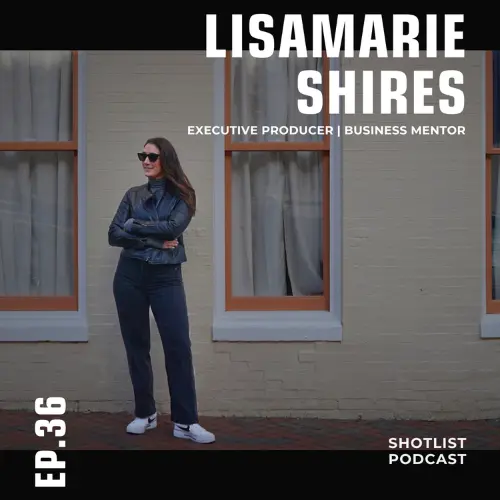
Episode 36 · February 19, 2025 · 1 hr 16 min
What They Didn’t Teach You in Film & Photography School: Building a Thriving Career Behind the Lens
with Lisa Marie Shires, Executive Producer & Business Mentor


This is the stuff they didn't teach you in film and photography school. If your work is good but your bookings aren't consistent, start here.
Lisa has been a photographer, producer and executive producer, so she's sat on both sides of the table. She knows exactly where freelancers get stuck. We talk about creating momentum, tracking the right numbers, and charging what you're worth.
Key takeaways
- Your work gets you in the room. Your energy closes it. Confidence and authority are what seal the deal once your portfolio has done its job.
- Outreach is about adding value. Don't just send your portfolio and hope. Build the relationship and stay top of mind.
- Track your numbers. Outreach, conversions, revenue goals. When you measure it, you know what's working and where to adjust.
- Detach from the outcome. Lean into the value you bring and trust that consistency builds long-term success.
- Compete on value, not price. Position yourself for clients who respect your expertise. Racing to the bottom on rates never ends well.
“The best investment that you can make is in your brain first. That's where literally everything originates that you have in your life or in your business.”
Lisa Marie Shires
Try this today
Set one outreach number for this week.
Pick a number you can actually hit, like five warm emails or two coffee chats. Track it. Next week, look at what came back and adjust.
Chapters
- Lisa’s Journey in the Industry
- Balancing Career and Family
- Standing Out in a Competitive Industry
- Effective Client Outreach & Avoiding Ghosting
- Mindset & Self-Worth in the Creative Industry
- Creating Structure in an Unpredictable Career
- Pricing & Competing on Value vs. Price
- Financial Management for Creatives
- Final Thoughts and Where to Find Lisa
Connect with Lisa
Connect with Marshal
More episodes like this
Transcript generated automatically, with names corrected. It may contain small errors.
The best investment decision that anybody can make, whether you are in production, in a creative field, like whatever you do, the best investment that you can make is in your brain first. That's where literally everything originates that you have in your life or in your business. So I'm just plugging. That is my favorite thing to share with people. Hello and welcome to another episode of the SHOTLIST podcast where we talk about how to make a life and a living behind the lens. I'm cinematographer and photographer Marshal Chupa and today I'm speaking with executive Roducer and business mentor Lisa Marie Shires. In this episode, Lisa and I focus on the theme of what they didn't teach you in film and photography school that is required to build a successful career. Lisa spoke to a three-step simple strategy to consistently be creating momentum and generating more work.
How to create measurable metrics for success and system that allow you to predict your revenue targets and make sure you're aiming to hit them. How to know your worth and the importance of energetics around money and believing in yourself and your rates? And what are the key things, things you need to do to separate yourself from the competition and position yourself and your unique value to your potential clients? Lisa's background and working not only as a creative herself, but in so many facets of the industry from producing, coordinating, and executive producing, has given her the gift of knowledge of knowing exactly our pain points we face as freelance photographers and filmmakers and how to directly address them. Having been on the other side of the table herself, this was a really fun conversation with a lot of value. Let's dive in. OK Lisa, thanks so much for coming on the show. Excited to have you here.
Thanks for having me, I'm so excited to be here. Yeah. So today I'd love for the Through line to be about, you know, everything they didn't teach you in photography and film school because I think there's a lot. And before we do that, I'd love to just touch into your kind of past history as a commercial executive producer. So I have been in this industry for almost 2 decades. My path, just like you know, many other filmmakers or photographers out there, was a little unconventional. I started out as a photographer shooting stills, editorial, commercial, like lifestyle type stuff. And I transitioned into producing about three years after freelancing full time as a as a photographer. I fell in love with it.
I had a business background, MBA, love math. And so it was like really the perfect blend of like creative and business. So I took the producer path first for commercial still photo shoots and campaigns and then moving on to the video side. It was like around that time where it was becoming very important for photographers to know something about video too. And I was like, oh, I want to like get in on this like commercial scene on the video side. So I've worked at some boutique production companies. I launched my own production company with a partner where we were non exclusively representing some directors and DPS. I've kind of like to look back on that as like we were some of the initial like non exclusive pioneers a little bit in that space. Worked in house at an ad agency, worked at a creative production company.
And so I've, I went from like doing all of the physical production, being the one on set, managing, coordinating all of the things to executive producer over time, managing a team of producers that were, you know, producing commercials and content all over the world. So it's been a wild ride. Learned a lot. I bet learned. A lot, yeah. And so where does that lead you now? So all throughout my career in like, I'm, I'm a girl, like I, there's like a natural nurturing side of me. And I think just like, you know, women in general. Not to mention, I think you're a mother of three, yes? Yeah, I have 3 kids, three kids under 10. Impressive. Yeah, Yeah. And actually, you know, they, they actually played a really big role in, in my career.
And like the trajectory and the decisions and the, the intentional choices that I made in my career, as I like, you know, transition from photographer to producer and photo to video. They, them coming into the world, all, you know, impacted some of those, some of those decisions. But throughout my whole career, I was always the one that people would come to asking, asking for advice. I was always the one people were asking, you know, what do you think about this or what do you think about this, either creatively or from a business perspective. I was always taking people kind of under my wing, showing them the ropes, mentoring, guiding. So I was informally, unbeknownst to me at the time, you know, coaching and shaping and, and, and helping people grow in their careers the entire time that I was, you know, making my way up the ladder from a production leadership perspective.
So a few years ago I decided to actually formalize that and got certified as a coach and I started coaching filmmakers and photographers on the side as I was EP ING for a company out of New York. So then I had to make a decision. Everything was really growing on that side. Everyone needed help and support, and I was finding so much fulfillment in serving the production community in that way and using all of my experience, all of my insights, to help make an impact on them and their businesses. So cool. I feel like, yeah, your background touches in so many facets and areas of the business. I love when life kind of comes together and says, hey, Oh yeah, I remember like that stuff you did for like 2 decades. We're going to like put that all into like a useful thing. And then you're going to get to do what you love.
Like I feel like when you hit that spot, I've I've, I've seen it or heard it a few times and I'm like, oh man, what a, what a cool place to arrive to. Yeah, just like proves out. Like none of that was a waste of time or none of that was, you know, those were chapters that all led to like the sequel that is now playing out. So super cool. I love that for you. Yeah, it's like there's definitely a plan and I have like seen it out. Amazing. So the first part I'd love to dive into then with you with all of the experience in in the Facets is just talking about getting hired. Because I think clients have so many options these days when it comes to picking creative talent. And I think a lot of like filmers and photographers feel like they're drowning out there, especially in the social media age. And we're all comparing each other. And so I'd love to just, yeah, maybe the question is like, what are the things that are setting apart top directors, DPS, photographers amongst the noise and, and what can people do to help themselves when they feel like they're drowning? I love these questions.
So like you said, there's a lot of competition out there. There are 1,000,000 and one other people out there doing exactly what you do. Whether you're a director or DP or photographer or producer, like whatever you do, there are lots of other people that can do what you do. But you are the only one of you in this world. You're like a thumbprint. There's nobody else out there like you. Maybe your portfolios or your reels might look similar to other people, but the way that you think about the craft, the way that you think about the work, the way that you approach the creative, the way that you approach your relationships all come from influences obviously, that you've had over your life, whether that be spiritual, mental, environmental, physical, social, you know, like the list goes on. So to stand out from the crowd, you know, I feel like filmmakers, photographers, there's always a lot riding on the work, a lot riding on the portfolio or the real. And my point of view, which might be unpopular, but it's mine, is that the portfolio like doesn't even matter. Like it, of course it matters, right? You're not going to get in the room or even, you know, be considered for a job if the work isn't to, you know, a certain level of like demonstrating like, OK, you are technically where you need to be and you have, you know, an eye and like and vision.
But so it's just assumed everybody's portfolio is like where it needs to be. So then what's left? What's left is you. I tell my clients all the time when they're talking to brands, producers, creative directors, you know, people that are in the roles where they're typically hiring for people like them. They're buying the person first, they're buying the relationship, they're assessing the vibe, they're assessing your personality and the energy that you present with. Because again, the portfolio is like is just a given, right? So it's all about the energy that you present and you bring to the table when you do have opportunities and even before an opportunity exists. Because as you are, you know, working to build your network, you're working to build your client base.
You're trying to like, you're out there, like trying to get work in all the different ways you can do that. The confidence that you show up with the leadership that you demonstrate, the thoroughness that you illustrate when it comes to like the creative and the brief, if there's one, you know, available. And just like your mentality about like a partnership in general and putting the client first over yourself and what you want as an artist. Like those are the things that are going to set you apart. Those are the things that are going to make any client, any potential client look at you and be like, huh, you're interesting and like lean in a little bit because you're bringing more than just a like here's my real hire me base off of this. Yeah, I like that. It sounds a lot like dating. You're very much just like, you know, and also how do you add value instead of thinking about what do I want, what can I give, what can I, yeah, show up with and how do I make their life better? So that's sounds beautiful.
But I hear my audience saying like, OK, well, what are some practical things? Like, does that mean I need to? How do I, does that mean I have to have a different messaging in my emails? Does that mean I have to like, I don't know, present something that others aren't doing? Like what does that mean? Like practically? So practically that means number one, you're thinking about them over yourself. Because when you're thinking about yourself and like what you want, you're not thinking about them. And if you're not thinking about them, you're not going to be able to come to the table with the type of solutions, with the type of ideas, with the type of like, I don't know, like techniques that might like serve the creative and elevated and like all of the, all the things like that. So from a practical perspective, number one is get really, really clear on your positioning. Get really, really clear on your messaging.
What are the things and you use the word like adding value. It's like you're thinking about how, what are all the ways that I could be adding value? How are how are you reverse engineering when you're thinking about your client and what they really need going, you know, a few layers deep, like below the like past the brief, like what they really need is to look really good in front of their clients. What they really need is for their clients to walk away from set like totally like blown away because that's going to mean that they're going to retain that client, they're going to come back for more. Everybody's happy, happy all of the the content converts and like does stuff for them. So knowing that it's like, OK, you need to start talking to these clients how they want and need to be talked to. So you're you getting clear on who you are as an artist, getting clear on like what's in their heads on what they really need. And then using that in the way that you talk to them in the things that you say and share via e-mail beyond just hey, I'm Marshal, check out my reel.
Would love to work with you sometime. Like no one's going to care about that. They don't care about that. So you have to use every single opportunity as a touch point to showcase your genius, your expertise. Tell them that you can help them and how give them some insight into your process. Let them know something about you and how it can serve them before there's an opportunity on the table. It's like this idea of you're you want to get like concert tickets right? And you put your name on like a wait list and then you're the 1st to know like when the tickets become available or something. It's the same kind of idea here. You're pre selling them so that they are like 50% or more already sold on you before the opportunity exists because you are just like you're speaking their language. You're building trust, and when trust is present, you're transferring certainty to them.
And it's like a yes. Like, of course, like, yeah, your name's in the ring for the next one that comes along. Yeah, that makes a lot of sense. Like pre selling. Yeah, building trust, all those things. Yeah. So the follow up Ian, you mentioned this already is like, I've heard this from multiple of my peers. It's just like, you know, I emailed a bunch of people and set My Portfolio and you know, I'm getting ghosted. It's just like, OK, then what? How do how do you reach out to people? How do you not just send a portfolio like what are the value adds? How do you create the Yes, the presale? It starts with you first. When you're actively out there proactively, like reaching out to people, trying to get their attention, trying to build these relationships, you first have to have such a rock solid belief in yourself, your worth, your value. Like you have to believe in those things in order to make someone else believe them about you too.
If you are wobbly in that area, you're going to transfer that uncertainty to them. And so like, first and foremost, you need to be rock solid on yourself. Second, when you're doing like this type of outreach, you don't hear anything back or like maybe they send a response and then it never goes anywhere and you follow up and you follow up and like nothing, nothing, nothing, crickets. The next thing that you need to do, and it's really hard to do this, but this is truly just the nature of the game. If you want to call it a game, it's just business. It's making the outcome that you perceive to be unfavorable mean absolutely nothing about you mean absolutely nothing about your work, nothing about your worth. Because what happens, and I mean, maybe you felt this before I, I did like years ago, before I, you know, really got into this work is you don't hear anything and or like they're there and then they're gone and they never come back.
It's like, OK, they didn't like my work. It wasn't good enough. There are other people that are better than me. You know, you can like go into a mental spiral. So like you kind of like detaching from that and just remembering like it means nothing about you. Especially like if you're reaching out to a producer or to a creative director, they have one million things that are all begging for their attention all at the same time. So you're rooting in the belief that someone needs to hear from me today and every day going forward over and over and over. If you're adding value at each one of those touch points, then you're not just like, hey, just checking in. Hey, just checking in. Do you have anything coming up like that's going to be like there are people, a lot of people that resist the follow up because they're worried about being annoying or, you know, coming off as like graspy, like that's going to come off as graspy. But if you are doing your follow-ups and you're like, hey, I saw this spot that, you know, you guys just put out like this one specific thing really stood out to me. Please, like kudos to your to your creative team. I just wanted to tell you guys how much I loved it. Would love to, you know, continue like developing our relationship.
So telling people that you like their work is definitely adding value because it shows you're paying attention and you're you're you're thoughtful in that way. You could be reaching out to them in a follow up and saying, you know, hey, I saw this, that this company did. I'm noticing these trends. Here's how I think about that as a director or as ADP or as a photographer. These are my thoughts on that. What do you think? How do you think this applies to your brand or, or would apply to, you know, some of the work that your clients are doing? If it's an agency, it could be like, Hey, I just I have this new work I wanna share, but like sharing new work is great. But if you're pairing that with actual data with actual metrics of like, hey, here's this spot that I directed brand new work. Would love to get your eyes on it.
I could see this like being something that this brand or this brand that you guys work with could like really it could it like kind of matches their vibe and it got, you know, 15 million views. And I know that it helped them increase their sales by X percent. So like having information and data like that, like almost like case study ask is going to get people's attention. So there are like a million and one ways that you can be adding value just by stepping into your authority and having a point of view. Yeah, I agree with that. And I think the piece that you spoke to though, that hit really hard. It's just like, don't attach yourself worth and value to the response you're getting. And I think I've heard this. Oh, I can relate so much. Obviously I'm a creative and also from so many of my peers, it's just like you watch them get knocked down emotionally, mentally, spiritually, for all the matter, just like, and I think that's as creative. That's not something that happens. So say for example, you run like a, I don't know, a construction company and you didn't get the job for building X thing or whatever.
You probably wouldn't be like, Oh, I'm not good enough. You'd be like, oh, someone outbid me or I wasn't didn't time it right or whatever the heck it is. Whereas I think as creatives, we just assume it's us because we're so attached to like the work we create is our own stamp. And so I think that's such a important piece to remember, which leads perfectly into my next question in and around mindset. And it's just like, I think a big theme I see from creatives is just not knowing their self worth and knowing their value that they have to bring to the table. And so I like, I have friends who are incredibly good photographers, but like, you know, they should be shooting for the Nikes, but they're just, you know, they're again shooting that few $1000 day rate instead of the few $1000 campaign. So speaking to those people, do you have any advice in and around? Yeah, creating that inner authority and value to bring and trust in yourself to then bring to your clients.
Yeah, I do. And it's kind of like along the lines of like what I was sharing a minute ago. But when you're in situations like that, especially from a mindset perspective, the most powerful thing that you can practice and learn to get really, really good at is detaching from the outcome because you, you're making these connections, you're meeting people like, you know, people are sending you briefs, they're considering you for jobs, whatever, whatever. There's the thing in the back of your mind of like, I'm either winning or I'm not. I'm either getting paid or I'm not. So it's very easy to attach to those outcomes. And when you are attached, the quality of what you bring to the table deteriorates. So what I mean by like detaching from the outcome is really being like you're a passionate participant while also being non judgmental at the same time, non judgmental about yourself, non judgmental about the creative, non judgmental about the, the, the budget, etcetera, etcetera.
And so then the question is like, OK, well, how do I, you know, practice this? How do I detach? How do I detach from this outcome to allow myself to show up to my fullest potential for the client and for and for myself and for the creative? And it breaks down into like three things. One is simply just like deciding that no matter what this outcome is positive, negative, whatever your perception of that of of of the possibilities are, just deciding that this doesn't mean anything about you. This doesn't mean anything about me, has nothing to do with me. Right. This has nothing to do with my identity, who I am as a person, who I am as a creative. 2 is deciding that no matter what happens, this is going to be one of the most valuable experiences that I have.
It's valuable to me. It's going to be valuable to my growth. I'm meant to learn something, regardless of the outcome. So whatever happens, I'm going to learn something. A business principle either way. And then #2 is reframing uncertainty of like, I might win, I might not win. I don't know what's going to happen. I really don't know what they're thinking. Like whatever it like reframing uncertainty as like this is an opportunity for me to dig deeper. This is an opportunity for potential. This is an opportunity for me to expose more possibility from the project at hand. So it's constantly being aware of your brain and how you are thinking and kind of like following those three steps and reminding yourself like, this doesn't mean something about me.
I'm going to learn something no matter what. This is going to be freaking awesome either way. Just could be a little mind bendy, especially if you know you're you're you really need the job, right? Yeah. And I think that's the challenge. I think a lot of freelancers, photographers and photographers, whoever you are, especially in the industry right now, it's just like I'm experiencing myself. It's just like, how can I wake up when I feel that freaking scarcity mindset hit me? I'm just like, you know what? That job just went away. I have no idea where it went. I have nothing on the table. How do you still show up and be like, I have value to add to the world. It's not about me. Like that's like, I don't know, it's such a massive that's such like it's inner work is like it's not even about your career anymore. It's about your own inner journey of self. And I think I don't know when we sign up for this freelance roller coaster of a career.
That's like the one of the biggest things someone I think speaks to. It's just like, I don't think not everyone's built for this. They'll tell you that like so many people are just like, I know even that was funny. I, I just, when I mentioned my lifestyle to my sister, she's like, I would never do that. She's just like, I, I love consistency. I love my routine job as a nurse and just like knowing what my schedule is and I know how much I'm going to get paid. And I'm just like, yeah, I, I don't, I haven't known any of that for 10 years now. So yeah, I don't think everyone's cut out for this, so to speak. Well, you know what? You bring up something that I think is actually really important. You mentioned like 2 words of like consistency and routine. Whatever your title is, this is a creative field. So like yes, you are creative, you are an artist, you have great ideas, but you are also a business owner and ACEO who needs to show up in their business every single day. But you can't show up in your business if you aren't self LED, like if you aren't leading yourself. So that's why I like to say when I'm working with, with filmmakers and photographers, like I'm helping you grow your business from the inside out.
So it's like this beautiful dance of like mindset and like the mental side of things and strategy and authority and confidence and using all that to get you in the room to get you in the room to get you having conversations with people you never would have dreamed you would have, you know, been talking to get briefs across your desk. Because you showing up, sticking to a routine, you showing up like I'm showing up. Even though this kind of sucks right now, I'm going to keep going. I'm going to keep doing the work. I'm going to experiment. Business is one giant freaking experiment. You are, you are putting yourself out there. You are trying new things, you're saying different things to different people and you're getting information in return. How is it landing? How is it not landing? And so you showing up and doing that every single day, whatever your strategy is, is going to give you information that you're going to use to be able to then root in the belief. OK, I know what I need to do in order to turn the faucet on. I know what like business activity helps me generate meetings, what helps me get, you know, briefs, What helps me, what helps people like know like they know where to find me. They know where to call me and like they know how to use me and to utilize my skills and my genius. OK, on that note, let's talk strategy then, because I often feel this.
I've had this discussion with a friend recently. It's like both freelancers, both freelance creatives, and it's like you can have any number of things you could do with your day when, you know, I'd say the amount of days I actually work as a cinematographer on Saturn, like, you know, so little and compared to how many days are in the year, there are so much free time and so much, so many options. It's like walking into the toothpaste aisle and be like, OK, I don't actually know what to choose to do with my day. So often times I sit down on my desk, I look at a blank piece of paper and I, you know, and I start sketching out like, OK, well, what should my day look like? And often times I'm like, am I choosing the right things? Are these things that move the needle? I don't know. I'm kind of guessing I'm not really clear on if I'm choosing the right things or what I'm doing today is like the thing I should be focusing on. So what should photographers, cinematographers, freelance creators be thinking about when it comes to choosing the things to move them in the right direction?
How to structure that? This is such also such a good question. So strategy is a very personal thing depending on who you are, the niche that you're working within, the type of clients that you have. Like strategy can be really like nuanced and customized based on that. But for everyone, like if I boil things down very, very simply as like standard strategy, no matter who you are, what you do, that strategy is every single day you need to meet people as many as possible. You need to tell them what you do. You need to share what your genius is so that they know how to use you and you need to make them offers. And that offer could simply be just like you're just communicating to them like I can help you. I can help you with this creative problem. I can help you with this strategic visual problem.
So me people share your genius, tell them what you do and make them offers. That's it. You do that every single day. You're going to start to see results. But also if we take this a step further, I like, I will always lean into the math. This is like where my like economics and like MBA brain like comes into play. Like I will always fall back on the numbers and always fall back on the math. So if you're sitting there and you say, OK, this year I want to gross $100,000 like you being able to back into those numbers is going to show you exactly what you need to be doing and the how heavy of a lift you need to have on the business development side of things. So if you're like, I need to make 100K, my day rate is this. That means I need this amount of days on set. You know, if you're a production company is a little bit different, but you get the idea, right? And I know that if I reach out to people cold or warm and I go on like based off basis off of like industry standard rates, like I'm going to see a 10 to 20% response rate, like positive response rate to those efforts to that outreach. Whether you're in the DMS or you're sending them an e-mail or is this like a real life like networking type event? You get a response 10 to 20% of the time. And then maybe like 2 to 3% of those people convert to you bidding on something.
Are you like getting an award or you, you know, getting getting the job, then you have so much information to then tell yourself, OK, that means I know I need to be meeting this many people a month, this many people a week, this many people a day. I need to be telling people like what I do and how they can plug me in. You can then like start to make a plan and then establish your routine and hold yourself accountable to making it happen because you know you have this big revenue goal. I like that it's creating structure out of uncertainty, essentially, or it's creating structure in something that feels like there isn't structure. At least that's how I feel and have felt for a very long time. It's like, OK, like I don't actually want to unpack the last decade of doing this. I'm like, how have I been doing this? How is this working? Like it's still, I'm confused a decade later of just like, you know, and often times it always is comes back to The Who you know, what opportunity arises, staying in touch with them at the right time, all those sorts of things. But I love how you kind of like use your math brain and just MBA brain and like created structure to that and percentages and OK, so I love that it creates that way you can kind of actually unpack and backwards analyze a step by step process with proven kind of results, so to speak.
What are the tactical things that we should be doing to create that structure? Like am I making a spreadsheet with all the names I can think of and or am I why should IDM over e-mail or should I pick up the phone or not? Like I had so many different people tell me different things. So what is your thoughts on that? And this is like another thing that's going to be like very personal to each person. So there's like the tracking and then there's the actual action taking, right? Tracking. You pick your poison, like do it however you want. Just make sure you're you're tracking it. So then you have a record to go back and be like, OK, you're sitting there one day and you're like, I don't have any work and no one's calling. And it's like, OK, well, let's look back and see what you actually did over the last couple of weeks or, or a month or a couple of months, right? Did you put in the effort in order to get you the result that you're hoping for? Because the result's not just going to like, fall on your lap.
Right. But sorry, before you go ahead, I think that's actually a important piece because this is something I struggle with. So I'm going to speak to about like I'm someone who will make a spreadsheet and then make ACRM and then come up with like 17 different ways of tracking things and looking at things and not not utilize any of them. Like I have fun building them. And then I'm like, I'm not actually going to and I don't actually want to use this thing. So I don't know if there's anything you said. It's obviously personal choice, but do you have anything that you're like this I see often helps creatives nail this down for them because I often times seeing information in a certain way is quite important to me. So I'm curious if there's anything versus like HubSpot for me. I tried that. It's like overwhelming. There's way too many data points and I'm like Jesus Christ, I can't do this and so. Yeah, I mean, it's a super robust system, but like I, I ran this whole intensive with my clients back in November of last year, kind of like trying to solve for one very specific problem.
And that might feel familiar to you or for like any of the listeners of like, OK, I get the motivation to sit down and like do all this business development stuff and like reach out to people and slide into their DMS like sharing the work and this and that I, and I'm like on fire. And then I get called for a job and then I am completely like sucked out of life for like 2 weeks straight. And so the business development of flow is very like abrupt start, stop, Start Stop starts off where I leave off like it has too much time passed. You know, all that stuff starts to come up. So I came up with a, a flow for my clients that utilizes the simplest elements of HubSpot, like the simplest that canned templatized emails that you can easily quickly, just like pop it up and then customize based on the person you're reaching out to.
So that when you're on set and like when you're on your break, like you can pull up HubSpot on your phone and see like, OK, I'm going to hit up two people while in like the next 5 minutes on my lunch break and here I already have everything ready to go. I'm going to tweak a few belittle things, make it custom to them and out the door it goes. So then it's not so Start Stop because when it is Start Stop, you're just prolonging the amount of time between you and the next brief you and the next project. So keeping it going is really, really going to be crucial, a, from a visibility perspective and B, just to like feel like you are accomplishing something like having that almost like a dopamine hit of like, OK, I'm not behind. Like when you get home from that job, like I'm not like digging out of like all this admin stuff. I mean, you say you have something that is stripping back HubSpot, like what is that tactically you just have?
Yeah, it's just a very simple pipeline. A very simple pipeline of like you're putting all of the people in on what I like to call your big list. So all of the, you know, companies that you might have worked with before or like you've been in touch with before. And then all of the cold ones too, all of their information and you're moving them through the pipeline. Like if you send them an e-mail, they move to the next stage. If you've sent them a DM, they move to that stage all the way up until like ideally there's a job opportunity at the end. But like also like follow-ups and stuff are like built into it too. So you can customize those pipelines for whatever makes sense for your business. But it's nice to have a visual of knowing where people are in that pipeline knowing like, OK, I've already reached out to these people. Maybe it's time that I like see if I can get their buy in and consent and pitch like an original idea as a way in, right? So you can start to get creative when you have the visual. And when it comes to technical software to do this, I mean, I'm just, and again, I shouldn't ask this question. It's just me being super nerdy.
And just like I've tried like 17 programs and all the things. What? OK, I can see the pipeline. I can see almost the Kanban board move them from left to right. You know, I had like a business mentor for a while. He was just like, that's it. You take the people from the left and you move them to the right. And I don't care how many phone calls you got to make, but your goal is to get them over There is like baseball, first, second, third base, move them over, go. And I'm just like, oh man, I am like this feels so salesy and like, so, yeah. So I think that's another good point though, is it feels salesy and I think creative don't love feeling salesy, you know? So this is a great point and it's a big fear and it's honestly a massive thought error because if you are rooting in the belief that Ioffer value, every time I talk to somebody, I give them information that they need to make informed hiring decisions.
I they need to hear from me. They need to know that I exist. They need to know that I have a solution to a problem that they have. Then how is that salesy instead of service? I like that you flipped it back on me. I like. That Jedi. Jedi magic, Yeah. Yeah, and it's like how to make if you know your can add value into someone's life, then technically it's not sales you're trying to. And if you actually generally could help them with a thing they're actually trying to achieve, then no, that's not. Again, you actually want to talk to the person when you walk into the store and the person's you get an A vibe off someone or they're actually trying to help you or they're just trying to like sell you something right there. So I think, yeah, flipping that energy is a very great way to think about it. And I think that's a massive mindset shift.
I think a lot of people need to figure out, I feel like we want, I want to hit. And so as we're still right there, I feel like there's another piece that could go deeper in self worth when it comes to value, 'cause I think what you just said kind of like hits me in a place that is like feels true. So then how do you then begin to like really believe these things? Is it like, OK, I'm going to get up and read these mantras on a sticky note every morning and we're like, how do you actually begin to shift your mindset around this stuff? Yes, exactly, exactly what you said. You can write them down on a sticky and you're seeing them every single day. It's like you are just believing the end is already here. I'm just like using money as an example because that's just what's coming to mind. I did $100,000 in 2024. I really want to hit $200,000 because of this reason. This reason and this reason.
You coming to the table everyday like what it takes to become $100,000 earner is not the same as a $200,000 earner. So you starting to embody who do I need to become to be the person to be a $200,000 earner? What do I need to believe about myself? What do I need to believe about my clients? What do I need to believe about my community? What do I need to believe about money in order to become a $200,000 earner? And then just adopt it in the belief like I already am. I already AM that person and I like to have my clients practice this technique. Just it's called stacking the evidence. So every single day you are like jotting down or every single week you're jotting down like all of the things that you experience in that week that point to those things being true.
And so even if you are not in the full belief of this yet or you're not seeing it like tangibly or feeling it yet, you are looking for all of the reasons why those things could already be true. And you stacking that and stacking that and stacking, it's just like habit stacking. If you've ever like read Atomic Habits, it's like a similar concept. It will change your life rapidly. You're going to start to feel things differently all of a sudden, like and this is like more like business energetics, but all of a sudden, oh, I have this job opportunity and like this thing came up and like, oh, this like connection like happened. Like stuff is just going to start to happen when you start to believe in yourself and believe that you are here to do and serve a certain way. So I can just, I'm going to relate to that personally, I'm actually good at that and I'm inconsistent with that. So I'll have weeks where I I'm start the morning journaling, drop into the vision, you know, write it all like, you know, read over my 10 year vision drop into the energetics of feeling into that.
You know, I'm like listening to inspiring music. I'm like, woof, like I feel like through the roof. And then a couple weeks later, which I find myself in now I'm like, yeah, I'm highly unmotivated and I don't I'm none of those energetics are there. So I'm curious when it comes to consistency, perhaps of like life does this roller coaster energy thing and it's like, how do you consistently show up into that? I don't know. Do you have any advice around creating structure or are you putting this on your calendar? Are you? I have no idea. Yeah. Yeah. I mean, there are things that you could be doing, like you can be like calendar blocking and actually like booking the time and whatever, you know, accountability tools that you have or like to use, like you could be implementing. But that doesn't mean you're always going to follow it because you are a human being.
You are a human being with a range of emotions. You are a human being that is experiencing a lot of different things and being influenced in a lot of different ways. So the number one thing to combat, you know, that sense of inconsistency is awareness that is actually happening You and you are like in the awareness of like kind of like in a little bit of a slump. OK, I'm going to accept that. I'm going to allow that to be there and allow to like sit in this. I'm going to give myself like an hour to feel this way. And then I'm going to start to reach for the tools that I know are going to pull me out. I'm going to put on that inspirational music. I'm gonna revisit my 10 year vision and just you're, you're bringing yourself back gently or aggressively depends. You're you reach for the things that you know are gonna pull you out instead of allowing your mind to take the wheel because that's essentially what's happening.
When your emotions and like your mind take the wheel, your productivity, your momentum plummets. I agree. And we're humans, so we're emotional creatures. So that is the game. I think that's the dance. How do you, in moments of clarity, create tools and resources and structure so that when you inevitably become a human and have emotions, you can reach for them into the toolbox? Yeah, exactly. You just it's, it's awareness, it's awareness of your thoughts, it's accepting it and it's then making like conscious choices. OK, well, let's talk about money because that's a big one in this kind of cycle, especially emotionally. So what are the some of the common themes that allow filmmakers, photographers, cinematographers to make good money? Or what is the what is separating those people who are making good money from?
I'm scraping by, I can't figure this out. I don't know what this like I'm trying to make this leap of faith to, to get out of my side hustle to like I'm crushing like half a mil a year and I feel comfortable in what I'm doing. Like what's? What's that? So the first thing that I would say is, number one, like believing in your rate and confidently putting it forward. We could talk a little bit about on rates too. We can like dive in a little bit on that. The other thing that I would say is that the thing that separates like the two people like you just mentioned is they're the people that are going to compete on price and then they're going to be the people that are competing on value. The people that are competing on value are the ones that you're watching on Instagram that are constantly working when it feels like the rest of the world is like shutting down.
OK, so tell me more about that. So competing on price, it's like, I like to think about this as like this is a very relational business. And when you are aligned with what I like to call your most aligned clients, the clients that believe in you, would advocate for you behind closed doors, love your ideas that lean on you for your point of view and for your solutions that just are like your biggest fans, your most aligned clients that aren't going to bat an eye at the rate when you are talking to them. Rate doesn't isn't a problem. Rate's never the problem because they're always going to find the money if it's something that was originally out of out of their budget. And it's you saying like, look, I'm not a commodity. I am offering a shit ton of sorry, like a shit ton of value. OK, great.
Because I do a lot and I've really been censoring myself. I've been, I'm here offering a shit ton of value and you need me right now. So this is goes back to economics, supply and demand. Like, sure, they can be like, OK, peace, I'm going to go find somebody else. But like at that point, like you're already in, like you, you're the train is has left the station like they're going to, you're going to figure it out. So it's believing in your rate. It's standing behind your rate and only negotiating with again, going back into the math and leaning into the math knowing like what your freedom number is, knowing what your personal burn rate is, knowing like I can't walk out the door without making a certain amount of money. So if I'm ever going to go lower on my rate, it is a very strategic business decision because the creative is going to help me generate a fuck ton more work in the kind of work that I'm excited to do. And that's really fulfilling.
And or this is a relationship that I'm really going to grow into. This is a relationship that is going to keep providing year over year over year. You can say this is my rate, I'm going to stick to it. And then you're like, well shit, I got to eat this month. And so then you're like, how do you combat that emotional decision making? Because, yeah, it's just like you said, strategically come down on your rate. But I think so many people face this moment of like, yeah, holding value for it, but also like, cool, I don't know. So there's like, how would you make that decision? And obviously if you have some savings and like your, that decision becomes much easier, all those sorts of things. But and but yeah, I don't know. I also think like by it's a mindset, so staying in scarcity, you know, then you actually don't propel yourself into the next level and be able to hold your ground. So, yeah, maybe speak a little bit more to that. If you haven't made a conscious choice to decide, like I am building my brand, I am building my business, I am looking to reach a certain level and that's going to require me being cutthroat about what I'm saying yes or no to. And if money is really tight and like you said, like maybe you have savings that you decide I'm going to tap into this, or maybe you take it a business loan or something to allow you the comfort and like the spaciousness to do that. Like that's one thing.
But if you don't have those things, then it becomes the question of like, yes, like take the job if you need the money to like keep the water on in your house. But this also has me thinking about, OK, it comes back to your positioning and your messaging. Who are you talking to? Are you talking to the bottom, the clients that need constant education, the clients that don't really have the money to afford your, your, your genius? Or are you talking to the top? Because if you're talking to the bottom, you're always going to be faced with people that are trying to negotiate your rate. Down, down, down, down is the race to the bottom versus in the way that you talk about yourself and what you do and how you can help people. Are you talking to the top? If you're talking to the top, you're going to attract the top. You're not in the in the bottom will be envious, but they're going to be like, yeah, I can never afford that person.
I like that. So let's dive into rates then. Something that I've noticed, OK, you want to make $100,000 a year, I think as this differs from cinematographer, photographer, you know, production company, all these things. So production companies have production fees, you know, they can buffer 20% margin, that kind of thing. A photographer can sell usage in their photos, which I think is a massive margin. Cinematographers, I see this challenge being like, you can have a higher day, a high day rate, but you're kind of locked into that and it's there isn't really any room for other ways of making money. So I'm curious what you have to say about not only rates, but like how to, I mean, how the hell you become a half $1,000,000 cinematographer if you're only charging day rates? Like are there other strategies, you know, out there? And yeah, how can how can someone get multi 6 figure in this in this game?
So we'll use cinematographer like as an example because like, yeah, like unless you have an agent that is opening big, big ass doors for you with like big, big budgets where like, you know, 5K to 10K rates are like totally acceptable. What that means is if you, if you are not in that position, then your business development lift has to be a lot higher. You need more days on set. You need to be charging for every single prep day, every single travel day. If you're an owner, making sure that like, it actually like makes sense and you're, you're, that's just like money going, you know, back into your pocket unless you're paying off like a loan or something for your equipment. So it's, it's just again, like one big math problem. You want to hit a certain revenue rate, you're going to have a certain capacity. Like you can't, you can't shoot and be on jobs 365 days a year. When you think about like one commercial, maybe it's like a 2 day shoot, like between your prep and travel and the, the scouting and like everything like at least, you know, four to five days, right, that you're probably billing for. And then you think about, OK, how many more times do I need to do that same thing in a year in order to hit my revenue goal? And oh, it's not enough to hit my revenue goal because I know that I've hit the market threshold for from a rate perspective, from a budget perspective, then you're in a, you're in a position to like kind of like evaluate and decide like, is this OK?
Is the balance that I am experiencing between work and life feeling good? Am I getting creative That's at a certain quality that is continuing to push me, continuing to challenge me, continuing to help me, like put tools in my tool, tool belt or not? And if not, then maybe the next thing that you're thinking about or you're considering is a relationship with an agent and exploring what that could look like, how that can either augment or like how that would change literally everything and if that's something that you would want. Let's speak to the very specifics of rates and the industry. So, and as a photographer versus a cinematographer versus, yeah, I guess production company, what are you seeing? The advantages, disadvantages of all of that and who can make more money?
Like how? I don't know. I'm just seeing so many different business models going on. And like, for example, the cinematographer can make the day rate, but I'm also noticing that the photographer actually charge a higher day rate, often times commercially. And then also attach usage, which if is like massive buyouts for campaigns can be huge. So this has got my brain thinking as a cinematographer, like, oh, wow. Like I need to get back into pushing more of my stills world because there's much more leverage here for time versus money. And like as a production company, which I've also played, it's like, OK, well, there's a 20% margin here that can be charged for running this production. And then that's like on top of my rates as being ADP and all that. So yeah, I'm just like trying to like think how can we speak to creating more income within your field? And yeah, what's possible?
Are you stuck? If you're like, you know, at just like this is my day, right? This is the industry cap. I guess I got to work more days. Yeah, I mean, you're only stuck there if you want to be stuck there. If you let your blame brain tell you that you're stuck there, there are 1,000,000 in one ways. Like, OK, you're using like photography as an example. It's like they're going to get their creative fee and then they have their licensee licensing fees on top of that, and then they have their own equipment and that the stuff that they license could, you know, pay in dividends year over year over year of the stuff that's renewed. I have my own thoughts on photo licensing, but like that's a probably its own podcast production company wise, Like then when you're looking at, OK, am I just going to like be ADP or photographer or like, you know, explore the production company model. It depends on how much you love business, how much you love business development. You need to do it no matter what. But when you move on into the production company side, like yeah, you're going to get your production fee. You'll probably also get margin on some of your hard expenses. And if you are physically doing some of the work and you're collecting your day rate, like yeah, it could be very profitable, very profitable.
But you are also like there are other things to be considering. There are other things to be considering from a business development standpoint. Like you're building out the full bids. Like you, you need to know how to like bid a job and like bid it. Well, aside from just saying like my day rates this, it's like you need to be able to bid out of whole production or like hire the people that know how to. So then your overhead could increase. So speaking to quoting, I think something I see and I've heard from my peers is like, if you're coming from being like, I'm a photographer, this is my day rate. And then all of a sudden you're kind of thrown into the deep end of producing and being a production company all of a sudden, which I think happens very easily. It's like a slow trajectory. And people are like, wait, oh, I have to hire a couple people. I've never hired a couple of people. And then you're like, OK, well, and then you're like, oh, I got to buy and rent these things.
Cool. Like that happens very quickly. And what I've noticed from some of my peers, like they, they don't charge margin, there's no production fee and they're just like working three times as hard, but just making their day rates still and then having to hire everyone, manage things and all that. So what do you say to those people? And what should be people? What should people be thinking about when quoting jobs that they What are the biggest mistakes in that process, let's say? All right, So the biggest mistakes in bidding is here. Here's what I would tell this person. This is what I would tell this person as a seasoned producer. Hire a producer on your next job. Have them do the bidding, the revisions of the bid. Learn from people that know how to do it well. Learn from people that know how to do it well before you start doing it yourself, because then you're leaving money on the table.
You're likely leaving a lot of money on the table, either forgetting things or not calculating things appropriately or and like you're burning yourself out. Like if you're wearing 2 hats like say you're ADP director, that's one thing. If you are EP director, production coordinator, EP, like you're doing all of it. Yes, that can optically come off as efficient to the client, but it's also probably capping the potential of the project. I agree. As someone who's played EP and DPA few times for sure, yeah, I think in those moments I have hired producers and coordinators to fill those roles and there's like, that's the only way I can do that. You can only wear so many hats. Yeah, I mean, it's the same thing. Like if even if you are a director that's on the greener side and you get like a your biggest commercial yet and you have all these nerves about this shoot, you're going to hire the best fucking gaffer you could find. You're going to hire the best CP that you can find. You're going to hire heads of department that know what they are doing and that you can be leaning on and learning from as you are ultimately like stepping into your leadership role of the entire shoot.
So when you are uncertain or feeling wobbly or even if you're like, I don't even have anything to compare this to to know if I'm doing it right, hire the people that know what they're doing and learn that way. I agree 100%. There's been no bigger success I've had than like, surrounding myself with people that are same or if not more talented than I am. And the collaboration of that, of being like, cool, I want to get here. How did we get here, you know, And then we just jam on that and it ends up being a beautiful collaboration. And yeah, no one's the wiser for knowing that you had no idea what you're doing when you stand on. You stood on set because you put yourself, put the right people around yourself. So I love that, and I resonate with that a lot. Before we stray too far away from money, are there any systems, processes, tools that you know creative should be thinking about using that can help them consistently? Have you heard of the profit first approach? Yes, I read the book.
I tried it for a while. I've kind of made my own version of it now, so I'm curious to hear your opinion. Same. I like the concept. So the concept is basically like profit first. Like you pay yourself first before anything else. And then if you aren't covering your expenses, then you need to make changes in your business in order to like, it's just a really good way to get clarity on if something's working or not working in your business. So always pay yourself first, scrutinize every investment and make sure it's not just a distraction, something distracting you from the work that you really need to be doing. Like, for example, I mean, you probably know plenty of people that have been in a situation like this and they're like, do I like buy this new camera or do I not buy this new camera? And like try to like you start like rationalizing like how that how it would make business sense to like buy this camera or invest in this equipment. But like you need to have a very holistic view of your business and have crystal clear clarity on the money, on the cash flow, on what's coming in, what's coming out and what you're forecasting before you make any type of, of an investment decision.
And make sure you have like a Dang good like business plan to make sure that it gives you a return. If you are investing, which by the way, I'm just going to plug this, the best investment decision that anybody can make, whether you are in production in a creative field, like whatever you do, the best investment that you can make is in your brain first. That's where literally everything originates that you have in your life or in your business. So I'm just plugging that because my favorite thing to share with people. Yeah. So are you saying that like because I buy a big shiny red camera that like everything doesn't fall into place? I mean. Maybe it depends, like there's so much nuance to that, right? Like how did that fall into your business plan? How, how are you going to use that to generate the number of days that you now need to pay that back and hit your revenue goals? Yeah, no, I just, I say that jokingly because I think that is such a common not mistake, but oversight of a lot of creative just like buy the shiny big gear and think they will come. I feel like I did it right and that like, you know, I operated from the very beginning, 10 years ago, like started on the DSLR.
You know, until people are like, hey, let's, I really love this video stuff, you should keep doing it. Then I took the big leap of faith, spent 12 grand on the Visa card, bought the Sony FS7. You know, I was like built the production company website and I was like, OK, I'm doing this video thing and now I look official because I have a big large camera that people think looks like I know what I'm doing. Great, now I've got that part. And then it was like I kind of milked that for four or five years until I started getting asked to shoot bigger commercial projects where they needed the red camera, they needed the Alexa. And I, it wasn't until I rented the like a red camera like 5 or I don't know, it's probably six or seven times in one year. And I was like, oh, that's the same price I could pay to actually lease, lease to own it. So I was like, well, why am I giving the production company this money? So then, yeah, that's when I made the leap of faith-based on, OK, I know that I'm consistently getting this amount of work per year.
I'm already giving this money to someone else. Now let's put this in my own pocket and take a leap of faith and take like a lease versus trying to front, you know, you know, $75,000 in cash. Let's lease it over five years, three to five years and make some strategic decisions on that. So that has been kind of my pathway with that. Yeah, which makes a lot of sense. It's like you're using that as a tool to like put more money in your bank account. Another creative way to help you reach your goal if you ever feel like your rates capped. But kind of like coming back to like tools and systems. Like I personally like, I like this whole profit first thing I like to schedule. And I mean, this might not work for everybody, but like this is what my mentor taught me, which is you have money coming into an account when you get paid. And it's almost like an envelope system. So you have your income, you have your taxes, you have your operating expenses, you have investments if you if you invest your money and you have maybe if you're an S Corp, you have payroll or like an owner's straw. And so as money is coming in, every time money comes in, I schedule one day a week, I take 15 to 30 minutes. I go into my bank account, I see what has come in and I immediately put 30% into a separate account for taxes. That is a high yield savings account. So it's earning money just by sitting there waiting to be paid out to the government.
Then I put in money into my operating expense account. I move money over there knowing what my monthly expenses are going to be to always make sure that that is covered. And that could include salary if you are an S Corp. So profit first paying yourself. And then I just, I just keep moving from bucket to bucket kind of like in that order, so that I'm always left with zero in my income account. So that might mean that you, you know, have multiple checking accounts. I use an online bank that allows me to have multiple checking accounts and easily move stuff between each account. And it's just, it's nice and clean and organized and clear and I feel like I have control and I have insight. I love that because I also operate this way and it is yeah, I guess my own version of profit first. But I agree the income account is key. So something that I've done is, yeah, having those percentages set up because I think that's maybe something that's just to clarify is like, and I've messed with those a few times. It's like, OK, well paycheck comes in, you said 30% for taxes, like as a sole proprietor, that's like the right number.
But I think as a corporation, it can be like, you know, it's 11 five and then plus GST, you know, it's 5%, so like 16 five and then you can. So I start to move these numbers around and put them in the right buckets. By the way, I don't think we have time for this conversation, but like corporation versus sole proprietorship and taxes and all that, like those are big things that can really affect, you know, cash flow and how much you can actually make in ways to leverage those things. But so just going to, I think it's a bigger conversation, but. Yeah, bring in an accountant on. Have a chat with an accountant. Yeah, totally. When it comes to other tools, like I'm just thinking like, obviously there's your invoicing system and you said to start to track this. Some of the stuff is like, do you just have spreadsheets or like what are what are the things are you doing to track money? Or you how do creatives keep this simple enough? Because I think creatives hate spreadsheets.
I mean, you're in Canada, right? Yeah, I mean, QuickBooks, I would just like use something like QuickBooks, like you just use an online accounting software to keep track of everything. All of your invoices come from there. Like everything is just like contained into one place. You could be a little more like manual and old school and like use a spreadsheet and like, make sure you're like tracking, OK, I'm going to get paid this job net 30 or this job net 45 or 60 so that you're tracking that kind of stuff of when you're like your accounts receivable is owed. But yeah, I don't really have anything like novel to say here other than like QuickBooks or use Wave or I mean, there are a bunch of different accounting softwares out there like that. Stripe, if you want to be able to accept credit card, yeah. Yeah, it's OK. I'm just like really nerdy on that. So I'm like working on myself to develop a few things on the back end, like how can I create structures and systems for, you know, the creatives that still work with our brains that love the color labels and boxes and all this sort of stuff, but actually are functional tools. So stay tuned for that everyone.
I'm I'll be dropping some things in the future here, but I always just love to I love to know what other people are doing, if they have any like yeah, things like that. So I. Love little nugget. Yeah. So when it comes to marketing, I think this is another big one. What are some of the main pitfalls people are not doing that they should be doing for marketing? What are some of the, you know, what are the things they should be doing? OK. I think one of the biggest, most common pitfalls that people are doing is allowing distraction to like distract them from like actual true marketing. So I'm talking like you are, you've been editing your reel for months. You've been diddling around in your website for months and perfecting and perfecting and perfecting. All that's doing is keeping you from like putting yourself out there.
It's it's holding you back. It's expanding your timeline. Marketing goes back to that really simple strategy that I shared earlier. Meet people, tell them what you do and make them offers. But I think, you know, there are a few things that are important when I think about and like what I know that my team and like my producers would be doing where they would be looking for people if they weren't like going straight to a production company or to, you know, an EP. They were looking for freelancers and mainly on Instagram, like searching hashtags. They're, you know, maybe even like doing research of like, OK, this was a reference that the client shared for this project that we have on the table who shot Like they're they're doing a lot of like creative reconnaissance, honestly. So I would say from a marketing perspective, make sure that you are showing up in all of the places that you know people are hiring, you are going to be playing and hanging out.
And the two things I wouldn't be sleeping on right now are like Instagram. Obviously LinkedIn is really hot right now. Like I know plenty of filmmakers and photographers that are finding a lot of success booking a lot of meetings by utilizing LinkedIn. Can I speak to that? How do you utilize LinkedIn? How am I? Oh, I'm not. No, how I know how how do cinematography photography utilize it? Is it just. I'm going to post my latest project? Is it I'm going to start jamming in people's DMS there. Like what? How do you? Yeah. Both. So that big list that I referenced earlier, I would go on a following rampage of all of these people on both of those platforms. As soon as you make a connection with these people, you're sliding into their DMS and you're just like saying hello. You're not asking them for anything. You're not asking them to look at your work or you're real. You're just like saying, hey, so use it to build your digital network that will eventually turn into a real life meeting at some point.
You're posting work, you're tagging all of the people Because I think the way that and look, I don't know, I'm not an algorithm expert, but the way that Linkedin's algorithm works compared to Instagram is very different. You go and you post work and you tag all the people that were attached to it. Agency client, all the crew, like all the people, it's automatically going to show up and be, you know, exposed to their network on LinkedIn. So I think there's like it's a little bit better than Instagram from a feasibility perspective, but I would be doing the same thing, like honestly, like I would be doing the same thing. Post the work tag the people say this thing was a big challenge. This is how we overcame it. Loved it so much gratitude. Like that's it. As people are commenting, you're engaging, you're you're commenting back then.
And also when you are making new connections with brand new people, you can be forwarding them these posts and be like, oh, did you see this post? I think that it, you know, you would really like connect or resonate with it instead of sending them a link to your website which like might happen too, but you just have another marketing asset available and. When it comes to like mailing lists, what are your thoughts on that? I like them because I mean, if we learned anything from this whole TikTok thing that went down, like your, your lists, like your e-mail list is the one thing that no one's ever going to be able to take away from you. Agree, right? So it's very, very valuable. So like in your CRM or in your spreadsheet, like keeping that list is going to be really important, whether you're using it for like a newsletter that maybe you're sending out monthly or quarterly or whatever it is.
Yeah, it's like the one thing that's not going, that's the one thing that you have the most control over. Do you need to spend money to market? No, I don't think so. I think I think you can still be really successful organically. I I think I know because my clients are doing it every single day. My clients are booking meetings left and right with people by showing up and being visible online. And if you were to create consistency and structure to that, how? And I'm just thinking you and myself, I'm like, well, cool, I'll get on a binge one week, hammer out marketing and then I for the next three weeks don't do anything. How do you create consistency within posting keeping in touch with people like? Yeah. I mean, it's kind of like ties back to what we were talking about earlier too. Like you need to have your own system that like works for you, works for your lifestyle, whether you're, you know, you know, every Monday from 9:00 to 9:30, you're going to go on and you're going to engage and poke around and post something.
And that's just what you're going to hold yourself to as a non negotiable. So that's actually like one thing that we didn't talk about too, are like how non negotiables can really play a role in your success and you're deciding what those non negotiables are for yourself, for your business, for your clients and for marketing and making sure that you are hitting those non negotiables daily. So that's another thing to explore because you know, it's, it's like what I was mentioning about like turning the faucet on for turning the faucet off, like the non negotiables are a part of those things, the part of like dialing that in. But like without being like a social media strategist, like just be, just be consistent, just show up just like be there. Don't disappear for too long. So when you're working with your clients and they're not being consistent, how can we change or hold yourself accountable or how do you keep being like, dude, you're falling off the ladder and like, what's what's going on here? Yeah, I hold a really rigid standard for the people that I allow into my containers.
Meaning, and I say this like with a lot of love, but like, I expect you to be at a certain level of self leadership when you come to work with me. Meaning you're going to hold yourself a cannibal, you're going to own your own shit. You're going to take responsibility for what's yours and not sit there questioning like, why isn't anything working? Well, let's look at why. Let's look what did you do this week? What did you do this past month? OK, there's your, there's your answer. Or I have all of these awesome wins. OK, why? What did you do this week? Now let's double down on that. We know it's working. We prioritize the things that we care about, period. So if you are not connected to the activity, like you don't believe in the potential of the result, not saying be attached to it, but believing in the potential of it a +1, it's going to be hard for you to prioritize. So I think really connecting with the why, like why are you in this industry?
Why are you doing what you're doing? Why do you choose to be an entrepreneur and a business owner? Like why like always go back to that as a place to start. If you're really like spiraling and like, you know, I don't know. Yeah, I like that. It's just such a common experience, I think amongst all creative to be going down that path. And I think that's why maybe we need coaches in our life to hold us, you know, give us the insight. And it's often times, I don't know, again, coming back to what you spoke to, it's like, do you spend $5000 on the new lens or do you spend $5000 on the coach who's going to actually like, you know, increase, keep you accountable, look at your own shit and actually make an impact. And so I'm, I'm being a huge proponent in education, hence why I have this podcast and I'm trying to speak and help those in our community to, yeah, be able to grow and thrive and do what we love for a living.
Yeah. I'm curious you, I mean as we begin to wrap things up, what's firing you up right now? What's firing me up right now is I actually just hired a new coach myself and I am so excited for what changes are to come like in my business. So I'm a business coach, strategist, mentor for commercial filmmakers and photographers, and we're currently in the process of completely revamping my signature program. It's called Beyond Six Figures. I hate the name. It'll change at some point, but Beyond Six figures and this is like where we are exploring very deeply your positioning, your messaging and then combining it with strategy to get you in the room with the people you want to be in the room with. So I'll be making some announcements about like what those changes look like towards the end of February, early March. So this is like if you don't follow me on Instagram, my handles at Lisa Marie Shires, they'll be announcements there. Subscribe my newsletter, you'll get announcements that way too. But like, if you are someone that is like, I know I'm good at what I do, I'm just struggling to like bridge the gap to reach the people that I want to be working with. Like that's when you come and you work with me and we make the plan custom to you in a way that feels achievable and easy and fun.
Because if it's not fun, then why? What? What's the point? There's no, there's no point. Right. Yeah, I like that. And what does it look like to work with you? Like are you doing online 1 to one virtuals? Are you doing group stuff like? How does this look? It's a hybrid program, so you get a little bit of a one-on-one component and then group component to that as well. So you're in a community with other filmmakers, other photographers who you know, there might be some people a few steps ahead of where you are in business, a few steps behind. So I curate the space so that you're going to be learning from both ends, not just from me who like, yes, I will coach and pull things out of you, but I will also consult based on, you know, all of my experience, like don't do this, do this, let's try this, let's shift things this way. But then you're going to be hearing from your peers too. And So what that allows is for a very like normalized experience. Any insecurity or any, you know, negative thought that you've ever had, everyone else in that room has had it. And when you start to win, it feels really good to jump in and share that with everybody and like to be celebrated and know that it's also a space in which like we don't hold back. We talk about money, we talk about our clients, we talk about like what's working for you and you and you and how you can apply it to your personal circumstances. So we don't hold back.
We don't look at this as a competitive space. We'll get it as a very like supportive space that'll help you accelerate your career. Yeah, and I think that's why I appreciate about you a lot is that you're speaking to the things. And again, coming back to our through line for this whole podcast is like, what are the things we didn't get taught in photography and film school that actually make a difference? And that is why I started this podcast and that is why I'm trying to help people with. And I think you speak perfectly to a lot of that, you know, that actually make an impact in a move the needle, so to speak. And yeah, the other part of like, you know, creatives are very great at shaping light and, you know, moving cameras and all this, you know, locations and all that sort of stuff. But the stuff that actually allows us to make a living and then energetically live into what we love to do and our purpose and our mission, all that sort of stuff.
You know, it comes down to the a lot of the brass tacks is what you speak to. So thank you for what you do and thank you for, yeah, you know, just helping the industry as a whole. Thank you. Thank you so much for having me. Thank you for existing and being such like a a safe and like trusted resource for all of us more people in the industry. Thanks, Lisa. Thank. You OK? That was executive producer and business mentor Lisa Marie Shires. Lisa has such a unique skill set in being able to know our exact pain points we are facing in the creative industry and now is aiming to help us all through coaching and mentorship. I encourage you to check out some of her work at her website lisamarieshires.com or at Lisa Marie Shires on Instagram. This podcast means a lot to me and has been a passion project I continue to dump my time, energy and money into as I truly believe in spreading industry knowledge that is often kept locked behind closed doors and I want to help us all build a career that we love while making a great living from our craft. I want to ask is that if you found value in this episode, please give the podcast a follow and share it with a friend who would resonate.
We are all in this together and those small actions will allow me to continue to bring on more high level guests and more value to our community as a whole. Rising tide lifts all boats. I would also love to learn who my listeners are as frankly I have no way of knowing. So shoot me a DM on Instagram and I'd love to hear from you. In future episodes. I'll be speaking with photographers, cinematographers, directors, producers, reps and anyone who has decided to take this ambitious leap of faith and making a life and a living behind the lens. Thanks for listening and we'll catch you next time on shortlist.